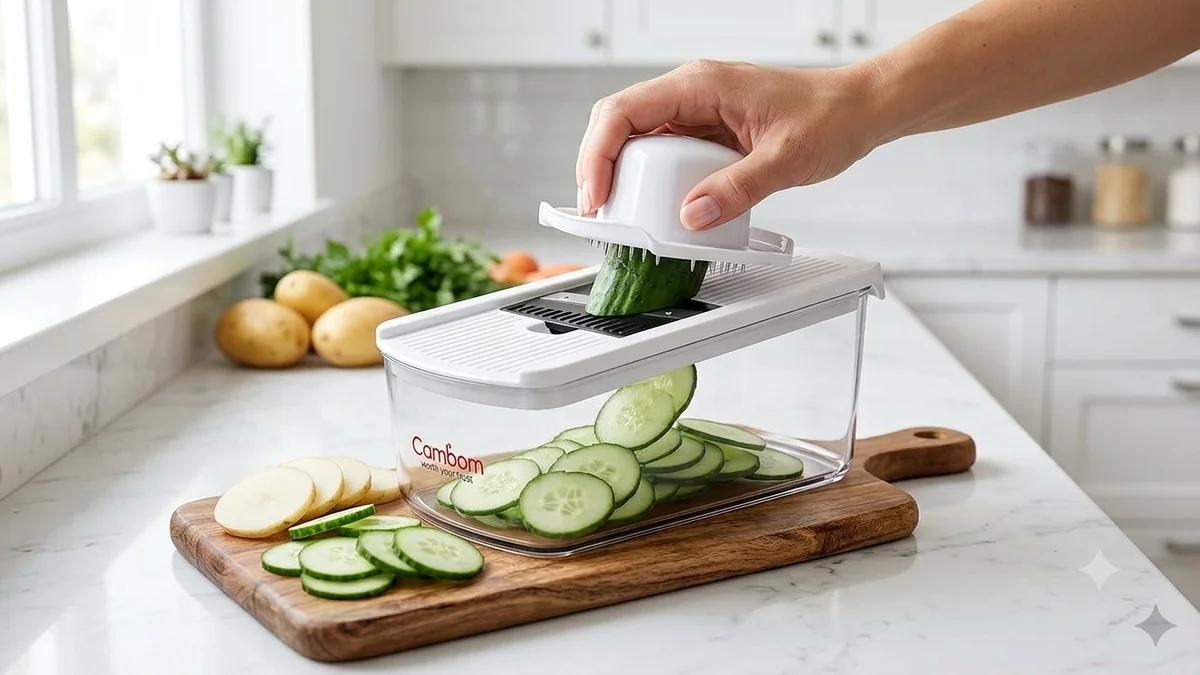

The most-repeated kitchen-safety statistic online is that “350,000 people a year go to the ER with knife injuries.” It shows up on hospital blogs with no study, no agency, and no year attached, and when we traced it, the real research number was different and larger. So the Cambom Kitchen Team stopped repeating other people’s figures and built its own from the raw federal injury data. Across the Cambom American Kitchen Injury Audit of 2023 through 2025, kitchen tools and cooking appliances sent an estimated 436,000 Americans to the emergency room every year, about 1,200 a day. Two findings run against the usual story. First, 84% of those visits are cuts, not burns. Second, the two injury types fall on completely different people: cuts overwhelmingly hit working-age adults, while burns land on children and the elderly. Our thesis: kitchen-safety advice is built on one unsourced number about one tool, and it misses that the American kitchen runs two separate epidemics with two different victims.
Key findings
Each line is a complete, sourced statistic. Copy them freely; see how to cite this page.
- Kitchen tools and cooking appliances sent an estimated 436,000 Americans to the ER each year from 2023 to 2025, about 1,200 a day, per the Cambom American Kitchen Injury Audit of raw CPSC NEISS data.
- 84% of kitchen-tool ER visits are cuts, and only about 6% are burns, in the Cambom American Kitchen Injury Audit, upending the idea that the stove is the kitchen’s main hazard.
- Cuts are an adult problem, burns are a young-and-old problem. Working-age adults (18–64) account for 76% of cut injuries, while 52% of kitchen burns fall on children under 18 or adults over 65, per the Cambom American Kitchen Injury Audit.
- Knives alone drive an estimated 326,000 ER visits a year (NEISS code 0464), per the Cambom American Kitchen Injury Audit (2023–2025), about three-quarters of all kitchen-tool injuries.
- The famous “350,000 knife injuries a year” figure has no named source. The peer-reviewed primary (Smith et al., Journal of Emergency Medicine, 2013) instead reports 434,259 knife-related ER visits per year on average for 1990–2008, across all knife types.
- Mandoline slicers sent an estimated 16,800 Americans to the ER each year (2023–2025 average), up 84% over three years, per the Cambom American Kitchen Injury Audit. No prior national estimate for mandolines existed.
- A mandoline shaves skin off rather than slicing into it: 35% of its injuries are avulsions (skin, nail, or fingertip torn away) versus 3% for kitchen knives, per the Cambom American Kitchen Injury Audit.
- Ranges and ovens are the leading burn source, an estimated 26,000 ER visits a year (NEISS code 0281), and 31% of them are patients over 65, per the Cambom American Kitchen Injury Audit.
- Microwave injuries skew young: the median patient is 22, and a third are under 18, per the Cambom American Kitchen Injury Audit, mostly children pulling out superheated food.
- 93.9% of kitchen-tool ER patients are treated and released the same visit, in the Cambom American Kitchen Injury Audit, so the kitchen wounds far more often than it hospitalizes.
The big picture: 436,000 visits a year, and five in six are cuts
Start with the scale. Across the Cambom American Kitchen Injury Audit (2023–2025), eleven categories of kitchen tool and cooking appliance in the federal injury data sent an estimated 436,000 Americans to the emergency room each year. That is roughly 1,200 a day, or one kitchen-tool injury walking into a US ER about every 72 seconds.
The mix is the surprise. Cuts (lacerations, avulsions, and amputations) make up 84% of those visits; burns are only about 6%, and the rest are bruises, fractures, and the like from dropped pans and jammed fingers. The kitchen’s cultural reputation is the hot stove, but the data says the blade is the real hazard by an order of magnitude. It is also rarely grave: 93.9% of these patients are treated and sent home the same visit, and only 2% are admitted.
Takeaway: the kitchen sends about 436,000 people to the ER a year, and five of every six are cut, not burned. The knife, not the flame, is the tool to respect.
How the kitchen tools actually rank
Here is every kitchen tool and cooking appliance we could isolate in the federal data, ranked by the estimated ER visits it causes in an average year (Cambom American Kitchen Injury Audit, 2023–2025). We use each item’s official CPSC NEISS product title rather than a tidier name, because the codes are broad and the labels matter.
| Tool (NEISS code, official CPSC title) | Est. ER visits/yr | Mostly |
|---|---|---|
| Knives, not elsewhere classified (0464) | ~326,000 | cuts |
| Slicers and choppers (0469) | ~32,000 | cuts |
| Ranges or ovens, not specified (0281) | ~26,000 | burns |
| Kitchen gadgets, not elsewhere classified (0428) | ~19,300 | cuts |
| Microwave ovens (0264) | ~8,900 | burns |
| Electric blenders (0215) | ~8,800 | cuts |
| Metal cookware, nonelectric (0460) | ~5,300 | burns |
| Other cookware (0465) | ~2,900 | burns |
| Coffee makers or teapots (0452) | ~2,500 | burns |
| Electric ranges or ovens (0278) | ~2,000 | burns |
| Food processors (0275) | ~2,000 | cuts |
Knives dwarf everything, about ten times the next category. And the split between cutting tools and heat sources is almost clinical: knives, slicers, gadgets, blenders, and food processors injure by blade, while ranges, ovens, microwaves, cookware, and coffee makers injure by heat. Which tool hurts you turns out to predict how, and as the next sections show, who.
Takeaway: knives cause about 326,000 ER visits a year, ten times any other kitchen tool. Everything else divides neatly into blades and heat sources.
Knives dominate, and the number everyone cites for them is folklore
The statistic you have almost certainly read is that about 350,000 Americans a year land in the ER with knife injuries. It is repeated as settled fact on hospital and orthopedic-clinic pages, always without a citation. When we followed it, no page tied it to a named study, an agency, or even a year.
The closest real primary is a peer-reviewed analysis of the same federal data we used. Smith et al., in the Journal of Emergency Medicine in 2013, estimated 8,250,914 knife-related ER visits from 1990 to 2008, “averaging 434,259 injuries annually, or 1190 per day.” That is the actual research figure, and it is about 24% higher than the “350,000” that circulates in its place. It also covers every knife: pocket knives, box cutters, and kitchen knives together, with cooking and kitchen knives making up 36% of the injuries where a type was recorded.
Our own count from the current data lands in the same territory: the “knives, not elsewhere classified” category (NEISS code 0464), which the injury narratives show is dominated by food-preparation knives, drove an estimated 326,000 ER visits a year across 2023–2025 in the Cambom American Kitchen Injury Audit. The point is not that “350,000” is wildly off. It is that the number everyone quotes has no source, understates the peer-reviewed figure, and gets attached to no year, which is how a statistic becomes folklore.
Takeaway: cite 434,259 knife ER visits a year (Smith et al., 2013, all knife types) or our current ~326,000 for the kitchen-knife category, both with a year attached. Drop the sourceless “350,000.”
The mandoline is the fastest-rising cut, and no one has been counting it
One cutting tool deserves its own alarm, and it is the one with no published injury count at all. Search for a national figure on mandoline slicer injuries and you will not find one: no CPSC breakout, no peer-reviewed case series, nothing in the medical literature. The only number in circulation is a recycled blog line about “nearly 22,000” ER visits in 2011 for “slicers and choppers” as a combined category, with no source.
Because mandolines have no dedicated product code, we isolated them the only way the data allows, by reading the free-text injury narratives and summing the statistical weights of every case that names a mandoline. Across the Cambom American Kitchen Injury Audit, mandolines sent an estimated 11,400 people to the ER in 2023, 17,900 in 2024, and 21,000 in 2025, averaging about 16,800 a year and rising 84% over three years, the steepest climb of any tool we measured.
The reason a mandoline earns the fear is not how often it hurts people but how. A knife slips and slices; a mandoline is a fixed razor you push food across, so fingers do not get nicked, they get planed. In the Cambom American Kitchen Injury Audit, 35% of mandoline injuries were avulsions, meaning skin, nail, or fingertip torn away, against just 3% for knives, and 96% of them were to the fingers. Two honest limits: this narrative-based count is a floor, since terse ER notes often just say “slicer,” and part of the three-year rise may reflect better documentation rather than pure growth. We report the three-year average as the headline for that reason.
Takeaway: mandolines cause at least 16,800 ER visits a year and climbing, and they are ten times more likely than a knife to shave off skin or nail. If a mandoline is on your counter, the finger guard is not optional. Our guide to safer mandolines weighs guards and holders directly.
Burns are a different epidemic, and they fall on children and seniors
Now the other world. Burns are a small share of kitchen-tool injuries, but they concentrate on the people least able to shrug them off. In the Cambom American Kitchen Injury Audit, 52% of kitchen burns fell on children under 18 or adults over 65, even though those groups account for far less of the overall injury count. Working-age adults, who take 76% of the cuts, take only a small slice of the burns.
The tools tell the story. Ranges and ovens are the top burn source at an estimated 26,000 ER visits a year, and 31% of those patients are over 65, older cooks reaching into hot ovens. Microwave injuries run the opposite way: the median patient is 22 and a third are under 18, mostly kids pulling out superheated noodles and soup and wearing the spill. Nonelectric metal cookware, the pot and the cast-iron skillet, sends about 5,300 people a year to the ER, 60% of them burned by a hot handle or rim.
This is the finding the “350,000 knives” folklore buries. The kitchen is not one hazard, it is two, and a burn-prevention message aimed at careful adult knife users misses the toddler at the microwave and the grandparent at the oven entirely.
Takeaway: kitchen burns are a young-and-old problem, not a careless-adult one. Guard the microwave from kids and the oven door from older cooks; those two fixes hit the majority of serious kitchen burns.
Injuries climb when the cooking climbs
Kitchen injuries track the cooking calendar. In the Cambom American Kitchen Injury Audit, 18.6% of kitchen-tool ER visits fell in November and December, above the 16.7% those two months would carry if injuries spread evenly across the year. The effect is sharper for the mandoline, where holiday gratins and big-batch prep pushed 20.6% of injuries into those two months. More cooking means more knife work, more oven reaching, and more injuries.
Takeaway: the kitchen is most dangerous exactly when you use it most. Slow the batch prep and mind the oven over the holidays.
The honest counterweight: ugly, but rarely serious
A set of numbers this large invites overstatement, so here is the finding that pushes back. For all 436,000 visits, the kitchen almost never puts anyone in a hospital bed: 93.9% of patients in the Cambom American Kitchen Injury Audit were treated and released the same visit, and only 2% were admitted. Mandoline injuries are even more lopsided, at 98.5% treated and released. These are stitch-clean-and-go-home events, bloody and slow to heal but seldom life-threatening. The kitchen wounds constantly and hospitalizes rarely.
Takeaway: kitchen injuries are common and minor far more often than they are severe. Fewer than 1 in 45 ER visits for them ends in admission.
What the injuries cost, and what actually prevents them
At the average US emergency-department visit cost of $530 (AHRQ, 2017), 436,000 kitchen-tool ER visits a year represent roughly $230 million in annual ED costs, before counting stitches, lost work, or the follow-up on a shortened fingertip.
Prevention splits along the same two lines as the injuries. For cuts, the fixes are mechanical, because the wound is: keep knives sharp so they do not slip, and treat the mandoline finger guard and a cut-resistant glove as mandatory, since most mandoline cuts happen on the last few slices when the food is too small to hold. It is worth knowing that this glove-and-guard advice lives almost entirely on cooking sites rather than in any official safety document; the one government body on record backing cut-resistant gloves for blade work is OSHA, and only for occupational settings. For burns, the fixes are about the two vulnerable groups: keep young children away from the microwave and teach them that food heated in it is hotter than it looks, and give older cooks oven mitts that actually reach the wrist and a pull-out rack to avoid reaching into the heat.
Takeaway: sharpen your knives, guard the mandoline, and childproof the microwave. Those three habits cover the tools behind most kitchen ER visits.
How to cite this page
Cite these figures as: Cambom, “The Cambom American Kitchen Injury Audit,” cambom.org/blog/statistics/kitchen-injury-statistics/ (2023–2025 data, July 2026 analysis). The computed estimates (every figure attributed to the audit) are licensed CC BY 4.0: reuse them freely with attribution; a link back is appreciated. The full tool-by-tool table is available as a CSV download.
Methodology and sources
How the audit was built. We downloaded the full-year public-use files of the CPSC National Electronic Injury Surveillance System (NEISS) for 2023, 2024, and 2025, more than 1.1 million raw injury records. NEISS is a stratified probability sample of about 100 US hospital emergency departments; each record carries a statistical weight, and summing the weights over any filter produces a national estimate. We defined the kitchen roster as eleven product codes and used each code’s official title from the CPSC NEISS Coding Manual (January 2025 revision): knives (0464), slicers and choppers (0469), ranges or ovens (0281), kitchen gadgets (0428), microwave ovens (0264), electric blenders (0215), metal cookware (0460), other cookware (0465), coffee makers or teapots (0452), electric ranges or ovens (0278), and food processors (0275). Burns are diagnosis codes 48 (scald) and 51 (thermal); cuts are amputation (50), laceration (59), and avulsion (72), all validated against the injury narratives. Because mandolines have no dedicated code, that count was isolated from the free-text narratives and is a lower bound. We deliberately excluded the broad “hot water” code (1934), which the manual defines to include non-kitchen scalds from bathtubs and sinks, so our burn figures understate kitchen scalds slightly. NEISS counts emergency-department visits only, so home-treated injuries never appear and every figure here is a floor. Single-year narrative subsets carry real year-to-year noise, so three-year averages are the headline. This analysis is refreshed annually as CPSC releases each new NEISS year; figures are from the July 2026 analysis of 2023–2025 data.
Numbered references:
- U.S. Consumer Product Safety Commission, National Electronic Injury Surveillance System (NEISS), public-use data files 2023–2025. https://www.cpsc.gov/Research—Statistics/NEISS-Injury-Data
- U.S. Consumer Product Safety Commission, NEISS Coding Manual, January 2025 (rev. 1). https://www.cpsc.gov/s3fs-public/JANUARY-2025-NEISS-CPSC-only-Coding-Manual-Rev-1.pdf
- Smith GA et al., “Knife-related injuries treated in United States emergency departments,” Journal of Emergency Medicine (2013). https://pubmed.ncbi.nlm.nih.gov/23849364/
- “Hand and finger lacerations treated in US emergency departments,” Journal of Emergency Medicine (2022), NEISS 2015–2019. https://pubmed.ncbi.nlm.nih.gov/35177285/
- Agency for Healthcare Research and Quality (AHRQ), Healthcare Cost and Utilization Project, Statistical Brief #268, “Costs of Emergency Department Visits, 2017.” https://hcup-us.ahrq.gov/reports/statbriefs/sb268-ED-Costs-2017.jsp
- U.S. Consumer Product Safety Commission, “Sharper Image and Frigidaire Mandoline Slicers Recalled” (2018). https://www.cpsc.gov/Recalls/2018/Sharper-Image-and-Frigidaire-Mandoline-Slicers-Recalled-by-Premier-Kitchen-Products-Due-to-Laceration-Hazard
- Occupational Safety and Health Administration, Poultry Processing eTool, “Cuts and Lacerations.” https://www.osha.gov/etools/poultry-processing/plant-wide-hazards/cuts-lacerations
- U.S. Census Bureau, 2020 Census, housing and household counts. https://www.census.gov/library/publications/2024/dec/c2020br-10.html
Last updated: July 4, 2026.
Frequently asked questions
How many kitchen injuries send people to the ER each year? An estimated 436,000 a year from kitchen tools and cooking appliances, about 1,200 a day, per the Cambom American Kitchen Injury Audit of raw CPSC NEISS data for 2023-2025. Because the federal data counts only emergency-department visits, the true number of kitchen injuries is higher.
What is the most dangerous tool in the kitchen? By sheer volume, the knife: an estimated 326,000 ER visits a year, ten times any other kitchen tool. By severity per incident, the mandoline slicer is worse, shaving off skin or fingertip in 35% of its injuries versus 3% for knives.
Are kitchen injuries mostly cuts or burns? Overwhelmingly cuts. In the Cambom American Kitchen Injury Audit, 84% of kitchen-tool ER visits are cuts and only about 6% are burns. The blade is a bigger hazard than the stove.
Who is most likely to get burned in the kitchen? Children and older adults. About 52% of kitchen burns fall on people under 18 or over 65. Microwave injuries skew young (median age 22, a third under 18), while range and oven burns skew old (31% over 65). Working-age adults mostly get cut, not burned.
What is the “350,000 knife injuries a year” statistic? An unsourced figure repeated on hospital blogs with no study or year attached. The peer-reviewed primary (Smith et al., Journal of Emergency Medicine, 2013) reports 434,259 knife-related ER visits a year on average for 1990-2008 across all knife types, with kitchen knives about 36% of the type-identified cases.
How serious are kitchen injuries? Rarely grave. In the Cambom American Kitchen Injury Audit, 93.9% of patients were treated and released the same visit and only 2% were admitted. The injuries are common and often ugly, but they seldom require a hospital stay.
The Cambom Kitchen Team tests and writes about the tools home cooks actually use. If a blade is what worries you, start with our guides to choosing a safer mandoline and rotary graters versus box graters; both keep your fingers clear of the edge.