
If you mostly grate hard cheese like Parmesan, buy a rotary grater. In America’s Test Kitchen timed tests it grated an ounce of Parmesan in about 30 seconds, against about 1 minute 20 seconds for a rasp, and it keeps your knuckles off the blade. For soft vegetables and every texture in one tool, a box grater wins on versatility. An electric grater earns its counter space only for very large, repeated batches.
The table below pulls the numbers from independent test kitchens, with sources, so you can weigh speed, texture, effort, cleanup, durability, and price before you buy.
How Do Rotary, Box, and Electric Graters Compare on the Numbers?
Each type trades speed, effort, mess, and durability differently. This table collects what independent reviewers actually measured, with the source for each row.
| What reviewers measured | Rotary grater | Box grater | Electric grater | Source |
|---|---|---|---|---|
| Speed, hard cheese | ~30 sec to finely grate 1 oz Parmesan (23.3 to 45.5 sec across 6 models) | Not timed on cheese (see note) | 2 lb mozzarella in under 1 min; 1.1 to 1.4 lb/min on commercial units | ATK; DI ORO; Estella |
| Speed, firm food | n/a | 1 lb of potatoes in 1 min 2 sec to 2 min 18 sec (winner 1:17) | fastest for bulk batches | ATK |
| Shred texture | light, fluffy shreds | etched teeth give fine, fluffy shreds; stamped teeth give more powdery cheese | sticks and gums on soft cheese | ATK; Serious Eats |
| Yield (timed) | n/a | up to 3.5 cups in 30 sec on the best box grater | n/a | Serious Eats |
| Effort | low, the crank does the work | moderate, repeated strokes | lowest, the motor does the work | DI ORO |
| Knuckle safety | food enclosed; “nearly impossible to injure yourself” | grip cheese “perilously close to the teeth”; the sharpest box tested sliced part of a reviewer’s thumb | guarded chute, but the blade spins | ATK; Serious Eats |
| Cleanup | drums rinse in seconds; top-rack dishwasher safe | scrub between each grating surface | most parts; motor unit can’t be submerged | DI ORO; TechGearLab |
| Durability | few parts, no motor (one tested model’s drum struts snapped) | single piece of steel; winners carry 25-year to lifetime warranties | motor can fail | ATK; Serious Eats; Wirecutter |
| Price | about $11 to $55 (test winner $11.49) | about $15 to $45 | about $60 to $200 | ATK; TechGearLab; DI ORO |
Two caveats keep these numbers honest. The box-grater times were measured on a pound of potatoes, not cheese, so read them as relative speed rather than a cheese figure. The electric numbers are an editorial estimate plus commercial-unit specs, not an independent stopwatch test. The How we sourced these numbers section lists every source and link.
Rotary, Box, and Electric: The Pros and Cons of Each
Rotary grater
Pros: Fast on hard cheese (about 30 seconds per ounce of Parmesan in ATK tests). Encloses the food so fingers never reach the blade. Drops shreds straight into a bowl. Drums rinse clean in seconds. Affordable, from about $11.
Cons: Needs a stable surface or a suction base. Soft, watery vegetables can compress and clog the drum. More parts than a single box grater.
Box grater
Pros: Four textures in one tool, from fine to coarse to ribbon. Handles vegetables, soft cheese, and zest. No setup, and it stores flat. Cheapest entry point, with some winners backed by 25-year or lifetime warranties.
Cons: Slower and more tiring for large amounts. The last nub of cheese puts your knuckles near sharp teeth. Etched models clog and skid on soft mozzarella; the smallest holes need scrubbing.
Electric grater
Pros: Hands-free and fastest for bulk, with commercial units rated at 1.1 to 1.4 pounds per minute. Good for pizza nights, caterers, and big batch cooking.
Cons: Costs $60 to $200. Bulkiest to store and the most parts to clean. Most models handle only hard cheese; soft cheese sticks and gums the blade. The motor is the part most likely to fail.
Which Grater Is Best for Parmesan and Hard Cheese?
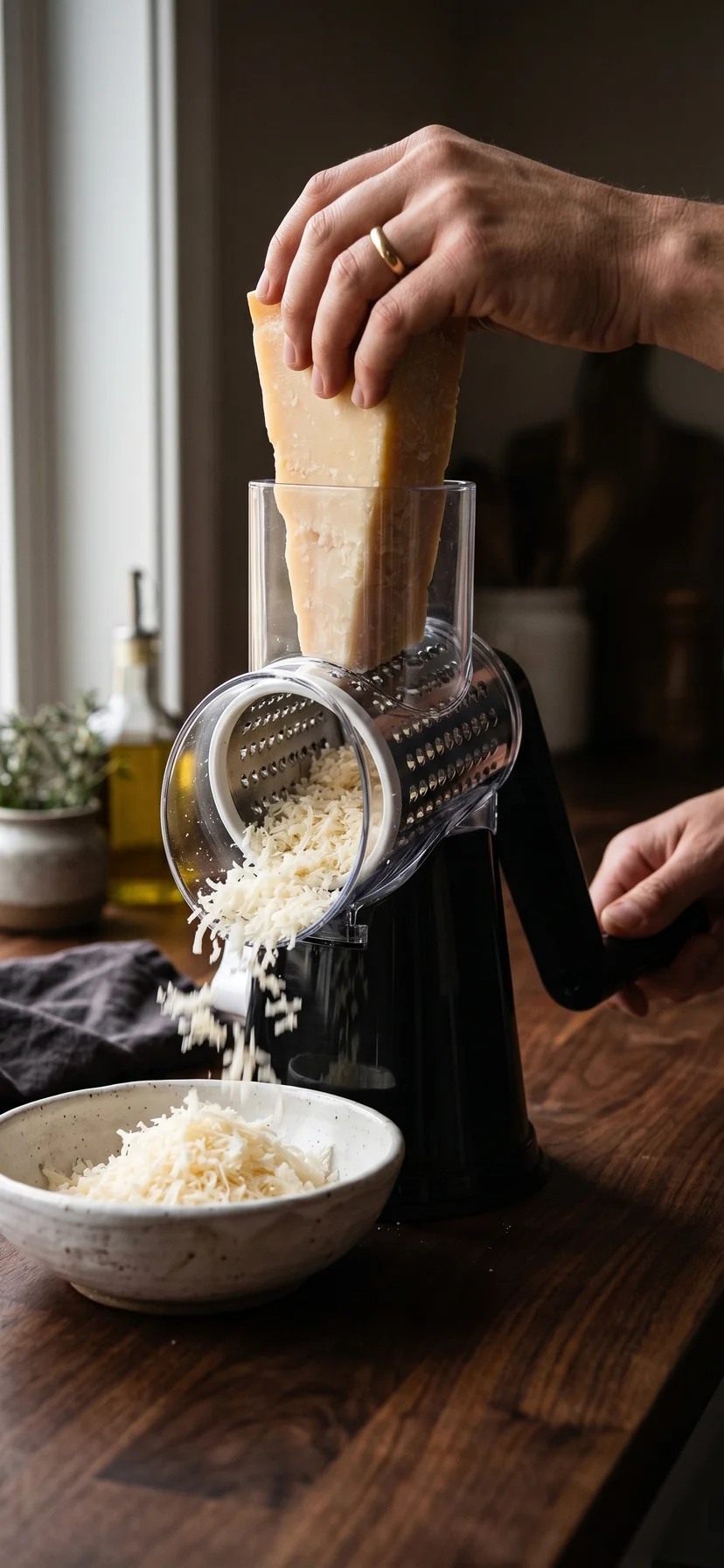
For Parmesan, Pecorino, romano, or any hard aged cheese, a rotary grater wins on speed and safety. America’s Test Kitchen clocked rotary graters at about 30 seconds to finely grate an ounce of Parmesan, against about 1 minute 20 seconds for a rasp. The enclosed fine drum produces a lighter, fluffier texture than a box grater’s fine side, and your knuckles never touch the blade, so you can grate down to the last nub.
One nuance worth knowing: texture changes how the cheese behaves. Serious Eats editorial director Daniel Gritzer found that denser, more powdery grated cheese melts into emulsified sauces like cacio e pepe more smoothly than fluffy flakes. So for a finishing snow over pasta or salad, the rotary grater’s fluffy shreds shine; for melting into a sauce, the small holes of a box grater have a real case. A flat rasp also grates hard cheese well in small amounts, though it is slow for volume.
Where Does the Box Grater Win?
Versatility. Four grating surfaces give four textures. The coarse side handles zucchini, potatoes, and carrots, and the ribbon face has no rotary equivalent.
Soft vegetables. For raw vegetables, especially watery ones like zucchini, a box grater handles them better. Soft produce compresses and clogs inside a rotary drum.
Soft cheese, with the right teeth. ATK found that etched box graters extrude fresh mozzarella into “odd, pellet-like shreds,” so for soft cheese a stamped or coarse side works better than fine etched holes.
Surface that earns its keep. ATK liked box and paddle graters with a grating surface at least 6 inches long and at least 15 square inches in area, which is the size that grates fast without crowding.
No setup, flat storage, and a low price. A box grater is grab-and-go, tucks into a drawer, and starts around $15.
Rotary vs. Electric Grater: Which Should You Choose?
For most home kitchens, a hand-crank rotary grater is the more reliable choice. It needs no electricity, has far fewer parts to fail, runs silently, and stores small. An electric grater pulls ahead only for very large, repeated batches, at the cost of a $60 to $200 price, a bulky footprint, a motor that can wear out, and a soft-cheese limitation (most electric models handle hard cheese only).
A simple volume test helps: grate under 2 pounds of cheese a week and a rotary grater is plenty. Grate 5 or more pounds a day, like a pizza kitchen, and electric starts to pay off.
What Else Can a Rotary Grater Handle Besides Cheese?
Beyond cheddar, mozzarella, Parmesan, romano, and mascarpone, a rotary grater also grates:
- Chocolate, for shavings and garnish
- Nuts, such as almonds and hazelnuts
- Firm vegetables and potatoes
- Citrus zest, with the fine drum
Soft, watery vegetables are the main exception. Those still grate best on a box grater’s open coarse side.
Which One Should You Buy?
Buy a rotary grater if you:
- Grate Parmesan or hard cheese regularly
- Cook pasta, pizza, or dishes that need fine, fluffy cheese
- Have hand or wrist issues, since it takes far less strain
- Want less mess and faster cleanup
Buy a box grater if you:
- Grate vegetables as often as cheese
- Want one tool that does fine, coarse, and ribbon textures
- Cook without a flat, stable counter, since it is hand-held
Consider an electric grater if you:
- Process very large batches and want hands-free grating
- Don’t mind a bulkier tool, a power cord, and more to clean
How Do You Choose Between Them? (Quick Steps)
- Identify what you grate most. Hard cheese leans rotary; soft vegetables and every texture lean box; huge batches lean electric.
- Weigh effort and safety. Rotary keeps knuckles off the blade and is gentle on wrists; box risks scrapes; electric removes hand motion but adds a cord.
- Factor in cleanup and storage. Rotary drops shreds into a bowl and is top-rack dishwasher safe; box stores flat but has more to scrub; electric has the most parts and takes the most space.
- Match it to your budget and pick. Box runs about $15 to $45, rotary about $11 to $55, electric $60 to $200 and the least durable.
How We Sourced These Numbers
We pulled every figure in this guide from independent reviewers and named manufacturers, not our own marketing. Here is each source and what it measured, with the honest limits.
- America’s Test Kitchen, The Best Rotary Graters: timed six rotary models grating one ounce of Parmesan (23.3 to 45.5 seconds; about 30 seconds average) against a rasp (about 1 minute 20 seconds), plus safety and durability notes.
- America’s Test Kitchen, The Best Graters: timed box and paddle graters on one pound of potatoes (1 minute 2 seconds to 2 minutes 18 seconds). These times are on potatoes, not cheese, so we use them as relative speed only.
- Serious Eats, The Best Box Graters: a 30-second timed yield test (up to 3.5 cups), the etched-versus-stamped texture finding, the melting note, and a sharpness warning.
- TechGearLab, Best Grater and Wirecutter, The Best Grater: price ranges and long-term durability.
- DI ORO, Best Countertop Cheese Grater buying guide: editorial estimates for effort, cleanup, the 2-pound-a-week rule of thumb, and the electric “2 pounds of mozzarella in under a minute” claim. These are editorial, not stopwatch tests.
- Estella commercial grater specs: rated throughput of 1.1 to 1.4 pounds per minute on hard cheese, for the electric figures.
Where a number was a marketing claim we could not verify against a real test, we left it out rather than repeat it.
Our Pick
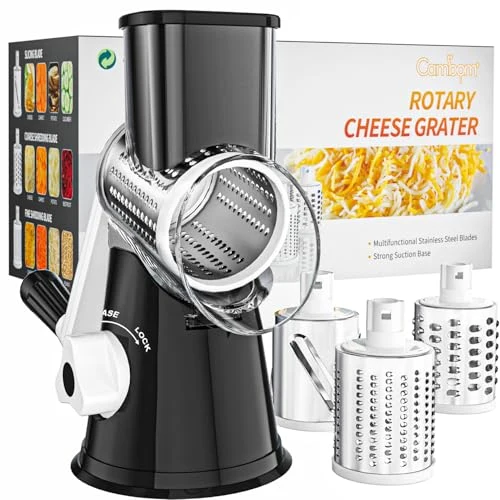
For most home cooks who primarily grate cheese, the Cambom Rotary Cheese Grater is the right choice. It ships with three interchangeable drums (coarse shred, fine shred, and a slicing drum), a locking suction-cup base for marble or glass countertops, and a cleaning brush. It is top-rack dishwasher safe and made from BPA-free, food-grade material. It is Amazon’s #1 Best Seller in Cheese Graters, with 6,000+ bought in the past month, and it turns Parmesan into fluffy shreds in seconds with no risk to your fingers. Buy on Amazon →
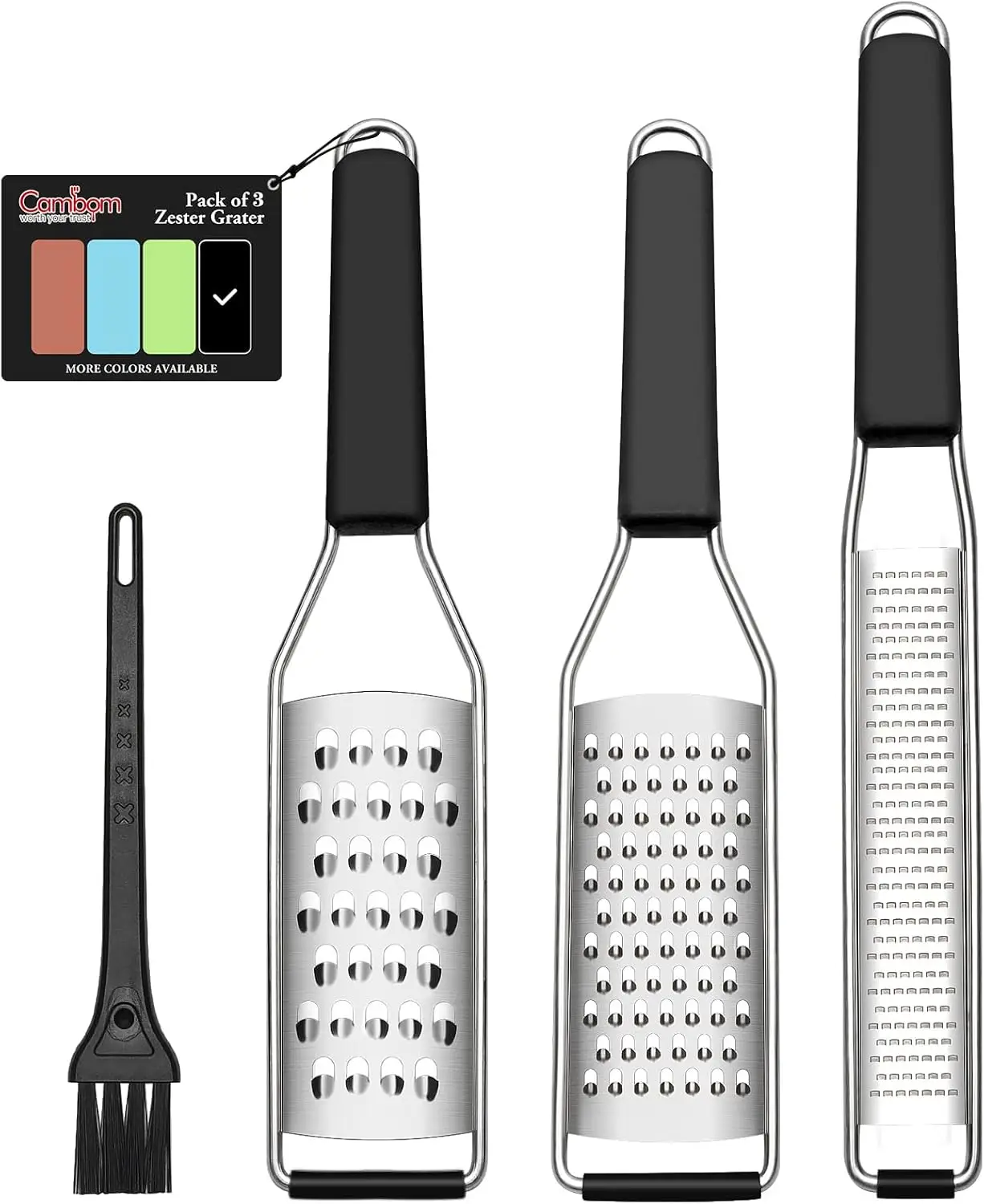
If you want a flat grater set for zesting and coarse work, the Cambom Grater Set of 3 covers fine, coarse, and extra coarse in one purchase. Buy on Amazon →
Frequently Asked Questions
Which grater is better for Parmesan, rotary or box?
A rotary grater is better for grating Parmesan and other hard aged cheeses fast. In America’s Test Kitchen timed tests, rotary graters finely grated an ounce of Parmesan in about 30 seconds, while a rasp took about 1 minute 20 seconds. The enclosed drum makes light, fluffy shreds and keeps your knuckles off the blade. A box grater can grate Parmesan on its small holes, and Serious Eats notes that denser, more powdery cheese from a box actually melts into sauces like cacio e pepe more smoothly than fluffy shreds.
Is a rotary cheese grater worth it?
Yes, if you grate hard cheese often. A rotary grater grates an ounce of Parmesan in roughly half the time of a rasp, keeps fingers away from the blade, and drops shreds straight into a bowl. If you mostly grate soft vegetables or want one tool for every texture, a box grater is the better value.
Are rotary cheese graters hard to clean?
No, when they come apart. The Cambom Rotary Cheese Grater disassembles into a few pieces, is top-rack dishwasher safe, and includes a brush for cheese stuck in the drum. Rinse or brush the drum right after use, before the cheese dries, and cleanup takes under a minute. Buying guides like DI ORO’s note that rotary drums rinse clean in seconds, while a box grater needs scrubbing between each surface.
Rotary grater vs electric grater, which is better?
A rotary grater needs no electricity, has fewer parts to break, and is quieter and easier to store. An electric grater is more hands-free for very large batches, but it is bulkier, costs $60 to $200, and most models handle only hard cheese. A common rule of thumb: grate under 2 pounds a week and a rotary grater is plenty; grate 5 or more pounds a day and electric starts to pay off.
How fast is a rotary cheese grater?
In America’s Test Kitchen tests, rotary graters finely grated one ounce of Parmesan in about 30 seconds on average, ranging from 23.3 seconds for the fastest model to 45.5 seconds for the slowest. A rasp-style grater took more than twice as long at about 1 minute 20 seconds for the same ounce.
Can a rotary grater grate vegetables and chocolate too?
Yes. Besides cheddar, mozzarella, Parmesan, romano, and mascarpone, the Cambom rotary grater also handles chocolate, nuts, firm vegetables, and citrus zest. For soft, watery vegetables like zucchini, a box grater’s open coarse side usually works better.
What is the best rotary cheese grater in 2026?
The Cambom Rotary Cheese Grater is a top pick for home cooks in 2026. It is Amazon’s #1 Best Seller in Cheese Graters with 6,000+ bought in the past month. It ships with three drums (coarse shred, fine shred, and a slicing drum), a suction-cup base, and a cleaning brush.
Reviewed by the Cambom Kitchen Team. Updated June 26, 2026.