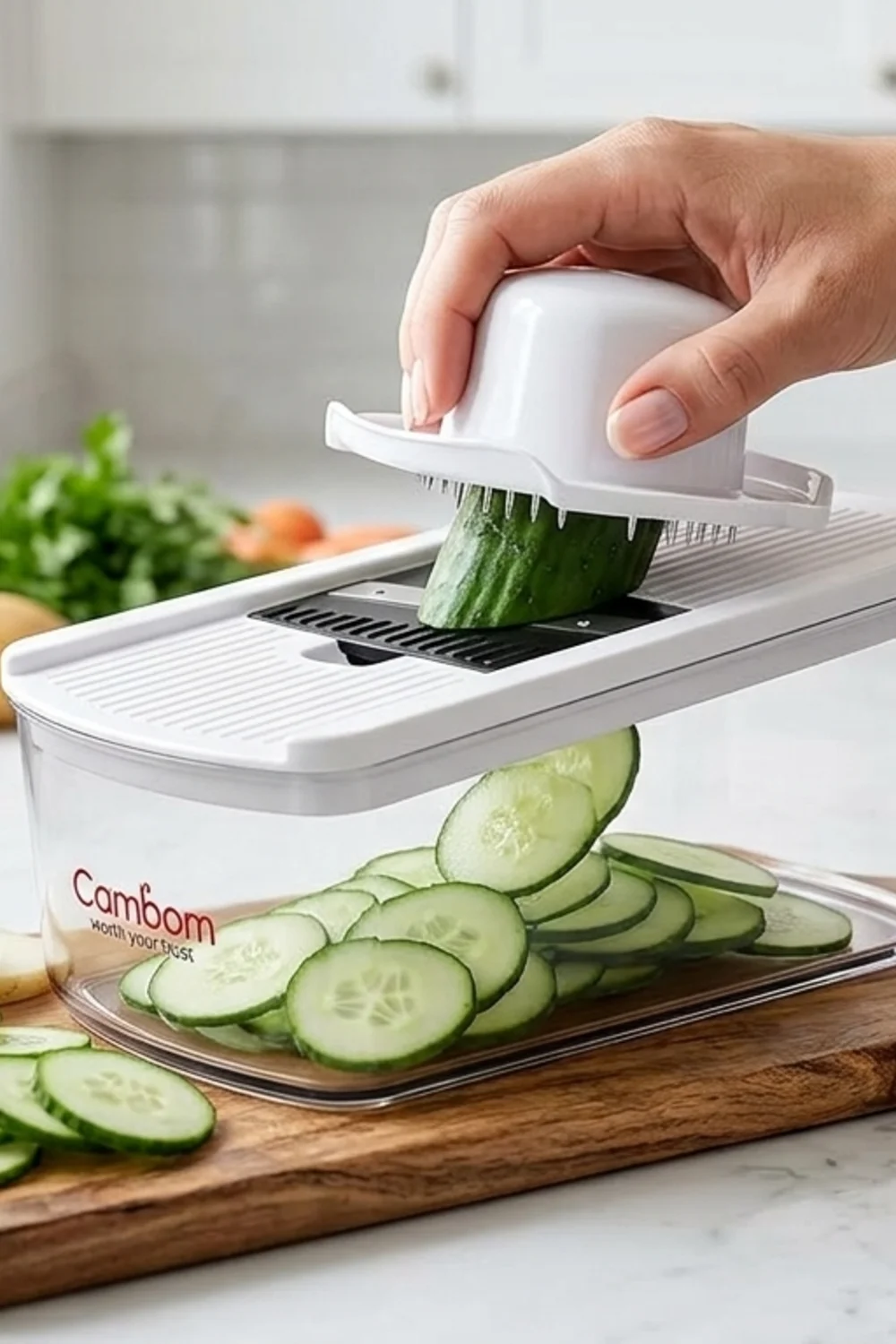
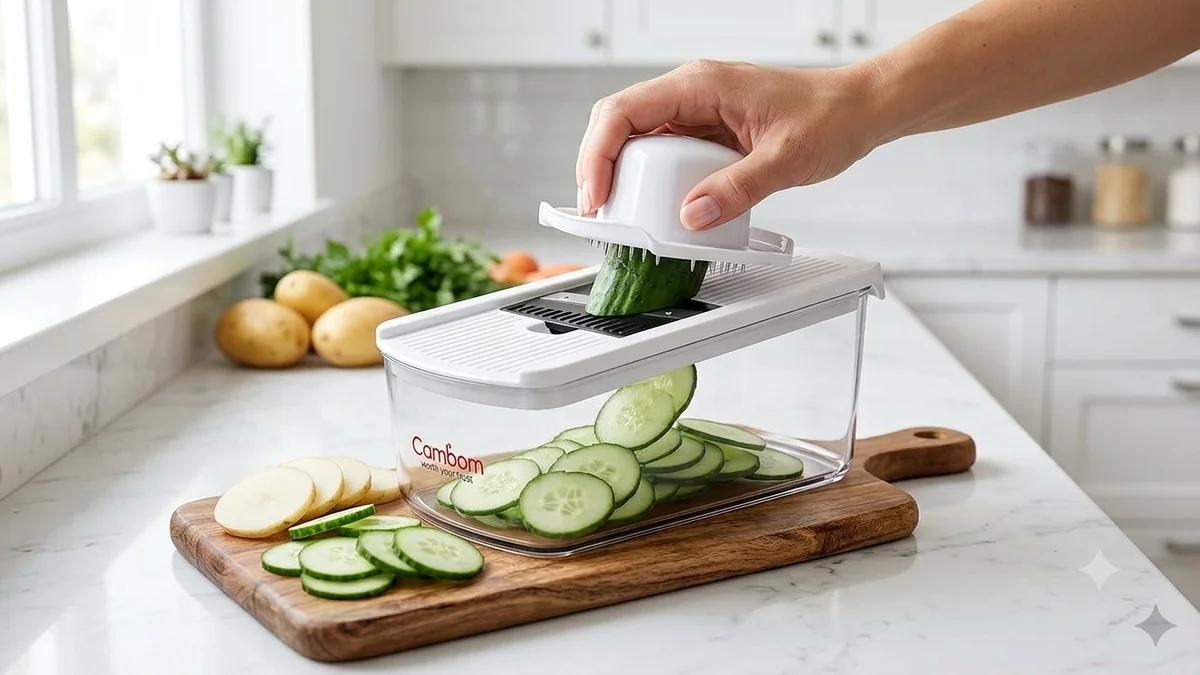
For everyday slicing, set a mandoline to 1.5-3 mm. That range covers most of what home cooks slice: cucumbers, tomatoes, salad vegetables, and the even rounds a gratin needs. RecipeTin Eats slices potatoes 1/8 inch (3 mm) for au gratin, which sits right in that band. Drop to 1-1.5 mm for crisp chips and carpaccio, and climb to 5-8 mm for fries and thick rounds. The chart below maps each mm setting to the vegetable, the dish, and the Cambom blade that makes the cut.
A mandoline repeats the same thickness on every slice. Even slices cook at the same rate, so chips brown together and gratin layers set as one. The number on the dial is the recipe.
The tables below pull thickness figures from named recipe sources and from two mandoline manufacturers’ own spec pages, with a Sources section that lists each link and its honest limits.
What mm setting should you use on a mandoline?
Start at 1.5-3 mm for general-purpose slicing. Below that, slices turn translucent and crisp up fast. Above it, you move into fries, batons, and chunky rounds that need more cook time. The tool sets the range: per SharpEdge, the standard Benriner mandoline “can be easily adjusted from 0.3 mm to about 3 mm,” while the Super Benriner No. 95 reaches further, listed by Korin at 0.5 mm to 5.0 mm. Use this master chart to pick the setting by what you are making.
Mandoline mm-to-dish reference chart
| Thickness (mm) | Cut style | Best for | Cambom blade |
|---|---|---|---|
| 0.5-1 mm | Paper-thin / translucent | Carpaccio, shaved fennel, radish, beet, parmesan-thin crisps | Straight slicing (thinnest setting) |
| 1-1.5 mm | Thin | Potato chips, apple crisps, cucumber for pickles, lemon rounds | Straight slicing |
| 1.5-2 mm | Standard thin | Cucumber salad, tomato, onion for burgers, zucchini | Straight slicing (~2 mm) |
| 2-3 mm | Everyday | Potato gratin, scalloped potatoes, sweet potato rounds, salad veg | Straight / thick slicing |
| 3-5 mm | Thick | Roasting rounds, eggplant for grilling, plantain, thick onion | Thick slicing |
| 5-8 mm | Very thick | Steak fries, thick-cut chips, melon, squash rounds | Thick slicing |
| Julienne (2-4 mm strips) | Matchstick | Shoestring fries, carrot/zucchini noodles, stir-fry, garnish | Julienne / shredding |
| Wave (crinkle) | Ridged | Crinkle-cut fries, waffle chips, decorative vegetable slices | Wave / crinkle |
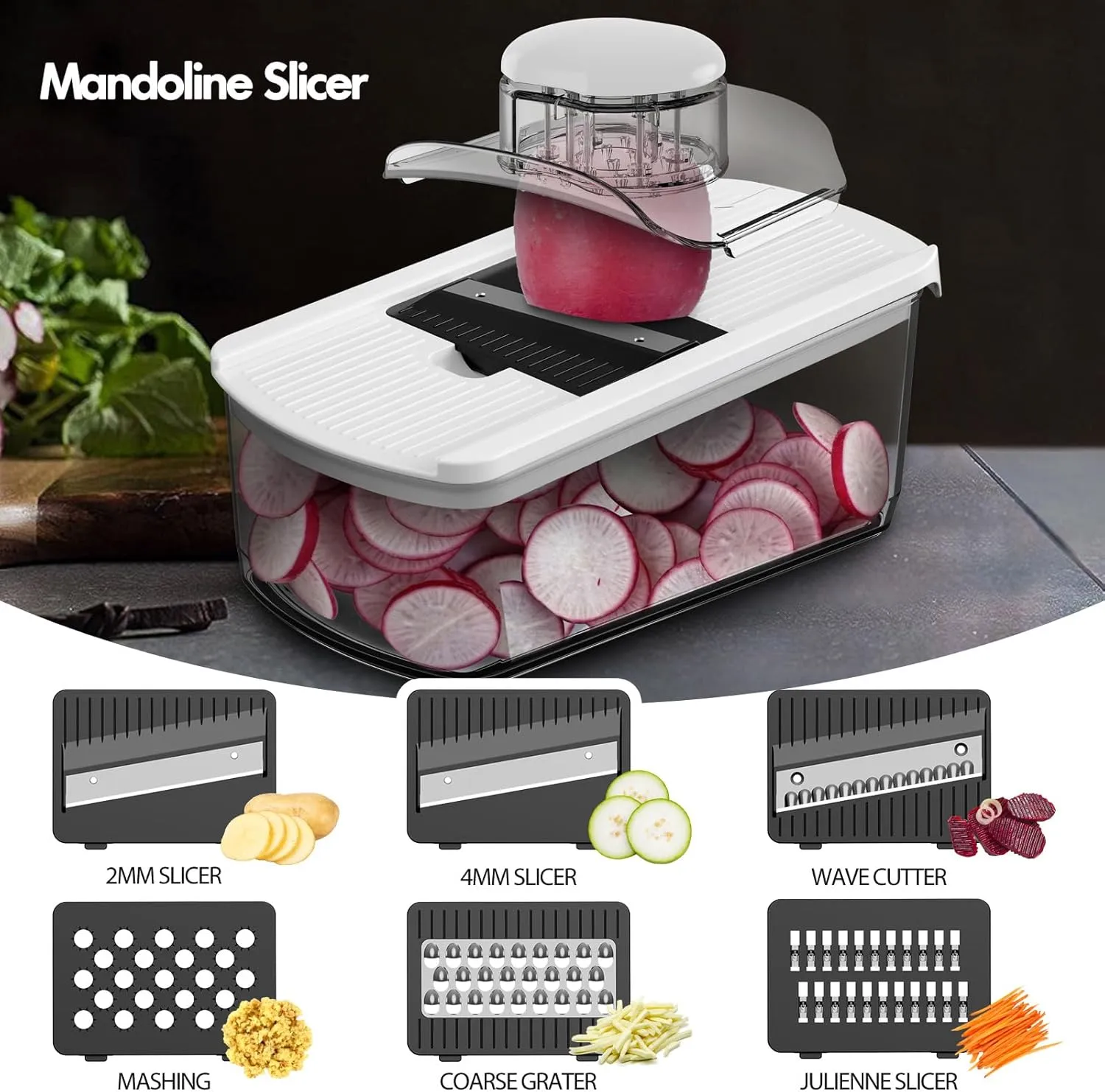
The Cambom Mandoline Slicer ships with 6 replaceable stainless-steel blades: a straight slicing blade around 2 mm, a thicker slicing blade, julienne and shredding blades, and a wave/crinkle blade. Swap blades to change the cut, then set the thickness on the dial.
What thickness do recipes actually call for?
Recipe writers rarely give a millimeter on the dial, so this table collects the dish-by-dish figures we could trace to a named source. Read each one as that cook’s recommendation, not a universal law.
| Dish | Recommended thickness | Source | Note |
|---|---|---|---|
| Potatoes au gratin / dauphinoise | 1/8 inch (3 mm) | RecipeTin Eats | ”Slice them 1/8”/3 mm thick. Or use a slicer!” |
| Homemade potato chips | just below 1/16 inch (~1.5 mm) | Peak to Plate | ”I use the very first notch which is just below 1/16” thick.” |
| Beef carpaccio | about 2 mm | Great British Chefs | Slice the partially frozen fillet “as thinly as possible, about 2mm.” |
| French onion soup | 1/8 to 1/4 inch (~3-6 mm) | Food Republic | ”aim for slices between 1/8- to 1/4-inches thick.” |
| French onion soup (alt) | 1/4 inch (~6 mm) | Tasting Table | ”they’ll disappear in the soup if they are too thin.” |
How thick should you slice potatoes on a mandoline?
Match the thickness to the dish, since potatoes are the least forgiving vegetable on a mandoline. Uneven slices cook at different rates, which leaves pale chips next to burnt ones and gratin layers that never set together.
| Potato dish | Thickness | Why |
|---|---|---|
| Chips / crisps | ~1.5 mm | Peak to Plate uses the first notch, “just below 1/16” thick,” so chips fry flat and crisp without a raw center |
| Potato gratin / scalloped | 3 mm | RecipeTin Eats slices au gratin “1/8”/3 mm thick” so layers absorb cream and bake at one rate |
| Roasted rounds | 3-5 mm | Keeps a soft middle while the edges crisp |
| Steak fries | 6-10 mm | Square off thick slices into batons, or use the wave blade for crinkle fries |
Russets run dense and dry, which makes them a strong pick for chips and fries. Waxy potatoes hold together better in a gratin. Either way, the dial does the work a knife cannot repeat by hand. A note on the steak-fries figure: we could not open a recipe page with a verbatim baton width, so treat 6-10 mm as a working range, not a sourced number.
What thickness should you slice onions and cucumbers?
For onions, the best-documented dish is French onion soup. Food Republic tells you to “aim for slices between 1/8- to 1/4-inches thick,” about 3-6 mm, because thinner disintegrates and thicker tastes off. A chef quoted by Tasting Table lands at the top of that band: “You want to go a ¼ of an inch because they’ll disappear in the soup if they are too thin.” For raw onion, slice thinner.
- Onion, 1-2 mm: salads, burgers, sandwiches, and quick pickling, where the onion wilts and turns mild.
- Onion, 3-6 mm: French onion soup and other long-cooked dishes where the onion has to survive the pot, per the Food Republic and Tasting Table figures above.
- Cucumber, 1.5-2 mm: marinated and smashed-style salads. Thin slices curl and take up vinegar and sesame in minutes.
- Cucumber, 2.5-3 mm: dill-and-vinegar or chunkier salads where bite matters more than absorption.
We left a precise cucumber-salad number out on purpose. The recipes we checked say only “very thinly” without a millimeter, so the cucumber figures above are our own everyday-use ranges, not a cited measurement. For matchstick onion or cucumber, switch to the julienne blade instead of changing the dial.
What is the thinnest a mandoline can slice?
It depends on the model, and the manufacturers publish the floor. SharpEdge lists the standard Benriner at 0.3 mm to about 3 mm. Korin lists the Super Benriner No. 95 at 0.5 mm to 5.0 mm. Either floor is translucent and paper-thin, the setting for carpaccio, raw shaved fennel and radish, and chips that fry flat. Great British Chefs slices beef carpaccio “as thinly as possible, about 2mm,” and in a second recipe cuts it at 1/2 cm then rolls it “to around 2mm in thickness,” so 2 mm is a realistic carpaccio target even when the blade can go finer. The Cambom straight slicing blade cuts around 2 mm for everyday slices, and the set adds thicker and textured blades for the rest of the range.
Go this thin only with firm, fresh produce. Soft or watery vegetables tear at sub-millimeter settings, so a tomato or a ripe pear does better at 1.5-2 mm.
One spec, two numbers: read manufacturer ranges with care
The Super Benriner No. 95 shows why you should check the listing before you trust a top-end figure. Korin gives its slice thickness as “0.5mm - 5.0mm.” MTC Kitchen lists the same model at “0.5mm - 8.0mm.” Both agree on the 0.5 mm floor, so the thinnest setting is solid. They disagree on the ceiling. We treat the floor as reliable and the top end as approximate until the maker resolves it.
Which mandoline blade do you use for fries, slaw, and crinkle cuts?
The blade sets the shape; the dial sets the thickness. Pick the blade by the cut you want.
| Cut you want | Blade | Setting |
|---|---|---|
| Rounds, chips, gratin | Straight slicing | 1-3 mm on the dial |
| Matchstick fries, slaw, veg noodles | Julienne / shredding | Fixed strip width (~2-4 mm) |
| Crinkle-cut fries, waffle chips | Wave / crinkle | Thicker setting for ridge depth |
| Thick rounds, steak slices | Thick slicing | 5-8 mm on the dial |
Julienne blades come in grades, not one width. Per Korin, the Super Benriner No. 95 ships with fine (54-tooth), medium (35-tooth), and coarse (10-tooth) julienne blades, so a finer blade makes shoestring strands and a coarser blade makes batons. For slaw, run cabbage, carrot, and onion through the shredding blade in one pass each, then toss. For waffle chips, slice on the wave blade, rotate the potato 90 degrees, and slice again to make the lattice.
How do you set mandoline thickness safely?
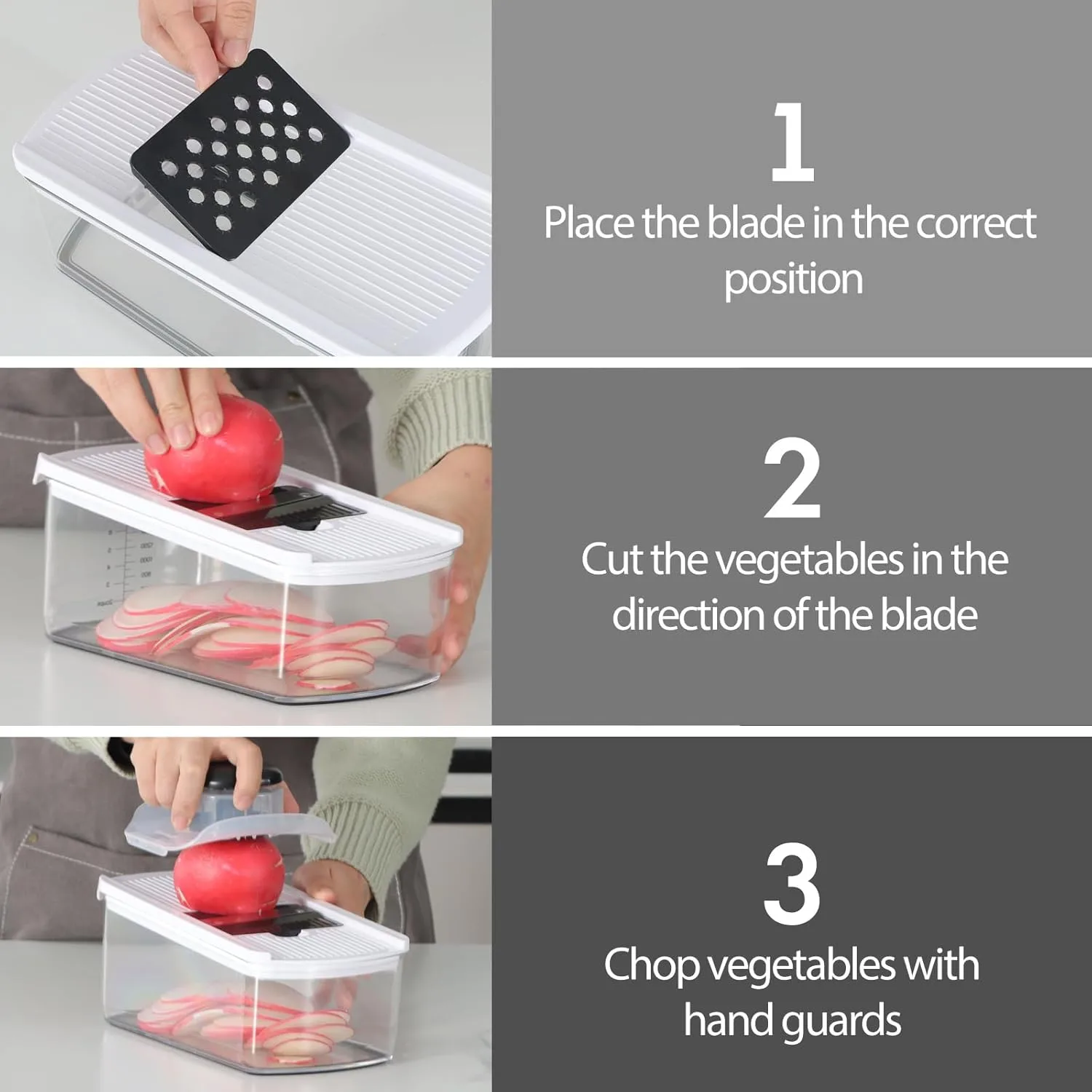
The blade can slice a fingertip, so the guard keeps a mandoline safe. Set the thickness first, then keep bare fingers away from the blade.
- Lock in the thickness. Turn the dial to your target before food touches the blade. Start at 1.5-3 mm, test the end of one vegetable, then adjust.
- Choose the right blade. Straight slicing for rounds and chips, julienne or shredding for matchsticks and slaw, wave for crinkle fries.
- Engage the safety lock and guard. Place the mandoline on a flat surface, press the finger guard onto the food, and keep the lock on until you slice.
- Slice with a steady stroke. Run the food down the blade in one smooth motion, fingers above the guard at all times.
- Stop before the food gets too small. When a piece is too small to hold in the guard, finish it with a knife. Most cuts happen on the last few slices.
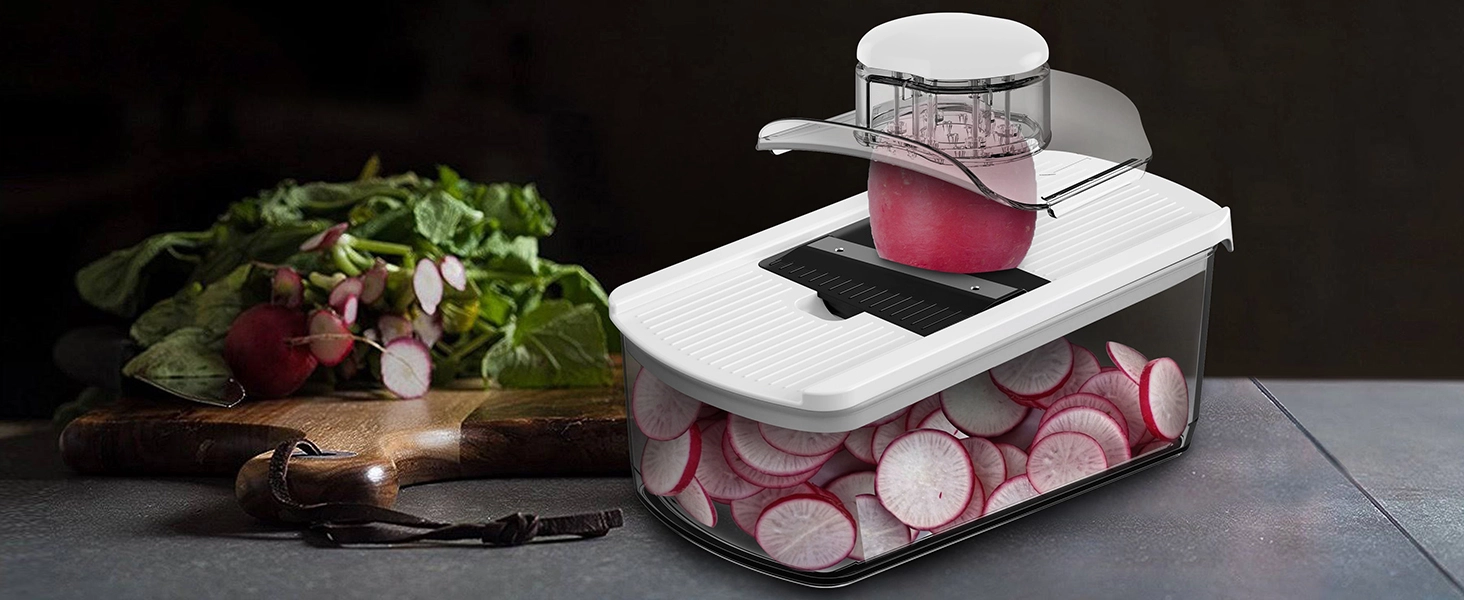
The Cambom Mandoline Slicer pairs a safety lock with a finger guard, drops slices into a 2 L catch container, and goes on the top dishwasher rack. It also includes a cleaning brush and a knife-holder storage box for the blades. See the full Cambom Mandoline Slicer for specs and blade details.
How We Sourced These Numbers
Every thickness figure in this guide traces to a named recipe or a manufacturer’s own spec page. Here is each source, what it covers, and the honest limit on it.
- SharpEdge, Benriner Mandoline product page: the standard Benriner’s adjustable range, quoted as “0.3 mm to about 3 mm.” A retailer product page, not an independent lab measurement.
- Korin, Super Benriner Mandoline Slicer No. 95: the Super Benriner’s “0.5mm - 5.0mm” range and the fine (54-tooth), medium (35-tooth), and coarse (10-tooth) julienne blade grades.
- MTC Kitchen, Super Benriner No. 95: the same model listed at “0.5mm - 8.0mm.” We include it to flag that two retailers disagree on the top end; the 0.5 mm floor is the figure both agree on.
- RecipeTin Eats, Potatoes au Gratin: 1/8 inch (3 mm) for gratin and dauphinoise. One recipe writer’s recommendation.
- Peak to Plate, Crispy Homemade Potato Chips: “the very first notch which is just below 1/16” thick” (about 1.5 mm) for chips. Tied to that author’s mandoline, so notch numbers vary by tool.
- Great British Chefs, How to make a carpaccio of beef and the Beef Carpaccio Recipe: about 2 mm for carpaccio, one by slicing and one by slicing then rolling. Both are for beef, not vegetables.
- Food Republic and Tasting Table: onion thickness for French onion soup, 1/8 to 1/4 inch and 1/4 inch. Specific to that dish, not raw onion.
A few numbers in this guide are our own everyday ranges, not sourced figures: the cucumber-salad thicknesses (the recipes we found say only “very thinly”), the 3-5 mm roasted-round band, and the 6-10 mm steak-fry band. We label them as ours rather than dress them up as measurements. We also could not pull verbatim millimeter specs from OXO, KitchenAid, Serious Eats, America’s Test Kitchen, or NYT Cooking because those pages blocked our fetch, so we left their figures out rather than repeat a number we could not confirm.
Frequently Asked Questions
What mm setting should you use on a mandoline?
For everyday slicing, set a mandoline to 1.5-3 mm. That range suits cucumbers, tomatoes, salad vegetables, and gratin. RecipeTin Eats slices potatoes 1/8 inch (3 mm) for au gratin. Drop to 1-1.5 mm for crisp chips and carpaccio, and go up to 5-8 mm for fries and thick rounds. Most adjustable mandolines reach this whole range: the standard Benriner runs 0.3 mm to about 3 mm per its product page, and the Super Benriner No. 95 runs 0.5 mm to 5.0 mm per Korin.
How thick should you slice potatoes on a mandoline?
It depends on the dish. Use about 1.5 mm for chips (Peak to Plate slices them just below 1/16 inch on the first notch), 3 mm for a potato gratin or dauphinoise (RecipeTin Eats slices 1/8 inch / 3 mm), and 6-10 mm for fries. Thin, even slices cook at the same rate, so chips brown uniformly and gratin layers set together.
What thickness should you slice onions and cucumbers?
For French onion soup, Food Republic recommends 1/8 to 1/4 inch (about 3-6 mm), and a chef quoted by Tasting Table uses 1/4 inch so the onions do not disappear into the broth. For raw use, slice onions thinner, at 1-2 mm for salads, burgers, and quick pickling. Slice cucumbers at 1.5-2 mm for marinated salads that soak up dressing, or 2.5-3 mm when you want more crunch.
What is the thinnest a mandoline can slice?
The standard Benriner adjusts down to 0.3 mm per its SharpEdge product page, and the Super Benriner No. 95 down to 0.5 mm per Korin. That paper-thin, translucent setting suits carpaccio (Great British Chefs slices beef about 2 mm), raw shaved fennel or radish, and crisps that fry flat. Cambom’s straight slicing blade cuts around 2 mm for everyday slices, with thicker and textured blades in the set.
Which mandoline blade do you use for fries and slaw?
Use the julienne or shredding blade for matchstick fries and slaw, and the wave (crinkle) blade for crinkle-cut fries and waffle chips. The Super Benriner No. 95 ships with fine (54-tooth), medium (35-tooth), and coarse (10-tooth) julienne blades, per Korin. Use the straight slicing blade for rounds, chips, and gratin. The Cambom Mandoline Slicer includes 6 replaceable stainless-steel blades covering all of these cuts.
How do you slice safely on a mandoline?
Always use the finger guard and never slice freehand, since the blade is extremely sharp. Set the thickness before you start, keep the safety lock engaged until you slice, and stop once the food is too small to hold in the guard. Finish small pieces with a knife.
Ready to dial in every cut? The Cambom Mandoline Slicer gives you 6 stainless-steel blades, an adjustable thickness dial, a safety lock and finger guard, and a 2 L catch container. Buy on Amazon.
Reviewed by the Cambom Kitchen Team. Updated June 26, 2026.