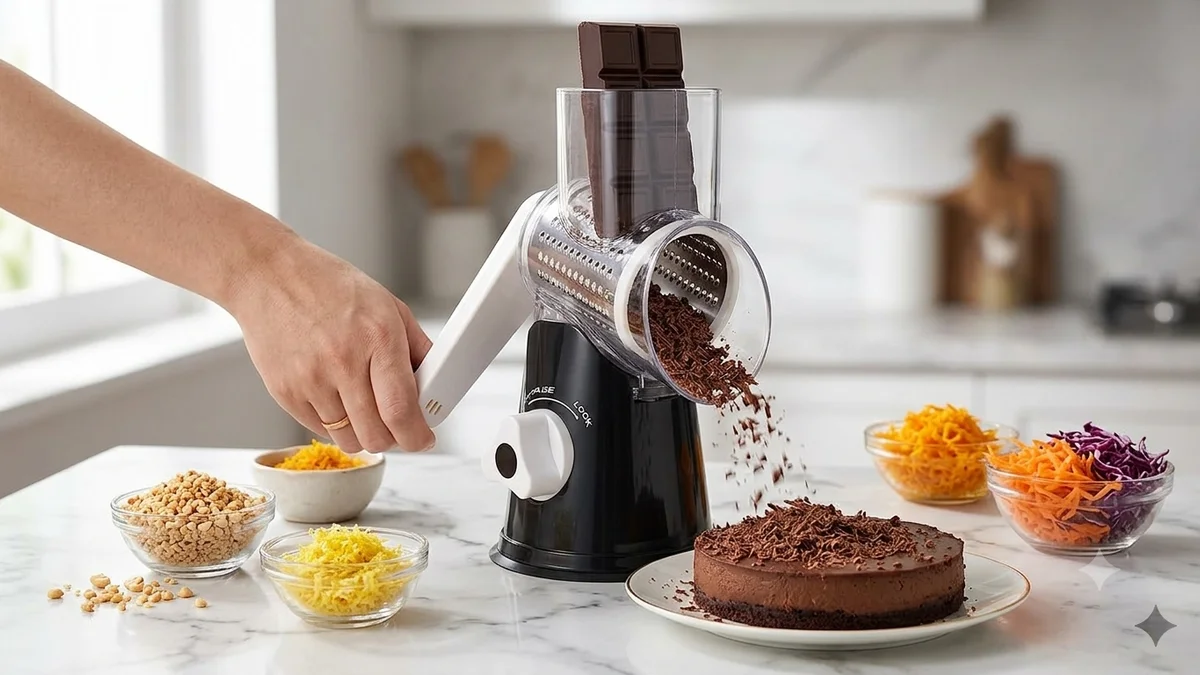

A rotary cheese grater is hand-cranked: pick a drum, drop a chunk of cheese into the hopper, press it down with the plunger, and turn the handle so light, fluffy shreds fall straight into your bowl. Clean shreds come from cold cheese and the right drum: fine for hard cheeses like Parmesan, coarse for semi-firm cheeses like cheddar. America’s Test Kitchen timed rotary graters at about 30 seconds to finely grate an ounce of Parmesan, so a block becomes a bowl of snow in well under a minute.
A box grater scrapes your knuckles, gives you uneven shreds, and sends cheese across the counter. A rotary grater fixes all three. This guide covers how to set it up, the right technique, which cheeses work best, and how to clean it.
What Is a Rotary Cheese Grater?
A rotary cheese grater has three main parts: a drum (the cylindrical grating surface), a hopper (where you put the cheese), and a handle that rotates the drum. You press the cheese against the drum, turn the handle, and out come light, fluffy shreds.
A box grater leaves cheese on the counter and sends shreds flying. The rotary version keeps the cheese contained, works faster for larger quantities, and spares your knuckles. It needs no electricity: the Cambom rotary grater is hand-cranked and grips the counter with a suction-cup base.
Speed is the part you can put a number on. When America’s Test Kitchen reviewed six rotary graters, priced from about $11 to about $55, they found the rotary graters “took about half a minute to finely grate an ounce of Parmesan” on average. The fastest model in that group finished an ounce in 23.3 seconds. That is the pace you are aiming for once your technique is dialed in.
How Do I Set Up the Grater?
Start by choosing the drum that matches your cheese, then lock the base. The Cambom grater includes three interchangeable drums, two for shredding and one for slicing.
- Fine drum for Parmesan, Pecorino, hard aged cheeses, chocolate, and lemon zest
- Coarse drum for semi-firm cheeses like Gruyère, cheddar, and mozzarella
- Slicing drum for thin slices of firm cheeses
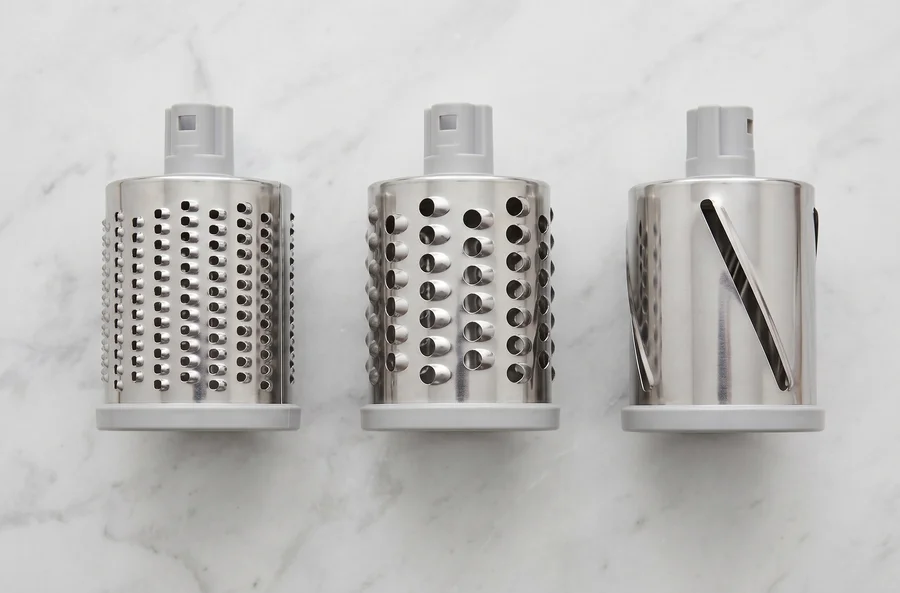
To swap drums: lift the top hopper, slide out the drum, and click in the new one. On the Cambom rotary grater, the process takes seconds.
One note on drum choice. The fine-for-hard, coarse-for-soft guidance shows up across cheese and grater write-ups, but no published test pins a hole diameter in millimeters to a given cheese. Treat the drum chart as a starting point, then adjust to the texture you want.
How Do You Use a Rotary Cheese Grater Step by Step?
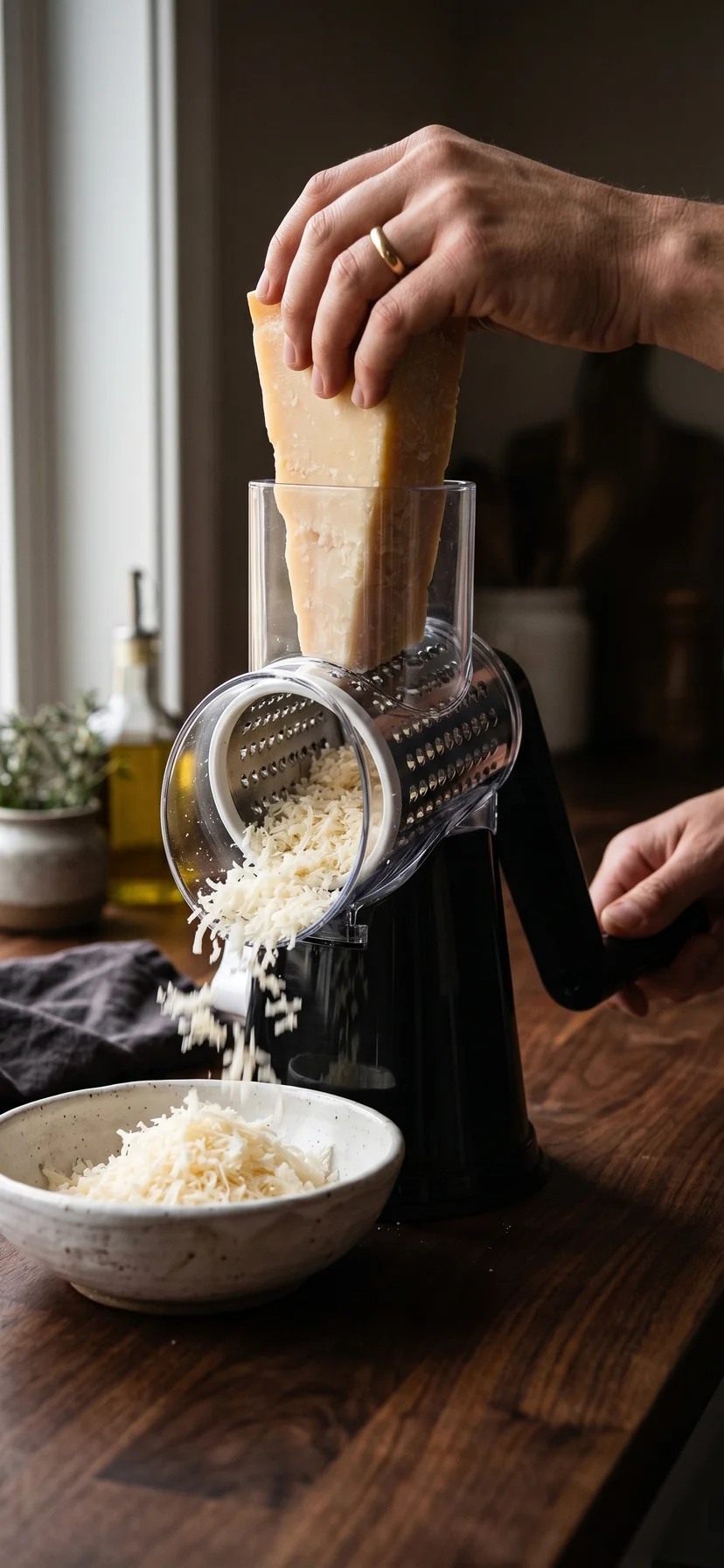
Use cold cheese, lock the base, and crank steadily. Here is the full sequence.
Step 1: Cut the cheese into manageable pieces Cut your block into pieces that fit comfortably in the hopper, roughly 2 to 3 inches wide. Skip the perfect shapes; aim for pieces that sit in the hopper without wobbling.
Step 2: Lock the suction base Place the grater on a stable, clean countertop. Press the suction lever down to lock it in place. The base holds the grater still while you crank, which a box grater never does. The Cambom base grips best on a smooth marble or glass surface.
Step 3: Load the cheese and apply gentle pressure Place the cheese in the hopper and use the top plunger to press it against the drum. The weight of your hand handles soft and semi-firm cheeses. For harder cheeses like Parmigiano-Reggiano, add a little more downward pressure.
Step 4: Turn the handle steadily Crank at a comfortable speed. Smooth, even rotation produces consistent shreds. Jerky cranking causes uneven results or jams the drum. The ATK timed test shows how much steadiness matters: the spread between their fastest and slowest rotary grater was more than 20 seconds per ounce, from 23.3 seconds up to 45.5 seconds.
Step 5: Let gravity do the work Hold a bowl or plate under the grater. The shredded cheese falls straight in, with no mess across the counter.

How Long Does It Take to Grate Parmesan?
About half a minute per ounce, once your crank is steady. The table below pulls the per-ounce times America’s Test Kitchen recorded across the six rotary graters it tested, plus two chilling guidelines for soft cheese and a quick-reference setup. Every row names its source so you can check the figure yourself.
| Reference point | Figure | Source |
|---|---|---|
| Average time to finely grate 1 oz Parmesan (rotary) | about 30 seconds | America’s Test Kitchen |
| Fastest rotary model tested (Zyliss winner) | 23.3 sec per oz | America’s Test Kitchen |
| Microplane rotary | 27.8 sec per oz | America’s Test Kitchen |
| Gourmia rotary | 28.3 sec per oz | America’s Test Kitchen |
| Westmark rotary | 32.0 sec per oz | America’s Test Kitchen |
| Rösle rotary | 38.0 sec per oz | America’s Test Kitchen |
| Slowest rotary model tested (Chef’n) | 45.5 sec per oz | America’s Test Kitchen |
| Hopper bottom surface area, models tested | 2.0 to 6.2 sq in (winner 3.5 sq in) | America’s Test Kitchen |
| Chill soft cheese before grating | about 15 min, solid not frozen | Tasting Table |
| Chill softer cheeses for cleaner shreds | about 20 min | DI ORO |
The ATK winning Zyliss carried a 3.5-square-inch hopper bottom, in the middle of a range that ran from 2.0 to 6.2 square inches. A bigger hopper did not win on its own. A steady crank and a sharp drum did more for speed than raw capacity.
Which Cheeses Are Best for a Rotary Grater?
Hard aged cheeses like Parmesan grate the easiest, and semi-firm cheeses work too when they’re cold. Match the cheese to the drum using the table below. The Cambom grater is rated for cheddar, mozzarella, parmesan, romano, and mascarpone, plus non-cheese foods like chocolate, nuts, vegetables, and zest.
| Cheese | Drum | Notes |
|---|---|---|
| Parmigiano-Reggiano | Fine | The classic; light, snowy shreds |
| Pecorino Romano | Fine | Saltier than Parmesan, same technique |
| Grana Padano | Fine | Milder Parmesan alternative |
| Romano | Fine | Hard and dry, grates cleanly |
| Gruyère | Coarse | Semi-firm, melts well |
| Aged Cheddar | Coarse | Works well when cold |
| Mozzarella | Coarse | Must be very cold, nearly frozen |
| Mascarpone | None | Very soft; chill hard or spread instead |
| Dark Chocolate | Fine | Works well on desserts |
| Lemon zest | Fine | Holds the zest without catching the pith |
Can You Grate Soft Cheese, and Why Does It Stick?
You can, but it has to be cold. Soft and semi-soft cheeses grate cleanly only when very cold or nearly frozen. Warm soft cheese compresses against the drum instead of shredding, the top cause of sticking and jamming.
Two write-ups put a clock on the fix. Tasting Table says of a quick freezer chill, “About 15 minutes should do the trick; you want it to be solid, not frozen.” DI ORO’s rotary grater guide lands close: chilling softer cheeses “for about 20 minutes before grating” firms them “just enough for cleaner shreds without requiring freezing.” Both are editorial kitchen advice rather than lab tests, so use 15 to 20 minutes as a window and pull the cheese once it feels firm but not rock-hard. Here is how to fix the common problems.
Cheese sticking in the drum Warm cheese causes this. Pop it in the freezer for 10 to 15 minutes before grating. Cold cheese grates clean; warm cheese compresses.
Uneven shreds Pressure causes this. Apply more consistent downward pressure with the plunger, and keep your cranking speed steady.
Drum jamming mid-grate Very soft, room-temperature cheese jams the drum. Freeze it first. If it jams, reverse the handle a half-turn to release the cheese, then continue.
How Do You Clean a Rotary Cheese Grater?
Clean it right after use, because dried cheese is harder to remove. The Cambom grater includes a cleaning brush and its parts are dishwasher safe on the top rack.
- Disassemble: remove the drum from the hopper
- Rinse under warm water while rotating the drum by hand, which flushes out most cheese
- Use the included cleaning brush to clear any stuck shreds from the drum holes
- The drum, hopper, and plunger are dishwasher-safe (top rack)
- Air dry fully before reassembling
Avoid soaking the drum in water for extended periods, and don’t use metal scourers, which can dull the grating surface over time.
Why Use a Rotary Grater Instead of Pre-Shredded Cheese?

Pre-shredded cheese carries a coating that helps it pour but works against a smooth melt. As the culinary-science site Inquisicook puts it, “Pre-shredded cheese is coated with anti-caking agents such as potato starch and powdered cellulose.” Those agents sit on the surface to stop shreds from clumping in the bag, and that same coating can keep the cheese from melting into a clean, glossy sauce.
How much coating? Reporting here is mixed, so treat it as a range, not a settled number. The Counter reported that some grated and shredded products “contain up to 9 percent cellulose,” a figure that traces back to lab testing it cites rather than one we measured. Mold inhibitors are common too: per Culture: the word on cheese, “the use of natamycin in shredded cheeses has been approved by the FDA since 1982.” None of this makes pre-shredded cheese unsafe. It does mean a block you grate yourself melts more evenly, clings to pasta without clumping, and tastes fresher. The few extra minutes of cranking pay off every time you cook.
Cheese is only the start. Once the drum technique feels natural, see what else you can grate with a rotary grater: chocolate, nuts, garlic, carrots and more.
Frequently Asked Questions
Can you grate soft cheese with a rotary grater? Yes, but chill it first. Soft and semi-soft cheeses like mozzarella grate cleanly only when very cold or nearly frozen, because warm soft cheese compresses and jams the drum instead of shredding. Tasting Table suggests about 15 minutes in the freezer, until the cheese is solid but not frozen through; DI ORO’s grater guide chills softer cheeses about 20 minutes for cleaner shreds without freezing. Freeze the block for 10 to 15 minutes before grating.
Why does cheese stick in a rotary cheese grater? Sticking is almost always caused by warm cheese. Cold cheese grates into clean, fluffy shreds, while warm cheese softens and compresses against the drum. Chill the cheese for 10 to 15 minutes in the freezer before grating, and clean the drum promptly after use so residue doesn’t dry on.
Is a rotary cheese grater dishwasher safe? The Cambom rotary cheese grater’s drums, hopper, and plunger are dishwasher safe on the top rack. For longest life, rinse off most of the cheese first, avoid soaking the drum for long periods, and don’t scrub it with metal scourers, which can dull the grating surface.
What else can you grate with a rotary grater besides cheese? Beyond cheese, a rotary grater handles chocolate, nuts, vegetables, and citrus zest. Use the fine drum for chocolate and zest and the coarse drum for firmer items. Cambom’s grater is rated for cheddar, mozzarella, parmesan, romano, and mascarpone plus chocolate, nuts, vegetables, and zest.
What is the difference between the fine and coarse drum? The fine drum makes light, snowy shreds and is best for hard aged cheeses like Parmesan and Pecorino, plus chocolate and lemon zest. The coarse drum makes larger shreds and suits semi-firm cheeses like Gruyère, cheddar, and mozzarella. The slicing drum makes thin slices of firm cheese. No published test assigns a hole diameter in millimeters to each cheese, so treat drum choice as guidance, not a measured spec.
How long does it take to grate Parmesan with a rotary grater? About half a minute per ounce. America’s Test Kitchen timed six rotary models finely grating one ounce of Parmesan and found they averaged about 30 seconds, ranging from 23.3 seconds for the winning Zyliss to 45.5 seconds for the slowest model. A steady, even crank gets you closest to the fast end.
Do you need electricity to use a rotary cheese grater? No. A rotary cheese grater is hand-cranked, so it needs no electricity, batteries, or charging. The Cambom model uses a hand crank and a suction-cup base that grips a marble or glass desktop while you turn the handle.
How We Sourced These Numbers
Every figure in this guide comes from an independent test kitchen or a named publication, not our own marketing. Here is each source, what it measured, and the honest limits.
- America’s Test Kitchen, The Best Rotary Graters: timed six rotary models (priced about $11 to $55) finely grating one ounce of Parmesan. Per-model times ran 23.3 seconds (Zyliss winner) to 45.5 seconds (Chef’n), averaging about half a minute, and the page lists hopper bottom surface area from 2.0 to 6.2 square inches. These are measured-test figures.
- Tasting Table, How To Grate Soft Cheese: the roughly 15-minute freezer chill for soft cheese, “solid, not frozen.” Editorial kitchen advice, not a lab test, so use it as a window.
- DI ORO, Best Rotary Cheese Grater: the roughly 20-minute chill for softer cheeses. This is a first-person buying-guide tip, not a measured study.
- Inquisicook, Pre-Shredded Cheese, Friend or Foe?: the anti-caking coating (potato starch and powdered cellulose) on bagged shredded cheese. Editorial culinary-science write-up.
- The Counter, There is wood pulp in your “100 percent” grated cheese: the “up to 9 percent cellulose” figure for some grated products. The Counter attributes this to lab testing it cites; we did not reach or run the underlying tests, so we report it as their claim.
- Culture: the word on cheese, Is shredded cheese safe to eat?: FDA approval of natamycin on shredded cheeses since 1982.
Two gaps we did not paper over. No published test assigns a drum hole diameter in millimeters to each cheese, so the fine-versus-coarse guidance stays qualitative. And ATK published hopper surface area but not grater weight or hopper volume, so we report only the figure that exists.
Ready to Try It?
If you want a reliable rotary grater, the Cambom Rotary Cheese Grater has three interchangeable drums (two shredding, one slicing), a suction base, and is fully dishwasher-safe (top rack). It’s the #1 Best Seller in Cheese Graters on Amazon, with 6,000+ bought in the past month. Buy it on Amazon →
Reviewed by the Cambom Kitchen Team. Updated June 26, 2026.