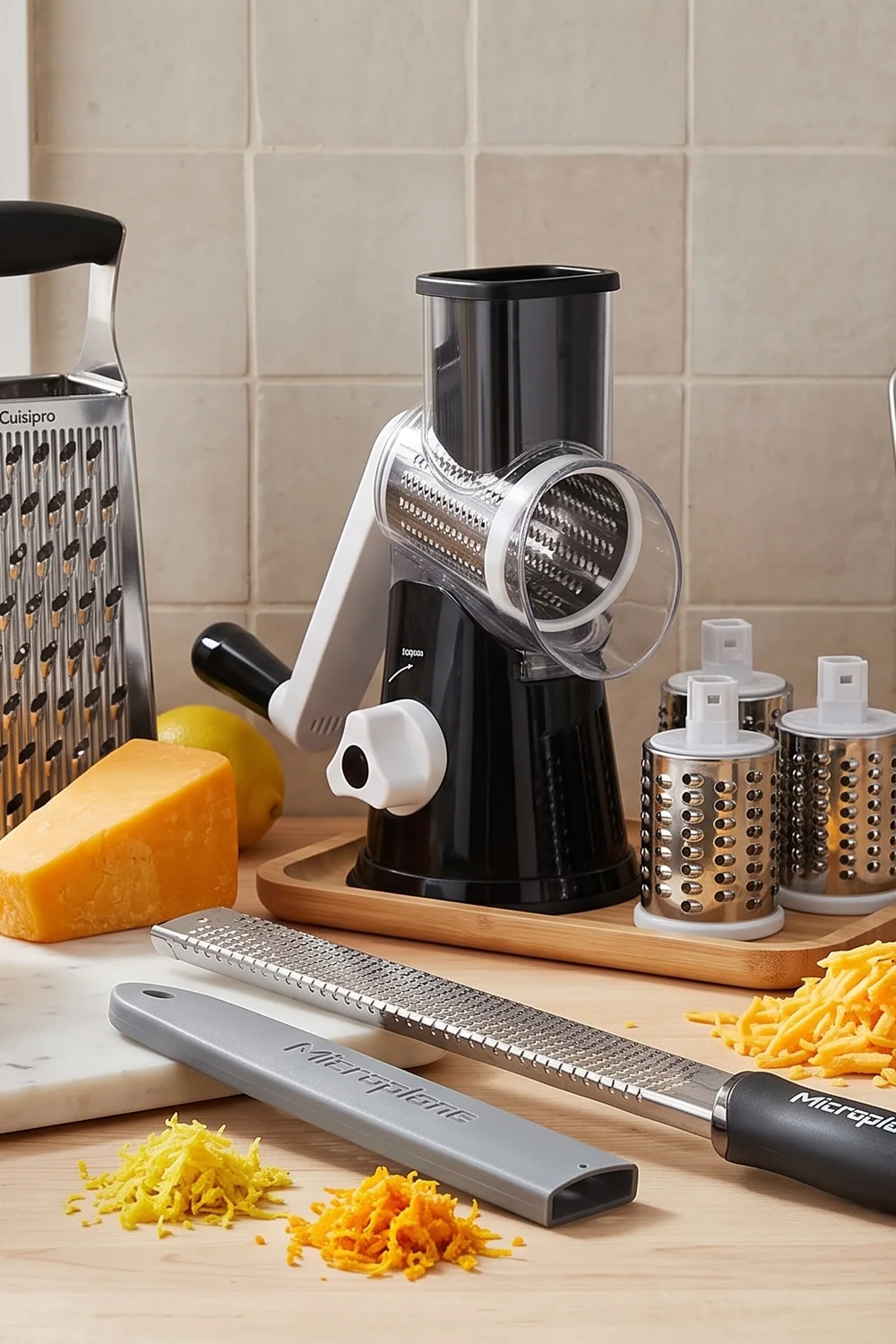
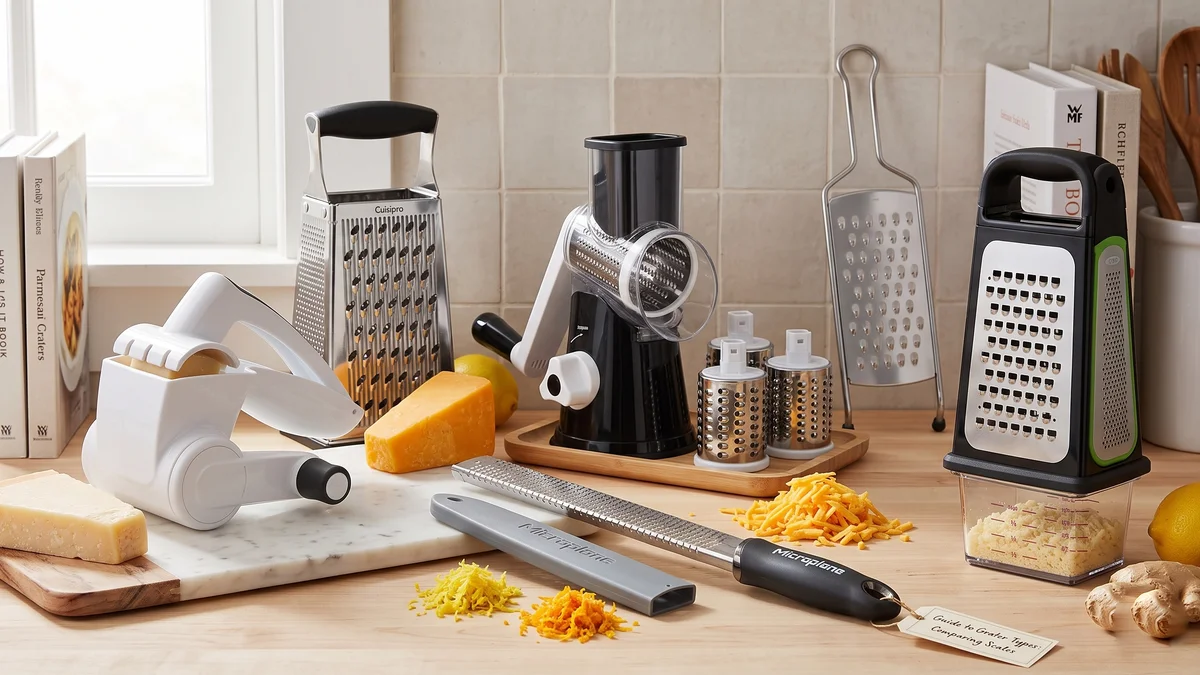
If you want a rasp for zest and Parmesan without buying a single-purpose tool, the Cambom lemon zester and grater set pairs a fine rasp blade with coarse and extra coarse paddles; it is not ranked here because no independent test covers it.
The best cheese grater for most kitchens is the Cuisipro 4-Sided Box Grater ↗: Wirecutter’s grater pick since 2015, and its eight-year-old unit still matched a new one in a blind sharpness test. For fast, high-volume shredding, the Cambom rotary, Food Network’s Best Rotary of 2026, is the safer machine.
This is the Cambom Kitchen Team’s comparison of the best cheese graters across all four styles: box, rotary, handheld paddle, and rasp. We ranked on current specifications from each Amazon listing and on the published results of independent test kitchens, mainly America’s Test Kitchen, Serious Eats, Wirecutter, Food Network, and Taste of Home, with the lab named wherever we cite a measured result. No brand paid for placement, and a competitor takes our top spot.
The 7 best cheese graters compared
Product names link to the current Amazon listing.
| Rank | Grater | Price (September 13, 2026)* | Type | Surfaces or drums | Dishwasher safe | Size and weight |
|---|---|---|---|---|---|---|
| #1 · Our pick | Cuisipro 4-Sided Box Grater ↗ Best overall | $23.72 | Box | 4 (fine to ultra-coarse, slicer) plus ginger base | Yes, 304 stainless | 10.5 × 4.5 × 3.75 in · 0.5 lb |
| #2 | Cambom Rotary Cheese Grater ↗ Best rotary | $26.99 | Rotary | 3 drums (coarse, fine, slicing) | Yes, top rack | 6.5 × 5.5 × 10.8 in · 0.9 lb |
| #3 | OXO Etched Box Grater with Zester ↗ Best box upgrade | $37.95 | Box | 4 (medium, coarse, slicer, removable zester) plus measured container | Yes | 12 × 4.5 × 3.4 in · — |
| #4 | Rosle Coarse Grater ↗ Best handheld paddle | $51.54 | Paddle | 1 coarse surface, 15.7 × 3.5 in | Yes, one-piece stainless | 16.5 in overall · — |
| #5 | Zyliss Classic Rotary ↗ Fastest tested rotary | $24.95 | Rotary | 1 fine drum, NSF certified | Yes | 6.3 × 3.1 × 4.4 in · 0.4 lb |
| #6 | Microplane Premium Classic Zester ↗ Best rasp | $17.95 | Rasp | 1 photo-etched face | Yes, hand wash preserves the teeth | 12 × 1.3 × 1 in · 0.2 lb |
| #7 | KEOUKE Rotary 5-in-1 ↗ Best budget multi-drum | currently unavailable | Rotary | 5 drums, 18/10 stainless | Hand wash, fully disassembles | 10.2 × 9.3 in, 2.6 in inlet · — |
*Prices as of September 13, 2026 and change often. Check the current price before buying. Dimensions and weights come from each product’s current Amazon listing data; an em dash means the listing does not publish a usable figure.
Which type of cheese grater do you need?
The style decides the experience more than the brand does. Four designs cover the market, and each wins a different job.
| Type | Tested speed | Wins at | Watch out for |
|---|---|---|---|
| Box | 1:17 to 2:18 per lb of potatoes | Versatility: 3 to 4 surfaces in one tool | Knuckles near the teeth; bulky to store |
| Rotary (drum) | 23.3 to 45.5 seconds per oz of Parmesan | Volume and safety: fingers never touch the blade | Soft, moist cheese can clog the drum |
| Handheld paddle | 1:02 per lb of potatoes, the fastest tested | Speed over a bowl or pan; slim storage | Usually one coarse surface only |
| Rasp (zester) | About 1:20 per oz of Parmesan | Fine Parmesan snow, zest, garlic, nutmeg | Too slow for anything by the cup |
The speed figures come from America’s Test Kitchen’s timed grater tests: its 2026 paddle-and-box lineup ran a pound of potatoes through each model, and its rotary testing timed an ounce of Parmesan per grater. The spread is real. The fastest tool in the whole field, the Rosle paddle, finished a pound of potatoes in 62 seconds, while the slowest box model took 2:18.
If you are weighing the two most popular styles against each other, our rotary grater vs. box grater comparison goes deeper, and the best rotary cheese grater guide ranks five drum models head to head.
Etched or stamped teeth: the split verdict
Grater teeth are made two ways, and the test kitchens genuinely disagree about which is better, which tells you something useful.
Etched teeth are chemically cut into thin stainless sheet, leaving edges sharp enough to shave translucent curls. Serious Eats and Wirecutter both favor etched surfaces: in the Serious Eats test, only two of ten graters produced usable lemon zest, and both were rasp-style etched surfaces. Stamped teeth are punched through thicker metal, so each hole sits taller and more open. America’s Test Kitchen came down on the stamped side for shredding, because the higher clearance pushes thick shreds through without clogging, and its best results on soft mozzarella all came from stamped teeth.
Both camps are right about their own test. Buy etched for hard cheese, zest, and fine work; buy stamped, or a coarse open surface, for soft and semi-soft cheese in volume. That split is why a well-equipped kitchen often ends up with a box or rotary grater plus a rasp rather than one tool doing everything.
The picks
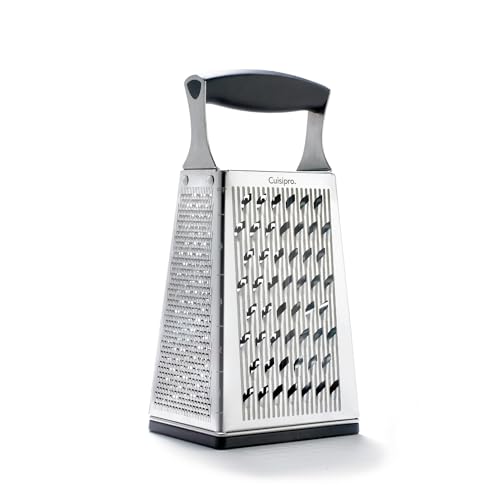
1. Cuisipro 4-Sided Box Grater: Best Overall
The most durable evidence in this comparison. Wirecutter has recommended this grater since 2015, reports a unit in its test kitchen for at least eight years, and that veteran still matched a brand-new one in a blind sharpness test. Serious Eats independently named it the best budget box grater, calling it surprisingly sharp, light, and genuinely dishwasher safe.
Pros:
- Wirecutter: all four sides genuinely work, and the slicer side stands in for a mandoline on small jobs.
- Wirecutter: limited lifetime warranty and a roughly decade-long track record as its top pick.
- Serious Eats: sharp, light, and no-frills, with a detachable ginger-grating base.
- 304 stainless construction, dishwasher safe per the listing.
Cons:
- America’s Test Kitchen rated it Recommended with Reservations: the worst performer in its lineup on soft fresh mozzarella.
- Serious Eats: the hard plastic base can slide on the counter, and the handle is stiff.
- Sharp enough that Wirecutter’s reviewer cut a knuckle; respect the etched sides.
2. Cambom Rotary Cheese Grater: Best Rotary
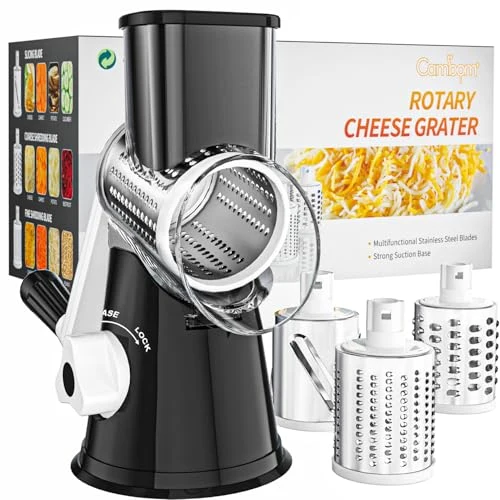
The rotary crown comes from two independent sources. Food Network named the Cambom its Best Rotary Grater of 2026, reporting it handled hard cheese and even a frozen stick of butter with ease while staying less messy than a box grater on mozzarella. Taste of Home has run one continuously since January 2023, and its long-term testers report the drums still have not dulled. It is also Amazon’s #1 Best Seller in cheese graters, the same model that went viral on TikTok.
Pros:
- Food Network: impressive on hard cheese and frozen butter, and less messy on soft mozzarella than the box graters it tested against.
- Taste of Home: no blade dulling or worn parts across years of long-term testing, and more than 29,000 Amazon ratings.
- Enclosed hopper keeps fingers off the blade entirely; the maker rates it at about a pound of cheese in 30 seconds.
- Three drums (coarse, fine, slicing) and a locking suction base; top-rack dishwasher safe per the listing.
Cons:
- Taste of Home: a standard cheese block needs to be quartered to fit the chute.
- The suction base grips smooth counters only; it will not lock onto wood or butcher block.
- Food Network: shreds run slightly less fine and precise than the sharpest box surfaces.
Rotary graters are their own category with real differences in drums, cranks, and hoppers; our best rotary cheese grater guide compares five of them, including the five-drum Cambom variant with an extra-fine Parmesan drum.
3. OXO Etched Box Grater with Removable Zester: Best Box Upgrade
Serious Eats’ box-grater winner, and the only model in its ten-grater test that produced both usable lemon zest and clean chocolate shavings. The etched surfaces cut fast: it finished a cheese block 35 seconds ahead of the slowest competitor. The measured, lidded container that snaps underneath doubles as storage.

Pros:
- Serious Eats: only grater in the test whose zesting side actually zested; etched teeth cut cleanly with little arm effort.
- Removable zester panel works on its own over a bowl or board.
- Measuring container catches, measures, and stores what you grate; backed by OXO’s replace-or-refund guarantee.
Cons:
- America’s Test Kitchen rated it Recommended with Reservations because it struggled with soft mozzarella.
- Wirecutter passed on it, finding the body short and the non-zester sides unremarkable.
- The narrow interior makes hand-washing awkward.
4. Rosle Coarse Grater: Best Handheld Paddle
The fastest grater anyone in our source set has timed. America’s Test Kitchen made it the top paddle-style pick of its May 2026 review, putting a pound of potatoes through it in 1 minute 2 seconds on the largest grating surface in the lineup, with virtually no wasted nub left behind. Serious Eats separately named it the best handheld grater, crediting the one-piece stainless build and the hooked rubber feet that steady it against a bowl rim.

Pros:
- America’s Test Kitchen: fastest model tested, 1:02 for a pound of potatoes, on a 15.7 by 3.5 inch surface.
- One-piece 18/10 stainless with a wire handle; nothing to delaminate, dishwasher safe.
- Serious Eats: rubber feet hook over bowls and boards, so it grates where the food lands.
Cons:
- One coarse surface only; no fine side, no slicer, no zester.
- The most expensive pick in this guide, at roughly double a box grater.
5. Zyliss Classic Rotary: Fastest Tested Rotary
The speed benchmark among drum graters. America’s Test Kitchen timed it at 23.3 seconds per ounce of Parmesan, the fastest rotary it tested, and Serious Eats picked it as best rotary, measuring the smallest wasted cheese nub of any drum model, under a millimeter. It is NSF restaurant certified, which is why the same machine shows up for tableside service.

Pros:
- America’s Test Kitchen: 23.3 seconds per ounce of Parmesan, the fastest rotary in its testing.
- Serious Eats: razor-sharp drum, reversible crank for left-handed use, near-zero waste.
- NSF certified for restaurant use; folds flat for a drawer.
Cons:
- One fine drum in the classic configuration; no coarse or slicing options.
- Serious Eats: the handle grip runs cramped for large hands.
6. Microplane Premium Classic Zester: Best Rasp
The finishing tool. Serious Eats named it the best rasp-style grater and Wirecutter its fine-grating pick, both for the same reason: photo-etched teeth that wrap the edges of the blade and turn hard cheese into weightless snow, citrus into pithless zest, and garlic into paste.

Pros:
- Serious Eats: teeth continue around the blade edges, so the corners grate instead of skating.
- Wirecutter: reaches the tapered ends of a lemon without digging into bitter pith.
- At 0.2 lb, the lightest tool here, and the cheapest.
Cons:
- Slow for volume: in America’s Test Kitchen timing, a rasp needed about 1 minute 20 seconds per ounce of Parmesan, more than three times the fastest rotary.
- Some owner reviews report handle failures, though Wirecutter’s staff units have not reproduced it.
7. KEOUKE Rotary 5-in-1: Best Budget Multi-Drum
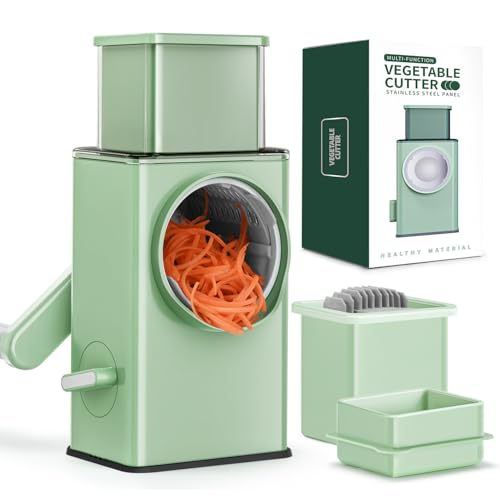
The cheapest way to get five drums. The KEOUKE ships coarse, fine, slicing, julienne, and wavy drums in 18/10 stainless for less than the single-drum Zyliss, and its enlarged inlet takes a whole small potato, so less pre-cutting than the typical rotary chute. Inside the drum housing, molded conical bumps push shreds outward, the design’s answer to the clogging that plagues rotary graters on moist food; KEOUKE’s product page documents all five drum patterns. No major test kitchen has run it yet, so this pick rests on specifications and price rather than lab results, and we say so.
Pros:
- Five 18/10 stainless drums for the lowest price in this guide.
- Enlarged inlet accepts a whole small potato; a push stick keeps hands off the blades.
- Every part disassembles, and the drums lift out for safe cleaning.
Cons:
- No independent test-kitchen results yet; the ranking here reflects specs and price.
- No published weight; the dimensions here come from the maker’s spec drawing (10.2 in long, 9.3 in tall, 2.6 in feed inlet) rather than the listing’s data fields.
- Like every suction-base rotary, it locks onto smooth counters only.
Also considered
- Cuisinart Box Grater (CTG-00-BG): America’s Test Kitchen’s best box-style pick at about $19 in its May 2026 test, but Serious Eats found the zest side lackluster and cleanup finicky. A fine budget box if you skip zesting.
- Susteas Rotary: Wirecutter’s speedy-grating pick, with five flat snap-in panels; its blades are stamped rather than etched, and testers found the panels fussy to seat.
- Mercer Grates Box (M35420): the fastest etched box in the America’s Test Kitchen lineup at 1:03 per pound of potatoes.
- OXO Good Grips Two-Fold: Wirecutter’s easy-storage pick; folds flat, but has no zester or slicer side.
- Progressive PrepWorks 7-Piece Set: Food Network’s overall winner, grating into an angled 2-cup container; more plastic than any other pick here.
- KitchenAid Fresh Prep Attachment: the lowest-effort option Food Network tested, but it requires a KitchenAid stand mixer and cannot grate finely.
- Cuisipro 6-Sided: Food Network’s box winner for its hairlike fine surface; Wirecutter counters that it takes twice the storage space for grating strips just 2.25 inches wide.
- Zulay Kitchen 5-drum and Geedel rotaries: solid budget drums we rank in the rotary guide.
One to skip: the KitchenAid Gourmet 4-Sided Box Grater. America’s Test Kitchen rated it Not Recommended with the dullest teeth in its lineup, and Serious Eats found its zesting side unable to produce usable zest.
Which cheese grater should you buy?
- You want one tool for everything: the Cuisipro 4-Sided. Four working surfaces, a decade of test-kitchen endorsement, and a lifetime warranty.
- You shred cheese by the cup for tacos, pizza, or meal prep: the Cambom rotary. Fast, enclosed, and proven by years of long-term testing.
- You zest, finish plates, and grate Parmesan by the pinch: the Microplane Premium Classic. Nothing else makes cheese that fine.
- You grate straight over the pot and hate bulky tools: the Rosle paddle, the fastest grater tested anywhere in our source set.
- You want maximum drum options on a budget: the KEOUKE 5-in-1 at under twenty dollars.
- Soft, moist cheeses dominate your cooking: a stamped-tooth box grater, plus 20 to 30 minutes of freezer time before grating.
Grate safely
Graters deserve more respect than they get. In the Cambom American Kitchen Injury Audit of raw federal CPSC data, the slicers-and-choppers category that includes graters accounts for roughly 32,000 ER visits a year, and the failure mode is always the same: the last inch of the block, gripped close to the teeth. Rotary designs exist to remove exactly that risk, since the food sits in a closed hopper and a crank does the work. With any open grater, sacrifice the final nub of cheese rather than your knuckle. Our kitchen injury statistics roundup has the full numbers.
Frequently Asked Questions
What is the best cheese grater in 2026?
For most kitchens the Cuisipro 4-Sided Box Grater is the best all-round cheese grater: Wirecutter has recommended it for about a decade, and its eight-year-old test unit still matched a brand-new one in a blind sharpness comparison. If you shred cheese in volume, a rotary grater is faster and keeps fingers away from the blade; Food Network named the Cambom rotary its Best Rotary Grater of 2026, and it is Amazon’s #1 Best Seller in cheese graters.
What do professional chefs use to grate cheese?
It depends on the job. For finishing a plate with fine Parmesan, most pros reach for a rasp-style Microplane. For tableside service, restaurants use rotary graters because the cheese sits in an enclosed hopper and grates fast; the Zyliss Classic is NSF restaurant certified for exactly that use. For prep volume, kitchens lean on box graters or a food processor’s shredding disc.
What cheese grater did America’s Test Kitchen recommend?
In its May 2026 review of paddle and box graters, America’s Test Kitchen named the Rosle Coarse Grater the best paddle-style model, the fastest in the lineup at 62 seconds for a pound of potatoes, and the Cuisinart Box Grater the best box-style model. In its separate rotary-grater testing, the fastest model was the Zyliss Classic at 23.3 seconds per ounce of Parmesan.
What is the viral TikTok cheese grater?
The rotary grater that went viral on TikTok under the #CheeseGrater tag is the Cambom Rotary Cheese Grater. Taste of Home has been testing one since January 2023 and reports the listing has more than 29,000 Amazon ratings. The appeal is real: the crank-and-drum design shreds a block of cheese in seconds and your fingers never go near the blade.
Is a rotary cheese grater better than a box grater?
For volume and safety, yes; for versatility, no. A rotary grater shreds faster, catches nothing on your knuckles, and in America’s Test Kitchen timing needs about 30 seconds per ounce of Parmesan. A box grater offers three or four different surfaces in one tool and handles soft, moist cheeses better, since open stamped teeth clog less than an enclosed drum. Many kitchens end up with one of each.
What is the difference between etched and stamped grater blades?
Etched teeth are chemically cut into thin steel, so they are sharper and shave cleaner, which wins for hard cheese and citrus zest. Stamped teeth are pressed through thicker metal, leaving taller, more open holes that clear soft or moist food better. The test kitchens split along exactly that line: sharper etched surfaces won the zest and hard-cheese tests, while stamped teeth handled fresh mozzarella without clogging.
Why is freshly grated cheese better than pre-shredded?
Pre-shredded cheese is coated with anti-caking agents such as potato starch, corn starch, and calcium sulfate, which the FDA’s standard of identity for shredded cheese permits. Those coatings keep shreds from sticking in the bag, but they also interfere with melting, which is why bagged cheese goes grainy in sauces where a freshly grated block melts smooth.
How do you keep soft cheese from clogging a grater?
Firm it up first: 20 to 30 minutes in the freezer stiffens mozzarella or Monterey Jack enough to shred cleanly. Use the coarse side rather than a fine one, and prefer open stamped teeth or a box grater for the softest cheeses, since enclosed rotary drums are the quickest to clog with moist cheese. Grating cold and cleaning right away keeps every style working.
Reviewed by the Cambom Kitchen Team. Updated August 30, 2026.