Store fresh pasta in the fridge for 1 to 2 days or freeze it for 1 to 2 months. Dust it with semolina, keep it in a single layer or loose nests in an airtight container, and for anything beyond a day, freeze it on a tray first, then bag it and cook it straight from frozen. The greenish-grey color homemade pasta takes on after about 16 to 24 hours is harmless oxidation, not spoilage.
This is the Cambom Kitchen Team’s playbook for keeping fresh pasta at its best: how long each kind lasts, how to store it in the fridge and freezer, and the prep steps that stop it from sticking or spoiling.
Fresh Pasta Storage Times at a Glance
The table below maps each kind of fresh pasta to how long it holds at room temperature, in the fridge, and in the freezer, plus the one prep step that matters most. Keep it as your quick reference; the sections below explain each row.
| Pasta type | Room temp (max) | Refrigerator | Freezer | Key prep note |
|---|---|---|---|---|
| Homemade egg pasta, cut | 2 hours | 1 to 2 days | 1 to 2 months | Dust with semolina, single layer or loose nests |
| Store-bought fresh, sealed | Keep chilled | 2 to 3 days | 1 to 2 months | Leave in the sealed pack until use |
| Store-bought fresh, opened | 2 hours | 1 to 2 days | 1 to 2 months | Re-seal airtight |
| Fresh stuffed (ravioli, tortellini) | 1 hour | 1 to 2 days | 1 to 2 months | Blanch 30 seconds before freezing |
| Raw pasta dough | 2 hours | About 1 day | Up to 4 weeks | Flatten to a disk, double wrap |
| Dried pasta (for reference) | Indefinite | Not needed | Not needed | Airtight pantry, about 2 years for best quality |
Treat the shorter number in each range as the quality target and the longer as the outer safe limit. The greenish-grey tint fresh pasta takes on after about 16 to 24 hours in the fridge is oxidation, not spoilage.
How Long Does Fresh Pasta Last?
It depends on what the pasta is made of and where you bought it. Three cases cover it.
Homemade egg pasta is the most perishable. Keep it 1 to 2 days for the best quality, and use the color as your visual clock. The greenish-grey shade it takes on after 16 to 24 hours looks alarming but is only oxidation, and the pasta is fine within two days of making it. We would not eat homemade pasta kept longer than about two days.
Store-bought fresh pasta lasts longer in its sealed pack, usually 2 to 3 days, because it is sealed and treated for a longer shelf life. Once you open the pack, treat it like homemade and use it within a day or two.
Fresh stuffed pasta sits in the middle, but its filling is the weak point. Filled shapes get sticky within an hour at room temperature as moisture seeps out of the filling, so move ravioli and tortellini to the fridge or freezer soon after you shape them.
Egg is the reason fresh pasta spoils faster than the dried box in your pantry. Eggs and moisture give bacteria a friendlier home, so fresh pasta cannot sit the way dried pasta can.
How Do You Store Fresh Pasta in the Fridge?
Dust it, shape it, seal it, and keep it cold. The flour coating is what stops the strands from welding into a clump.
- Toss the cut pasta in semolina. Its coarse texture keeps the strands from sticking better than fine flour.
- Shape it to fit. Twirl long pasta into loose nests and lay short shapes, sheets, and stuffed pieces flat in a single layer so none of them touch.
- Let it rest uncovered for about 30 minutes on a floured, parchment-lined tray so the surface firms up before it goes cold.
- Seal it. Move the pasta to an airtight container, or cover the tray, and refrigerate. A cover holds in moisture and keeps other fridge odors out.
Keep homemade egg pasta to 1 to 2 days and store-bought fresh to 2 to 3 days. Leaving fresh pasta in the fridge too long lets humidity change its flavor and texture, so when you need more time, freeze it rather than push the fridge window.
How Do You Freeze Fresh Pasta?
Freezing is what we reach for whenever pasta needs to keep beyond a day, and the trick is to freeze the pieces apart before you bag them so they never clump.
- Flour and shape. Dust the pasta with semolina or flour and form long strands into nests.
- Pre-freeze on a tray. Spread the pasta in one layer on a parchment-lined, floured baking sheet and freeze it uncovered until firm, 15 minutes to an hour depending on the shape.
- Portion and bag. Move the hardened pasta into airtight freezer bags or containers, press out the air, and seal. About 115 grams of fresh pasta per person makes single servings easy to pull.
- Label and date it. The best-quality window is 1 to 2 months.
- Cook from frozen. Drop it straight into boiling salted water without thawing and add about 30 seconds to 1 minute. Thawing uncooked pasta first turns it sticky. Do not refreeze pasta once it has thawed.
How Do You Freeze Stuffed Pasta Without It Cracking?
Blanch it first. Ravioli and tortellini crack or burst in the freezer because the wet filling expands against a raw, brittle shell. Drop the stuffed pasta in boiling water for about 30 seconds, drain it, and air-dry it on a towel for 15 minutes before the usual tray-freeze and bag. The quick dip firms the dough just enough to hold the filling. Cook the frozen stuffed pasta straight from the freezer like any other shape.
Can You Freeze Raw Pasta Dough?
Yes, if you are not ready to roll it yet. Shape the dough into a ball, flatten it into a disk so it thaws evenly, wrap it in a double layer of heavy-duty plastic wrap, and freeze it for up to 4 weeks. Thaw it overnight in the fridge before you roll and cut it. Freezing the dough as a disk rather than a ball means you are not waiting on a frozen core to soften.
How Long Can Fresh Pasta Sit Out at Room Temperature?
About 2 hours for egg pasta, then it needs the fridge or freezer. Fresh egg pasta is quick to spoil, so 2 hours is the cap. Stuffed pasta is shorter still, going sticky within an hour as the filling weeps.
The one exception is eggless pasta. Pasta bianca, made from just flour and water, can be left out to air-dry over a couple of days and then kept sealed for a month or two, because there is no egg to spoil.
Can Dry Pasta Go Bad?
Barely. Plain dried pasta is one of the most shelf-stable foods in the kitchen. Its moisture sits around 12 percent or lower, and mold and bacteria need water to grow, so a sealed box keeps for around two years and stays safe well beyond that. Past that window it is a question of flavor, not safety, and the printed best-by date is a quality marker rather than a hard cutoff.
Two cautions. Egg, gluten-free, and flavored dried pastas spoil faster than plain durum because their extra ingredients break down. And moisture or pests change the math: discard any dried pasta that smells off, shows mold, or has signs of pantry bugs.
How Can You Tell if Fresh Pasta Has Gone Bad?
Use your senses before the clock. The table below separates the harmless change everyone worries about from the real spoilage signs.
| What you notice | What it means |
|---|---|
| Greenish-grey tint after 16 to 24 hours | Harmless oxidation; still safe within the fridge window |
| Sour or off smell | Spoiled; discard |
| Slimy or sticky film beyond sauce | Bacterial breakdown; discard |
| Fuzzy white, green, or black mold | Discard the whole container |
| Dull, darkened patches not there when fresh | Spoilage; discard |
The dull, slimy look usually shows up just before mold, so it is your last clear warning. As a backstop, discard refrigerated fresh pasta past 2 days even if it looks fine.
What About Drying Fresh Pasta for Long-Term Storage?
Drying is the way to keep pasta for months without the fridge or freezer, since removing the water is what makes it shelf-stable. Air-dry floured strands on a rack or sheet for 12 to 24 hours until they snap instead of bend, then store them airtight. For most home cooks, though, freezing is simpler and more reliable than chasing the steady, controlled conditions a pantry-stable dry really needs.
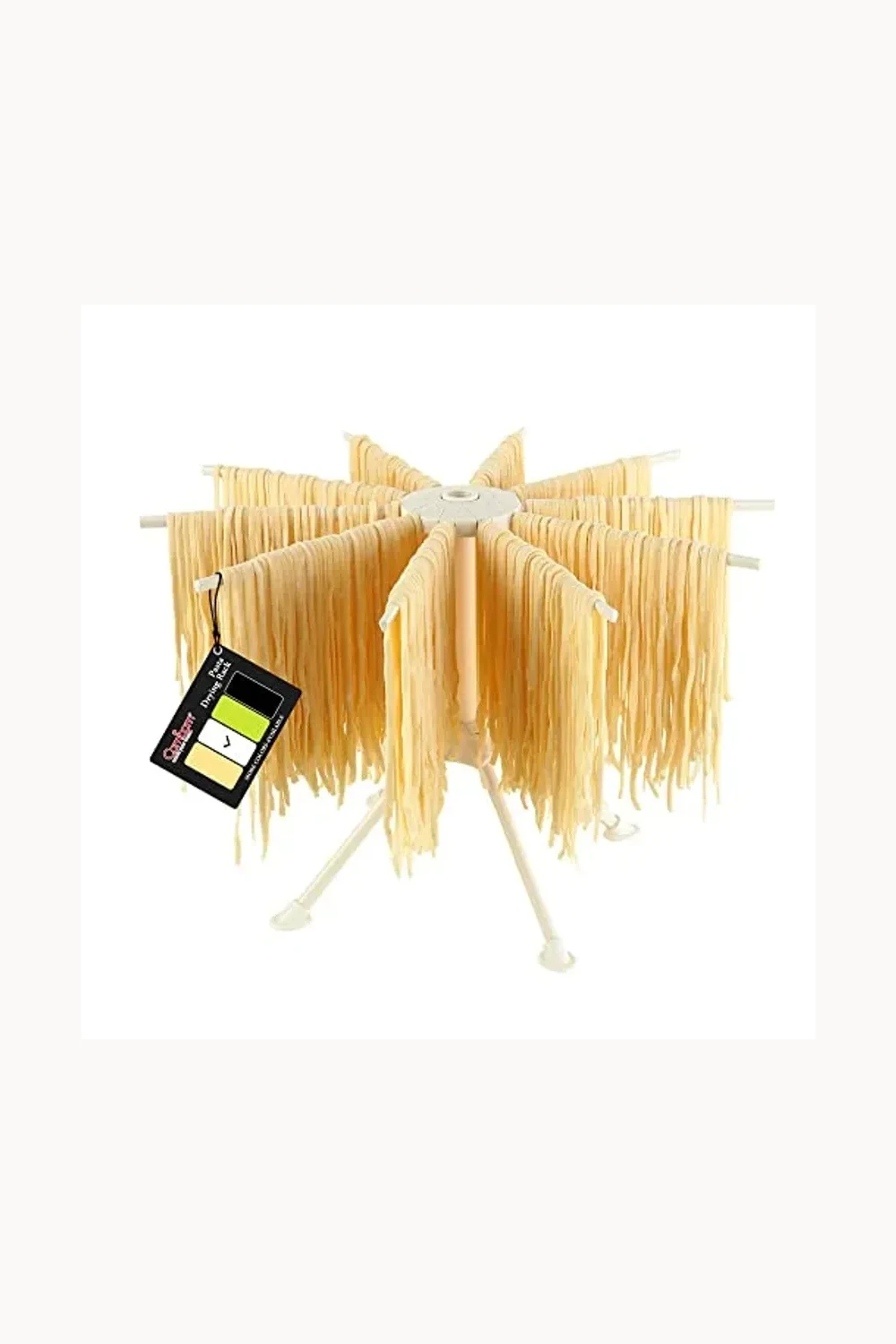
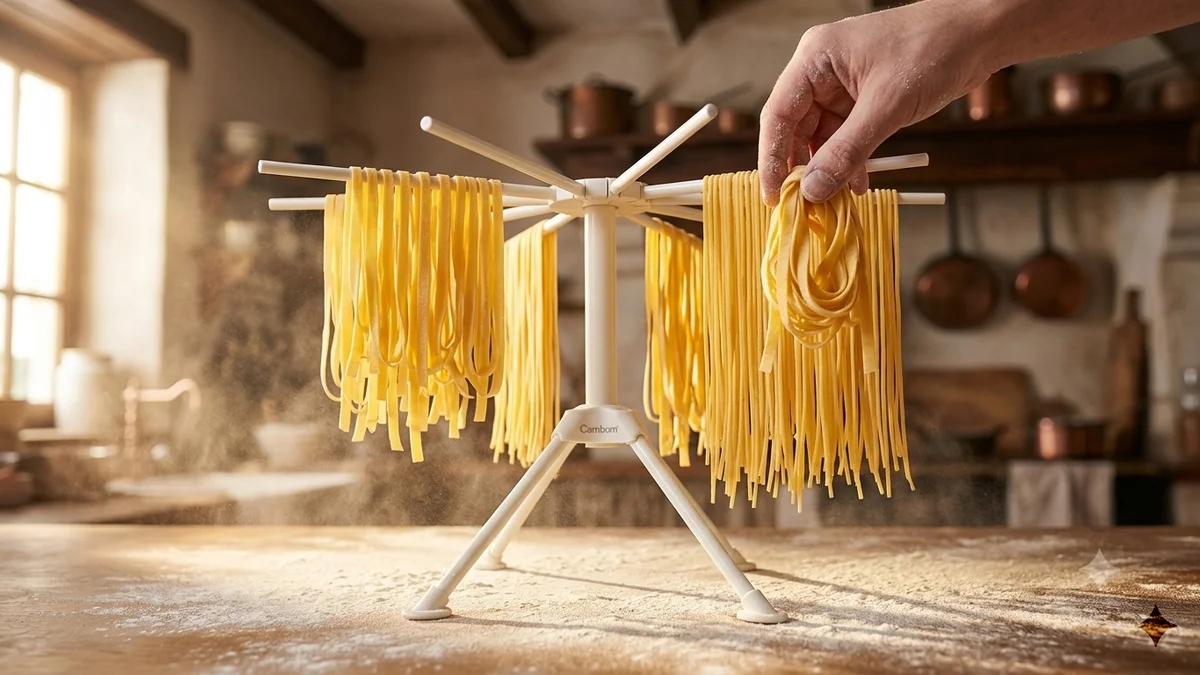
We cover the full method, the dry times by purpose, and the fix for curling in our guide to drying fresh pasta without it sticking. The one tool that makes it easy is a rack that holds strands apart so air reaches every side.
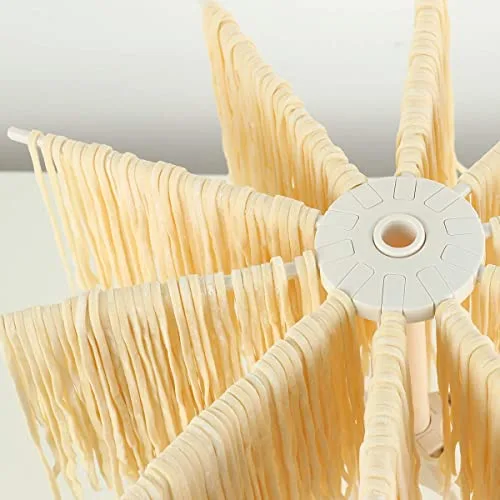
The Cambom Collapsible Pasta Drying Rack hangs a full batch on 10 lengthened arms, grips the counter with 4 rubber anti-slip feet, assembles without tools, folds flat to about 7.8 by 3.5 inches, and is dishwasher safe on the top rack. See it on Amazon.
Frequently Asked Questions
How long does fresh pasta last in the fridge? Homemade egg pasta keeps about 1 to 2 days in the fridge, and store-bought fresh pasta keeps 2 to 3 days in its sealed pack. Keep it airtight and dusted with semolina. After about 16 to 24 hours, homemade pasta turns a greenish-grey color, which is harmless oxidation, not spoilage, within the safe window. For anything past a day or two, freeze it instead.
How long can you freeze fresh pasta? Freeze fresh pasta 1 to 2 months for the best quality. Freeze it on a floured tray first until firm, then move it to an airtight bag with the air pressed out, and label the date. Beyond two months it stays safe, but the texture and color start to suffer.
Do you thaw frozen fresh pasta before cooking? No. Drop frozen fresh pasta straight into boiling salted water without thawing, and add about 30 seconds to 1 minute to the cook time. Thawing uncooked pasta first makes it sticky and ruins the texture.
Can dry pasta go bad? Plain dried pasta barely goes bad. Its moisture sits around 12 percent or less, too dry for mold or bacteria, so a sealed box keeps for around 2 years and stays safe well beyond that. Past that window it is a question of flavor, not safety. Egg, gluten-free, and flavored dried pastas spoil faster than plain durum. Discard any dried pasta that smells off, shows mold, or has pantry-pest damage.
How do you freeze stuffed pasta without it cracking? Blanch it first. Drop the ravioli or tortellini in boiling water for about 30 seconds, drain them, and air-dry them on a towel for 15 minutes, then freeze them on a semolina-dusted tray before bagging. The quick blanch sets the dough so the filling does not crack or burst the shell in the freezer. Cook them straight from frozen.
How can you tell if fresh pasta has gone bad? Trust your nose and eyes. A sour or off smell, a slimy film beyond any sauce, fuzzy mold, or dull darkened patches all mean it has spoiled and should go in the bin. Do not confuse these with the harmless greenish-grey oxidation that shows up after 16 to 24 hours in the fridge. As a rule, discard refrigerated fresh pasta past 2 days even if it looks fine.
Reviewed by the Cambom Kitchen Team. Updated July 1, 2026.