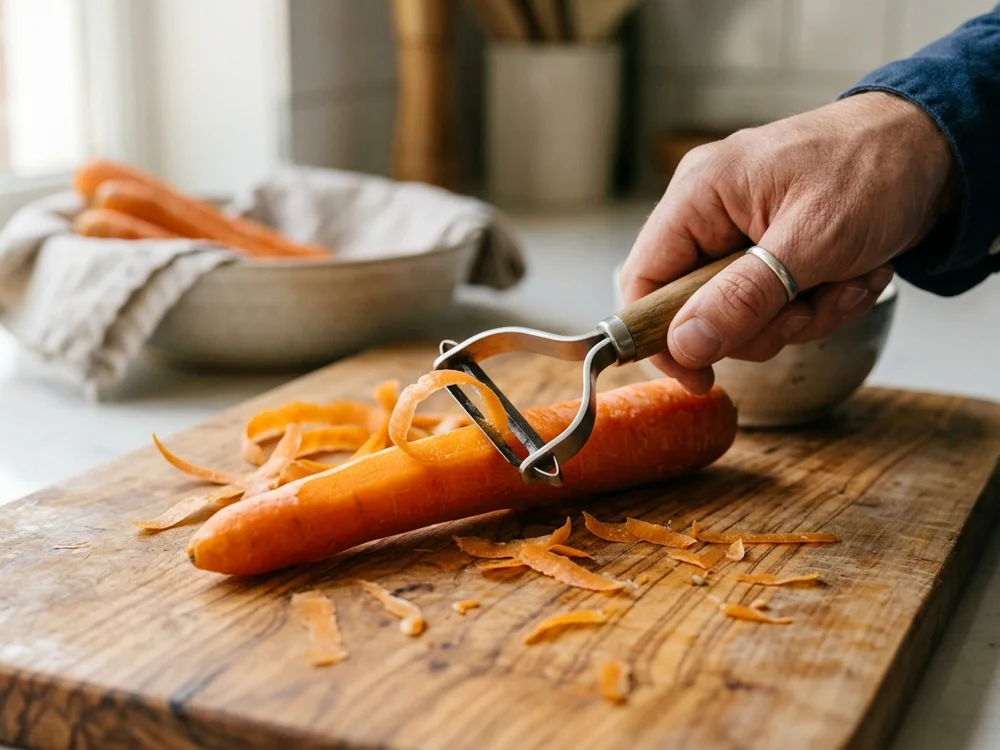
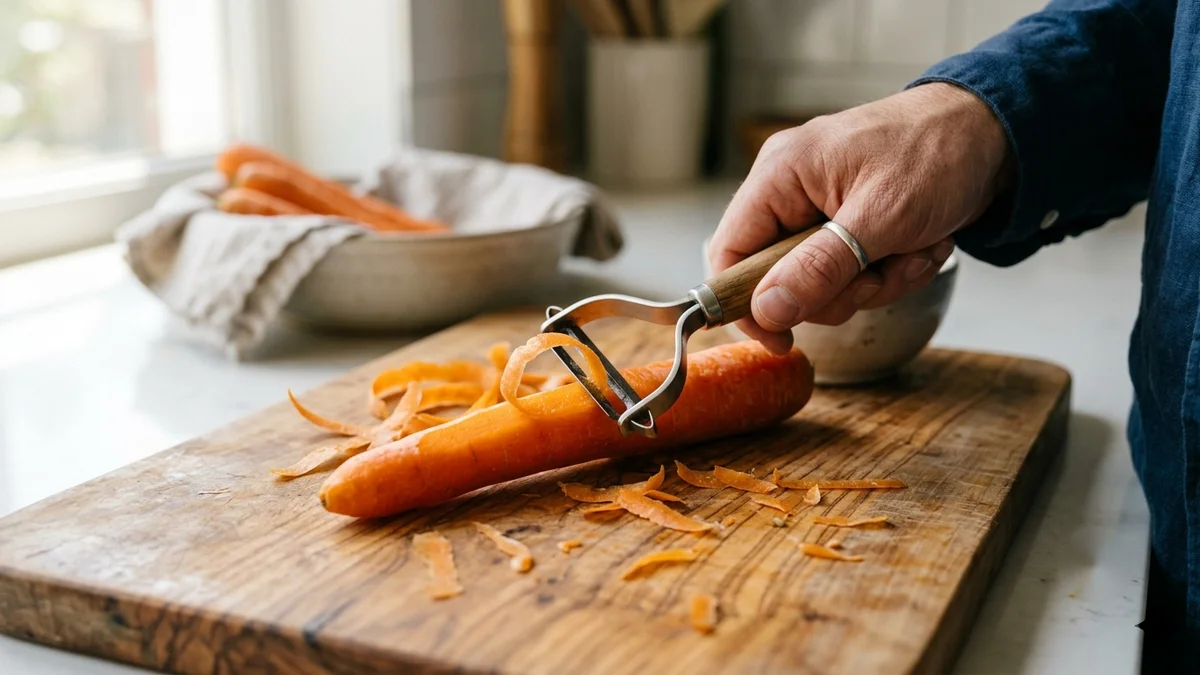
The best vegetable peeler for most kitchens is the Kuhn Rikon Original Swiss Peeler ↗, at $8.50 the cheapest tool in this guide and the one pick every major test kitchen agrees on. Its carbon-steel blade starts sharper than stainless rivals and stays that way, on a featherweight Y frame that works in either hand. If you prefer a straight swivel peeler or need the gentlest grip, the OXO Good Grips Pro is the comfort pick, and the all-stainless Rösle Crosswise is the buy-it-for-life upgrade.
We ranked these five from the published, hands-on findings of four independent test kitchens plus current Amazon product data, and we name the source for every verdict below.
The Best Vegetable Peelers, Compared
Product names link to the current Amazon listing.
| Rank | Peeler | Price (September 20, 2026)* | Style | Blade | Size and weight |
|---|---|---|---|---|---|
| #1 · Our pick | Kuhn Rikon Original Swiss ↗ Best overall | $8.50 | Y peeler | Carbon steel, straight edge | 6.0 × 0.8 × 2.8 in |
| #2 | OXO Good Grips Pro Swivel ↗ Best straight swivel | $17.95 | Straight swivel | Hardened stainless | 10.4 × 4.2 × 1.2 in · 0.2 lb |
| #3 | KitchenAid Classic Euro ↗ Best serrated | $11.99 | Straight, double edge | Serrated 420 stainless | 1.0 × 1.0 × 8.7 in · 0.1 lb |
| #4 | Rösle Crosswise ↗ Best premium | $30.33 | Crosswise swivel | 18/10 stainless, replaceable | 6.7 × 3.0 × 1.0 in · 0.2 lb |
| #5 | Linden Sweden Jonas ↗ Best for left-handers | currently unavailable | Straight, double edge | Stainless, ambidextrous | 8.8 × 2.5 × 0.5 in · 0.1 lb |
| n/a | Spring Chef Premium Swivel The bestseller to skip | $6.92 | Straight swivel | Dual stainless | — |
*Prices checked September 20, 2026 and change often; check the live listing. Dimensions and weights come from each product’s current Amazon listing data; an em dash means the listing does not publish that figure.
What the Test Kitchens Agreed On
We compared four independent editorial tests: Serious Eats (14 peelers, timed on more than five pounds of potatoes), Bon Appetit (tested lineup plus interviews with four executive chefs), America’s Test Kitchen, and Wirecutter (which has run peeler testing for over a decade). Four findings repeat across all of them.
The Kuhn Rikon Original is the consensus winner. Serious Eats crowned it in its 2026 roundup and its editorial director keeps a personal stash of them. Bon Appetit made it best overall after nearly every chef it interviewed named it first. America’s Test Kitchen links it as its winning peeler. Wirecutter lists it as one of its two picks of 2026. No other kitchen tool category we have covered shows this much agreement.
Y peelers beat straight peelers on speed. Serious Eats timed every model on two large russet potatoes and found Y-shaped peelers finished nearly twice as fast as straight swivel models on average, with fewer jams. The fastest time overall belonged to the crosswise Rösle at 1 minute 14 seconds.
Sharpness beats price. The $9 winner outperformed models costing four times more, and Bon Appetit declined to make its $50 luxury entrant a pick for exactly that reason. Once a blade dulls, no price tag saves it: peelers cannot be sharpened, so every reviewer treats them as consumables to replace every year or two.
Blade material is a real tradeoff. Carbon steel, used on the Kuhn Rikon, starts sharper and holds its edge longer, but it rusts if left wet and belongs out of the dishwasher. Ordinary stainless resists rust and survives the dishwasher, but the good stainless peelers specify extra-hardened or precision-ground steel to close the sharpness gap.
The 5 Best Vegetable Peelers
1. Kuhn Rikon Original Swiss Peeler: Best Overall

The Kuhn Rikon Original Swiss Peeler is the rare product that wins every ranking it enters. It took best overall at Serious Eats and Bon Appetit, it is America’s Test Kitchen’s winning peeler, and it is one of Wirecutter’s two 2026 picks. The reason is the blade: sharp carbon steel that cuts with almost no pressure and shaves delicate lemon zest with minimal pith, on a one-piece Y frame that weighs almost nothing. It carries a built-in eye remover for potatoes, and the same design has sold on Amazon since the early 2000s.
At $8.50 it is also the cheapest pick in this guide, and it is commonly sold in three-packs for the price of one mid-range peeler. Since no peeler can be resharpened, that pricing is a feature: when the blade finally dulls, you swap in a fresh one without a second thought.
Pros:
- The consensus best-overall across four independent test kitchens
- Carbon-steel blade starts sharper and holds its edge longer than stainless
- Ambidextrous Y frame, built-in potato-eye remover, three-pack economics
Cons:
- Carbon steel can rust: hand-wash and towel-dry right after use
- Featherweight plastic body feels disposable next to all-metal rivals
2. OXO Good Grips Pro Swivel Peeler: Best Straight Swivel

If you prefer the inline control of a straight peeler, the OXO Good Grips Pro is the one to buy, and Wirecutter names it alongside the Kuhn Rikon as one of its two picks of 2026. The body is die-cast zinc rather than plastic, so the tool carries its own working weight, and the precision-ground, extra-hardened stainless blade swivels to follow the contour of whatever you are peeling.
That weight-plus-grip combination is also why this is our recommendation for anyone with tired hands or arthritis. The wide, cushioned, non-slip handle needs the least clamping force of anything in this guide, and the heft lets the tool press for you. It runs $17.95, has been in continuous production for over two decades, and shrugs off the dishwasher.
Pros:
- Wirecutter 2026 pick; die-cast zinc body with real working weight
- The most comfortable grip here, well suited to arthritic or weak hands
- Hardened stainless blade, dishwasher safe
Cons:
- Slower on potatoes than the Y peelers in Serious Eats’ timed test
- Twice the price of the winner
3. KitchenAid Classic Euro Peeler: Best Serrated for Soft Produce

Straight blades skate over ripe tomatoes and peaches. Serrated teeth bite. The KitchenAid Classic Euro carries a double-edged serrated blade in rust-resistant 420 stainless, so one tool handles firm roots and slick-skinned soft produce without blanching. In Serious Eats’ timed potato test it posted 1 minute 33 seconds, in the leading pack and well ahead of every budget straight peeler.
The 8.6-inch handle is the longest in this guide, a genuine plus for large hands, and the blade cover it ships with keeps drawer clutter from dulling the edge. At $11.99 it sits in the same budget band as the winner, and it is dishwasher safe.
Pros:
- Serrated double edge grips tomatoes, peaches, and kiwi that straight blades slide over
- Longest handle here; ships with a protective blade cover
- Fast in timed testing, dishwasher safe, budget price
Cons:
- Serrations leave slightly rougher cuts on firm roots than a straight edge
- Big-brand basic: no eye remover, no replaceable blade
4. Rösle Crosswise Swivel Peeler: Best Premium
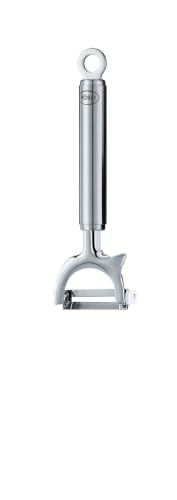
The Rösle Crosswise is the buy-it-for-life answer in a category of disposables. The entire tool is 18/10 stainless steel, made in Germany, and it posted the fastest potato time of all 14 models in Serious Eats’ test at 1 minute 14 seconds. Serious Eats made it its premium pick, and Food and Wine includes it among its six best of 2026.
What actually justifies the price is the blade program: Rösle sells replacement blades separately, which makes this the only mainstream peeler here you repair instead of retire. At $30.33 it costs about four Kuhn Rikons, so it is a deliberate upgrade, not a default. Note that Serious Eats flags it as unfriendly for left-handed use, and stock runs thin, so check the live listing.
Pros:
- Fastest potato time in Serious Eats’ 14-peeler test
- One-piece 18/10 stainless build with user-replaceable blades
- Built-in eye remover; pleasing, precise heft
Cons:
- The most expensive pick here by a wide margin
- Not left-hand friendly; stock frequently runs low
5. Linden Sweden Original Jonas Peeler: Best for Left-Handers

The Linden Sweden Original Jonas is the heritage classic of the group: a decades-old design still made in Sweden, with a rust-resistant double-edged blade that cuts on both the push and the pull stroke. That double grind is what makes it fully ambidextrous, the standout choice for left-handed cooks in a category that quietly grinds most blades for righties.
It earned an independent endorsement too: Prudent Reviews named it best overall after peeling more than a hundred fruits and vegetables across nine popular models, beating both the OXO and the Kuhn Rikon in that test. At currently unavailable with a slim metal-and-composite handle and dishwasher-safe build, it is the classic swivel peeler done right.
Pros:
- Double-edged blade peels in both directions and suits either hand
- Won an independent nine-peeler test against OXO and Kuhn Rikon
- Made in Sweden; dishwasher safe; decades-proven design
Cons:
- Slim handle offers less cushion than the OXO for long prep sessions
- No eye remover notch
One to skip, despite the sales rank
The Spring Chef Premium Swivel is Amazon’s number one bestseller in peelers, with over ten thousand sold in a recent month per its brand storefront, and at $6.92 the price is right. The test data is not. In Serious Eats’ timed test it was the slowest of all 14 peelers on potatoes at 2 minutes 30 seconds, nearly double the winner’s pace, and it was left off the recommended list. Popularity is not performance; spend the same money on the Kuhn Rikon.
We also could not include two models readers may expect: the serrated Kuhn Rikon Piranha, a Serious Eats runner-up, and the Zyliss SmoothGlide, Bon Appetit’s runner-up. Both showed no live Amazon listing when we checked prices for this guide.
Y Peeler or Straight Peeler: Which Should You Choose?
The style question decides more than any brand choice, and the timed data makes the tradeoff concrete. These times are from Serious Eats’ test, two large russet potatoes per peeler:
| Peeler | Style | Time (2 russets) |
|---|---|---|
| Rösle Crosswise | Crosswise swivel | 1:14 |
| KitchenAid Classic Euro | Straight, serrated | 1:33 |
| Kuhn Rikon Original | Y peeler | 1:43 |
| OXO Good Grips Pro | Straight swivel | 1:51 |
| Spring Chef Premium | Straight swivel | 2:30 |
Broad, crosswise blades clear the most skin per stroke, which is why the Rösle leads and why Y-style peelers averaged nearly twice the speed of straight swivels across the full 14-model field. Straight swivel peelers keep two real advantages: inline control on long, narrow vegetables like carrots, and handle designs like the OXO’s that favor comfort over pace. Pick the geometry first, then the blade: carbon steel for maximum sharpness with hand-wash care, hardened stainless for dishwasher convenience, serrated if soft fruit is on the menu.
Which Vegetable Peeler Should You Buy?
- For most kitchens: the Kuhn Rikon Original Swiss Peeler is the best vegetable peeler overall, the unanimous test-kitchen winner at the lowest price here.
- For arthritis or a weak grip: the OXO Good Grips Pro is the best vegetable peeler for limited hand strength, with a weighted body and cushioned grip that press so you do not have to.
- For tomatoes, peaches, and soft fruit: the KitchenAid Classic Euro is the best serrated vegetable peeler for slick-skinned produce.
- For a buy-it-for-life kitchen: the Rösle Crosswise is the best premium vegetable peeler, all stainless with replaceable blades and the fastest timed peel.
- For left-handed cooks: the Linden Sweden Jonas is the best ambidextrous vegetable peeler, double-edged to cut in both directions.
- For meal prep volume: pair a Y peeler for broad produce with a serrated blade for soft fruit; both together still cost less than one premium model.
A good peeler also earns its keep beyond peeling: chefs interviewed by Bon Appetit use theirs for vegetable ribbons, shaved cheese, and pith-free citrus twists. If you prep vegetables in volume, a peeler plus a mandoline slicer covers nearly every slicing job short of a knife.
How We Sourced This Ranking
We did not run our own peeling test. This ranking weighs the published, hands-on findings of Serious Eats (14 peelers timed on russet potatoes, lemons, and butternut squash), Bon Appetit (tested lineup plus interviews with four executive chefs), America’s Test Kitchen, Wirecutter (peeler testing spanning more than a decade), Food and Wine, and the independent nine-model test by Prudent Reviews. Specs, prices, and availability come from current Amazon product data, checked September 20, 2026. Amazon’s data feed does not publish star ratings or review counts, so you will not see any here, and we never invent test results.
Frequently Asked Questions
What peelers do professional chefs use?
Mostly Y peelers, and very often the Kuhn Rikon Original Swiss Peeler. When Bon Appetit interviewed executive chefs for its peeler review, almost every one named the Kuhn Rikon as their number one, and one put the preference plainly: 90 percent of the time it is the Y. Serious Eats’ editorial director reports the same thing, writing that he cannot remember the last time he saw any other style in a professional kitchen.
Which is better, a Y peeler or a straight peeler?
For most jobs, a Y peeler. In Serious Eats’ timed test of 14 peelers, Y-shaped models peeled potatoes nearly twice as fast as straight swivel peelers on average, handled curves better, and trapped less skin in the blade. A straight swivel peeler still earns a place for long, narrow vegetables like carrots, where its inline blade gives some cooks more control.
Can you sharpen a vegetable peeler?
No. Peeler blades are ground in a way that makes home sharpening impractical, and every test kitchen we compared gives the same advice: when a peeler starts tearing instead of gliding, replace it. That is why the sub-$10 price of the top pick matters, and why the Rösle stands out as the rare model with replacement blades sold separately.
How often should you replace a vegetable peeler?
Roughly every one to two years with regular use, according to the test kitchens we compared. One chef quoted by Bon Appetit uses a simpler rule: if you are wrestling with a potato, the blade is done. Carbon-steel blades hold their edge longer than ordinary stainless, which is part of why the Kuhn Rikon wins so many rankings.
Are carbon steel peeler blades dishwasher safe?
Treat them as hand-wash only. Carbon steel takes and holds a sharper edge than ordinary stainless, but it can rust if it sits wet. Rinse the peeler right after use and dry the blade with a towel. If you want a peeler you can throw in the dishwasher without thinking, choose a stainless model like the OXO Pro or the KitchenAid Euro.
What is a Japanese peeler?
A wide, horizontal peeler in the same family as the Y peeler: the blade sits crosswise on a T- or Y-shaped frame and you pull it toward you in broad strokes. The extra blade width helps with big produce like cabbage, daikon, and squash. The Rösle Crosswise in this guide uses the same crosswise blade orientation in a European all-stainless build.
What is the best vegetable peeler for arthritis or a weak grip?
Look for a heavier body and a cushioned, non-slip handle, so the tool does the pressing instead of your fingers. Of the peelers here, the OXO Good Grips Pro fits that brief best: its die-cast zinc body adds working weight and its wide soft grip needs the least clamping force. A sharp blade matters most of all, since a dull peeler is what forces you to squeeze.
Do serrated peelers work on tomatoes and peaches?
Yes, that is exactly what they are for. Serrated teeth bite into waxy or slick skins that straight blades skate over, so a serrated peeler takes the skin off ripe tomatoes, peaches, and kiwi without pre-blanching. The KitchenAid Classic Euro carries a double-edged serrated blade, which is why it is the soft-produce pick in this ranking.
Are Y peelers left-hand friendly?
Usually yes, and that is one of their advantages. A Y peeler with a symmetrical, double-ground blade works identically in either hand, while many straight swivel peelers are ground for right-handed use. The Linden Sweden Jonas is double-edged and fully ambidextrous, and Serious Eats specifically flags the Rösle as one model that is not left-hand friendly.