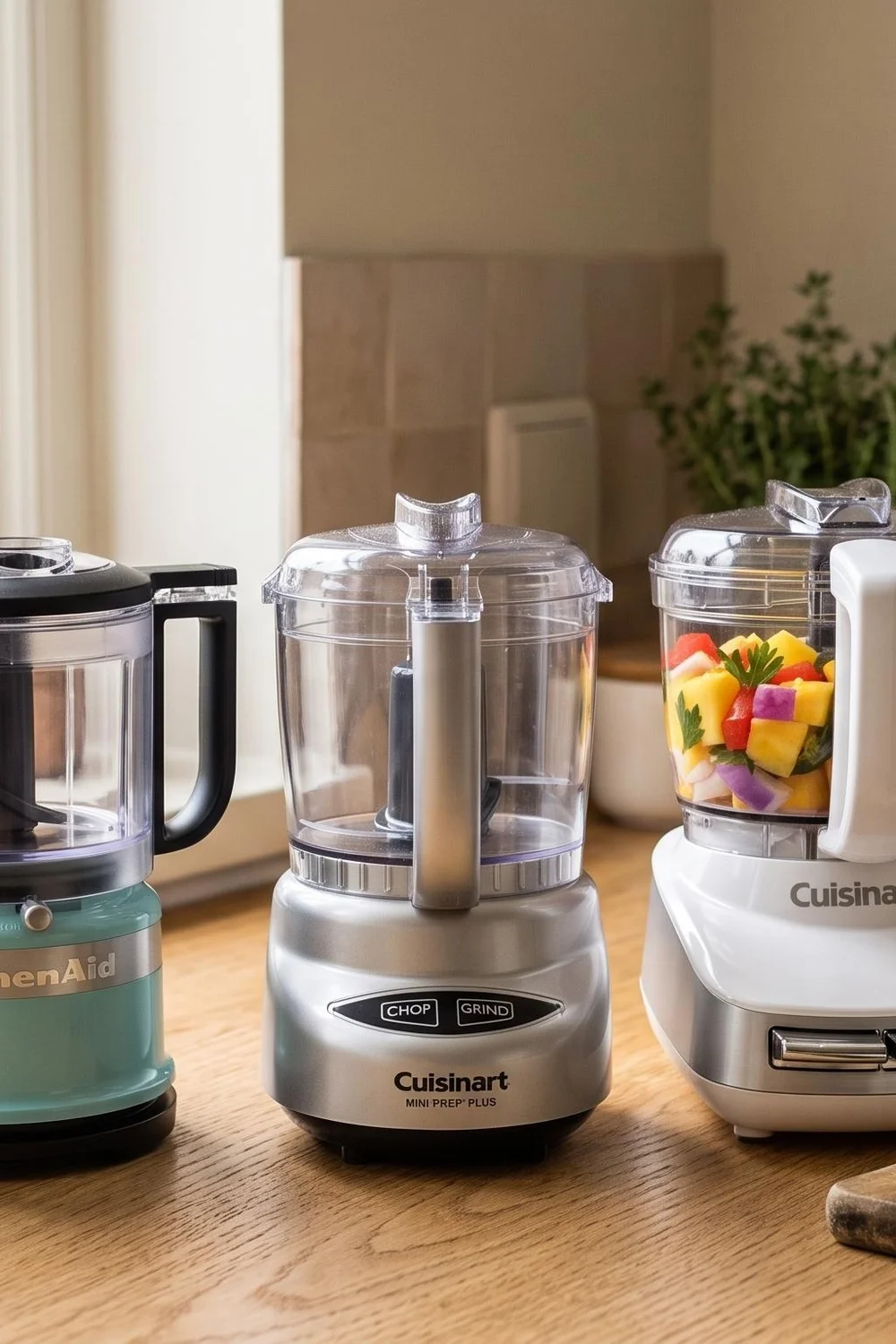
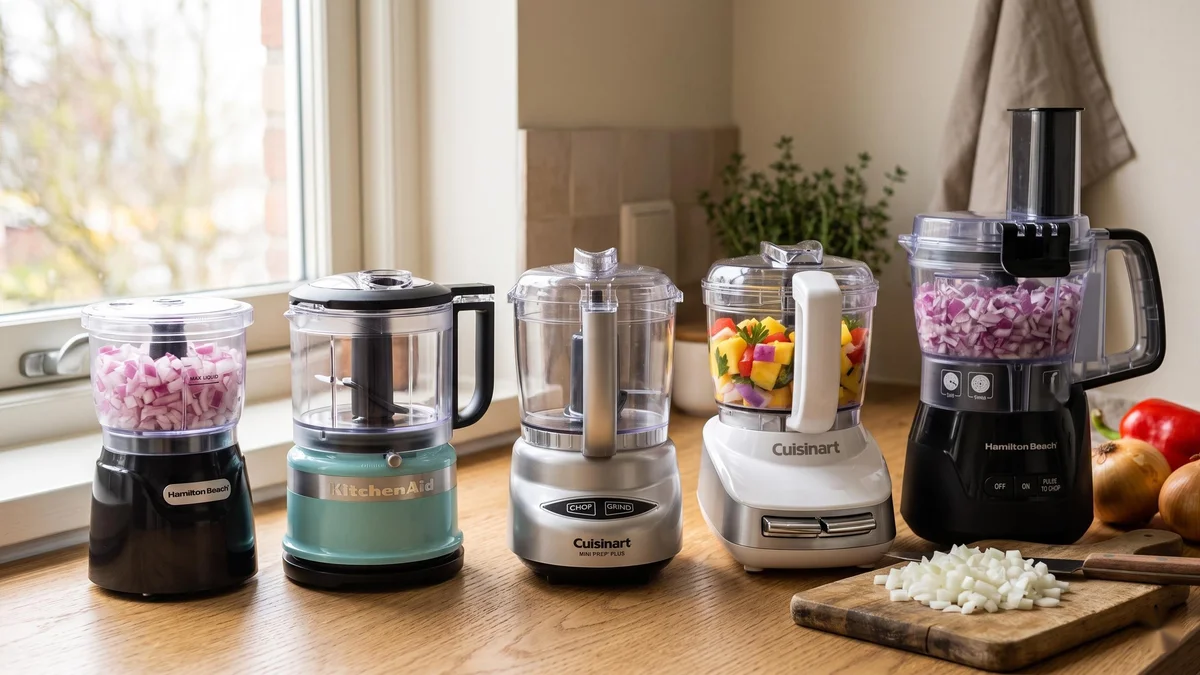
The best electric vegetable chopper is the Cuisinart Core Custom 4-Cup Mini Chopper ↗: Wirecutter’s favorite mini food processor, and the machine it steers buyers toward after testing sixteen manual choppers and declining to recommend a single one. Want the strongest tested result instead? The Hamilton Beach Stack & Snap 4-Cup was named best of the twelve minis Serious Eats put through a head-to-head. On a budget, the Hamilton Beach 3-Cup costs less than most manual choppers.
Every “electric vegetable chopper” is really a mini food processor: a small motorized bowl with a blade. We compared five on what four independent test kitchens published, with the verdict attached to each pick, alongside current specifications and prices. No brand paid for placement.
The 5 best electric vegetable choppers compared
| Rank | Model | Price (September 13, 2026)* | Capacity | Motor | Blade and speeds | Size and weight | Dishwasher-safe parts | Spare blade sold | Warranty |
|---|---|---|---|---|---|---|---|---|---|
| #1 · Our pick | Cuisinart Core Custom 4-Cup ↗ Best overall | $58.51 | 4 cups | Not published | Auto-reversing chop and grind blade | 7 × 5.2 × 9 in · 3.7 lb | Lid and bowl, top rack | Parts page, but no blade listed | 18-month limited |
| #2 | Hamilton Beach Stack & Snap 4-Cup ↗ Best tested result | $56.95 | 4 cups | Not published | Single blade, 2 speeds + pulse | 8.3 × 6 × 13.5 in · 3.5 lb | Bowl, lid and blade per listing | No | 1 year |
| #3 | Cuisinart Mini-Prep Plus 3-Cup ↗ Best small capacity | $39.95 | 3 cups | 250 W | Auto-reversing chop and grind blade | 7 × 5 × 9.3 in · 2.2 lb | Bowl, blade and lid | Yes — compatible DLC-2ACBN blade ($18.99) | 18-month limited |
| #4 | KitchenAid 3.5 Cup Food Chopper ↗ Best for herbs | see price on Amazon | 3.5 cups | 240 W per listing | Chop and puree, 2 speeds | 7 × 5.6 × 8.7 in · 2.7 lb | Bowl and lid | No | 1-year hassle-free replacement |
| #5 | Hamilton Beach 3 Cup ↗ Cheapest electric | $21.75 | 3 cups | 350 W per listing | Single stainless blade | 5.2 × 5.9 × 8.5 in · 2.1 lb | Bowl and lid | No | 1 year |
*Prices are pulled from current Amazon product data and refresh daily. Capacity, dimensions (width × depth × height) and weight come from each product listing. Warranty terms come from the manufacturers’ own documents: the Cuisinart MCH-4 and DLC-2A manuals both state an 18-month limited warranty, Hamilton Beach publishes 1 year on its spec sheets, and KitchenAid backs its choppers with a 1-year hassle-free replacement. “Not published” means the manufacturer does not state a wattage for that model, and we would rather leave the cell empty than fill it with a number nobody published.
What the test kitchens actually agree on
“Consensus” is a word roundups use to avoid showing their work. Here is the work. Four publications have ranked mini choppers, they tested different fields, and they did not reach the same answer.
| Model | Wirecutter | Serious Eats | Food & Wine | The Spruce Eats |
|---|---|---|---|---|
| Cuisinart Core Custom 4-Cup | Favorite mini food processor | One of five picks | — | — |
| Hamilton Beach Stack & Snap | — | Best mini food processor of twelve tested | — | — |
| Cuisinart Mini-Prep Plus | Named as the alternative to manual choppers | Best small-capacity mini | Best electric | Best electric |
| KitchenAid 3.5 Cup | Better than the Cuisinart at mincing herbs, worse at mayonnaise | — | — | Best mini, in their food-processor guide |
| Hamilton Beach 3 Cup | — | — | — | — |
Three things follow from that grid, and they matter more than any single ranking.
Serious Eats and Food & Wine disagree about the Cuisinart. Serious Eats tested twelve minis and put the Hamilton Beach first, filing the Mini-Prep Plus as the small-capacity choice. Food & Wine and The Spruce Eats both name the Mini-Prep Plus outright. Same machine, three different slots.
Wirecutter’s endorsement is the most consequential one, because of what it is answering. After testing sixteen manual choppers they wrote that they “can’t wholeheartedly recommend any of them,” and their reasoning is structural rather than about any one unit: the section headings run “Manual choppers are flimsy,” “They’re hard to use,” “They’re hard to clean and not really dishwasher-safe,” and “They don’t actually save you the trouble of using a knife.” Their answer is a mini food processor, and the Core Custom is the one they name. They cite its available replacement parts and its warranty as the reason it is the better value.
The cheapest model here has no test-kitchen verdict at all. Allrecipes covered the Hamilton Beach 3-cup as a shopper-favourite find, which is commerce coverage rather than a comparative test. It is in this guide on price and listing specs, and that is how it is ranked.
The best electric vegetable choppers, ranked
1. Cuisinart Core Custom 4-Cup: Best Overall
The one with the strongest published case, and the only pick backed by two publications for two different reasons. Wirecutter calls it their favorite mini food processor and reaches for it specifically as the answer to the manual-chopper problem: “Given this machine’s available replacement parts and 18-month warranty, we think it’s a better value over a manual vegetable chopper. The lid and bowl are dishwasher-safe in the top rack.” Serious Eats includes it among the five minis they recommend after their own testing.

Specs: 4 cups · auto-reversing chop and grind blade · lid and bowl dishwasher-safe, top rack · 18-month limited warranty
Pros:
- The only mini here that two separate test kitchens recommend on independent grounds.
- Four cups is enough for a full onion plus aromatics without stopping to empty the bowl.
- Cuisinart runs a parts page for this model, and Wirecutter counts its available replacement parts as part of the value. No chopping blade appears on that page, so treat parts as bowls and lids rather than blades.
Cons:
- Same brand as the Mini-Prep Plus at #3, so this guide leans Cuisinart whether you like it or not.
- No wattage published for this model, so you cannot compare it on paper to the cheaper units that do state one.
2. Hamilton Beach Stack & Snap 4-Cup: Best Tested Result
If you want the machine that beat a field rather than the machine most often listed, this is it. Serious Eats tested twelve mini food processors and named the Stack & Snap the best of them, placing it ahead of the Cuisinart Mini-Prep Plus, which they moved to the small-capacity slot. The assembly is the differentiator in daily use: the bowl stacks and snaps rather than twist-locking, which is one less alignment fight with a wet bowl.

Specs: 4 cups · single chopping blade, 2 speeds · bowl, lid and blade dishwasher-safe per the listing · stack-and-snap assembly
Pros:
- The only pick in this guide that won an outright head-to-head, against eleven rivals.
- The only non-Cuisinart four-cup here, which matters if you already own Cuisinart parts you do not want to duplicate.
Cons:
- One publisher backs it. The verdict is strong; the evidence base is narrow.
- Costs more than the Cuisinart Core Custom while carrying less cross-publication support.
3. Cuisinart Mini-Prep Plus 3-Cup: Best Small Capacity
The most-named electric chopper in the category, and the only one in this guide with a parts channel you can actually use. Food & Wine and The Spruce Eats both make it their best electric, and Serious Eats keeps it as their small-capacity pick. The Spruce Eats reported it made short work of onions, peppers, carrots, tomatoes, mushrooms and garlic. The 250-watt motor is the only figure Cuisinart publishes for it, and the reversible blade chops on one edge and grinds on the other.

Specs: 3 cups · 250 W · auto-reversing chop and grind blade · bowl, blade and lid dishwasher-safe · 18-month limited warranty · compatible DLC-2ACBN blade sold separately ($18.99)
Pros:
- Named best electric by two publications and kept as a pick by a third.
- The spare blade exists. Every other machine in this guide, and every manual chopper in our main comparison, is a single unit you replace whole.
- The cheapest Cuisinart route into the category.
Cons:
- Three cups fills fast. Serious Eats moved it out of their top slot on capacity grounds.
- The blade flip is a two-hand operation with a sharp part, which undoes some of the hands-free advantage.
4. KitchenAid 3.5 Cup Food Chopper: Best for Herbs
The only pick here chosen for a specific task rather than an overall verdict. Wirecutter put it directly against the Cuisinart and split the result: it “outperformed the Cuisinart at mincing herbs, but it underperformed at making mayo.” If a large share of your chopping is parsley, basil and cilantro, that is a real reason to pick it. If you want an emulsifier, it is a reason not to.

Specs: 3.5 cups · 240 W per the listing · chop and puree, 2 speeds · bowl and lid dishwasher-safe
Pros:
- The one documented task-level advantage in this field, from a head-to-head rather than a spec sheet.
- Two speeds instead of a blade you flip.
Cons:
- The most expensive pick in this guide by a wide margin. The colour variants the reviews point to are not currently sold at a price we can quote, and the variant that is available lists well above the figure those reviews showed.
- Wirecutter’s own comparison marks it down on emulsifying, so it is a specialist rather than an all-rounder.
5. Hamilton Beach 3 Cup: Cheapest Electric
The pick that breaks the assumption this whole category runs on. Electric is supposed to be the upgrade you pay for and manual the budget option. This machine costs less than most of the manual choppers in our main comparison, including our own. Allrecipes covered it as an inexpensive shopper favourite; no test kitchen has ranked it, and this guide does not pretend otherwise. The listing states 350 watts, the highest claimed figure here, which is a good illustration of why wattage is the wrong thing to shop on.
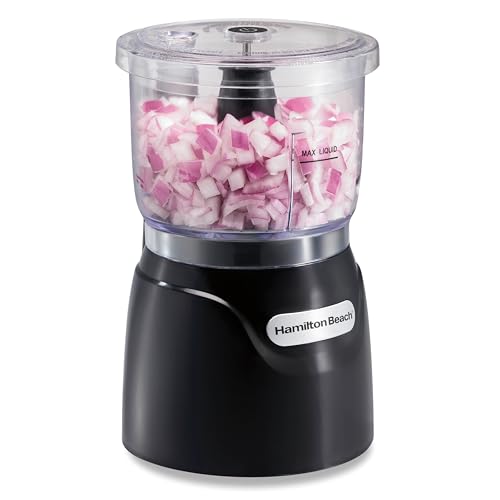
Specs: 3 cups · 350 W per the listing · single stainless blade · bowl and lid dishwasher-safe
Pros:
- Cheapest route out of manual chopping, at a price below most manual choppers.
- Same three-cup capacity as the Cuisinart Mini-Prep Plus at a fraction of the price.
Cons:
- No comparative test verdict exists for it. Shopper coverage is not a tested result and we are not going to dress it up as one.
- One speed, one blade, no spare parts.
What an electric chopper costs to run
Two costs get asserted in this category and neither usually gets checked: electricity, and what happens when the blade dulls. Both are computable, so here is the arithmetic rather than a range.
Electricity. The Mini-Prep Plus draws 250 watts, per Cuisinart. Run it five minutes a day and that is 0.25 kW × 5/60 = 0.0208 kWh a day, or 7.6 kWh across a year. The EIA puts the US residential average at 18.44 cents per kWh for May 2026, so that is $1.40 a year and $7.01 over five years. Per use it is under four tenths of a cent. Your state changes the answer by less than you would think: at New Mexico’s 8.07 cents the five-year figure is about $3.07, at Rhode Island’s 26.71 cents about $10.15.
The blade. This is the cost that actually separates the machines, and it turns on part numbers rather than brand. A compatible DLC-2ACBN blade for the Mini-Prep Plus is a listed part ($18.99). It does not carry across the range: Cuisinart’s own CH-4CB blade states it fits the CH-4, CH-4BK and CH-4DC only, and no blade is listed on the Core Custom’s parts page. For the other four electric choppers here, and for every manual chopper in our main comparison, no spare blade is sold: the replacement part is the whole unit. Mueller’s own spare-parts store stocks six items and none of them fits a chopper. Wirecutter reached the same conclusion in its manual-chopper review.
Put together, as a worked example dated August 2026 so you can see where each number comes from: the Mini-Prep Plus at $39.95 costs $41.35 to own for a year including electricity, and $65.95 across five years if you replace the blade once at $18.99 in year three. The Mueller Pro-Series manual chopper at $26.99 costs $26.99 across five years, because there is nothing to buy, and nothing you can buy when the blade goes. That is a 2.4× difference in five-year cost, and it buys a machine that is still serviceable at the end of it.
The year-three blade is our convention, not a finding. Nobody publishes a blade-dulling interval for this category, and we are not going to invent one.
Which electric chopper fits your kitchen
| If this is you | Pick | Why |
|---|---|---|
| You want the safest choice and no research | Cuisinart Core Custom 4-Cup | Two publications back it on independent grounds, and it is Wirecutter’s answer to the manual-chopper problem |
| You want the model that won a test | Hamilton Beach Stack & Snap | Beat eleven rivals in Serious Eats’ testing |
| You cook for one or two, and store small | Cuisinart Mini-Prep Plus | Three cups, the smallest footprint here, and the only buyable spare blade |
| You mince a lot of herbs | KitchenAid 3.5 Cup | The only documented task advantage in this field, from a direct comparison |
| You want out of manual chopping cheaply | Hamilton Beach 3 Cup | Costs less than most manual choppers, with the evidence caveat stated above |
| Grip strength or one-handed use is the reason | Any of them over a manual | Wirecutter’s testers with limited dexterity preferred mini processors without exception |
When an electric chopper is the wrong buy
An honest guide has to name the cases where the answer is no.
If your chopping is a single onion before dinner, a knife is faster than washing a motor base, a bowl, a lid and a blade. Cookware Junkies put the time at roughly thirty seconds per onion with a knife and treated cleanup as the deciding factor against choppers generally. A mini processor does not change that arithmetic.
If you need slicing, shredding or dough, none of these machines will do it. They are three to four cup bowls with a chopping blade. A full-size food processor starts at seven cups and adds discs.
If counter or cupboard space is the binding constraint, a manual chopper wins on volume and on parts count. Every electric here has a motor base you cannot submerge.
And if what you actually want is uniform dice rather than speed, both of the test kitchens that pushed hardest on this category ended up unenthusiastic about the whole idea. Wirecutter’s verdict after sixteen manual units was that they could not recommend any of them, and their alternative is the mini processor, but a mini processor chops unevenly by design, because a spinning blade cuts whatever reaches it. If you want even cubes for a mirepoix, that is a knife job, and no machine in this guide is a substitute.
Frequently asked questions
What is the best electric vegetable chopper?
The Cuisinart Core Custom 4-Cup Mini Chopper has the strongest published backing. Wirecutter calls it their favorite mini food processor, and it is the machine they point buyers toward after concluding they could not wholeheartedly recommend any of the sixteen manual choppers they tested. Serious Eats also lists it among their five picks. If you want the model that won a head-to-head test outright, Serious Eats crowned the Hamilton Beach Stack & Snap after testing twelve minis.
How many watts does an electric vegetable chopper need?
Less than the marketing suggests. The Cuisinart Mini-Prep Plus runs a 250-watt motor and handles onions, peppers, carrots, tomatoes, mushrooms and garlic, and the KitchenAid 3.5-cup listing states 240 watts across two speeds. Wattage is a poor proxy for results anyway: none of the test kitchens that ranked these machines ranked them by motor power, and the model with the highest claimed figure in this guide is also the cheapest.
Is an electric chopper better than a manual one?
For hard vegetables, big batches and hands-free work, yes. Wirecutter’s paid test panel, which included testers with limited dexterity, limb differences and wheelchair users, preferred mini food processors to manual choppers without exception. Manual choppers still win on price, silence, counter space and the number of parts to wash.
What does it cost to run an electric chopper?
About a dollar and a half a year. A 250-watt motor run five minutes a day uses 7.6 kilowatt-hours over a year, which is $1.40 at the US residential average of 18.44 cents per kilowatt-hour reported by the EIA for May 2026. That is under four tenths of a cent per session. Electricity is not the cost that matters here; the purchase price and whether spare parts exist are.
Can you buy replacement blades for an electric chopper?
For one model in this guide. Cuisinart sells parts for the Mini-Prep Plus, and compatible DLC-2ACBN blades are listed on Amazon. Wirecutter cites available replacement parts as part of why a mini food processor is a better value than a manual chopper. No spare blade is sold for the other four models here, and none is sold for the Mueller, Kuhn Rikon, OXO pump or Cambom manual choppers either.
What is the difference between an electric chopper and a food processor?
Size and ambition, not mechanism. Every electric chopper in this guide is a mini food processor: a motor base, a bowl of three to four cups, and a blade. A full-size processor takes seven to fourteen cups and adds slicing and shredding discs. If a recipe asks you to process a whole batch of dough or shred a block of cheese, the mini will not do it.
This guide covers the electric half of the category. For the manual choppers, the combined ranking and the type-by-type decision, see our best vegetable chopper comparison.