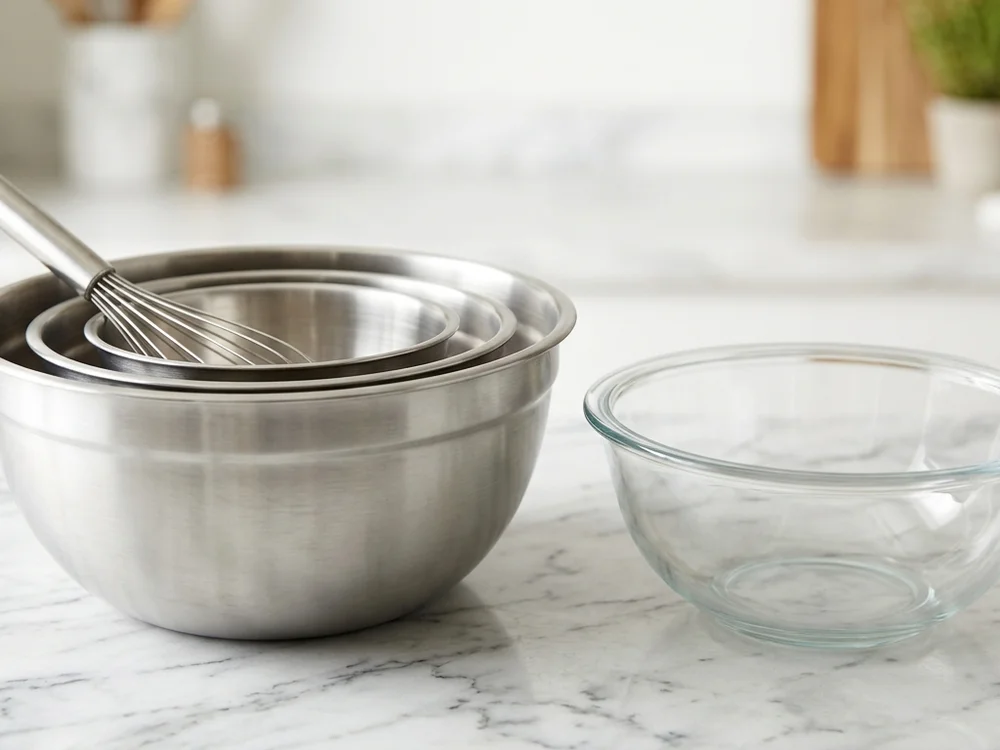
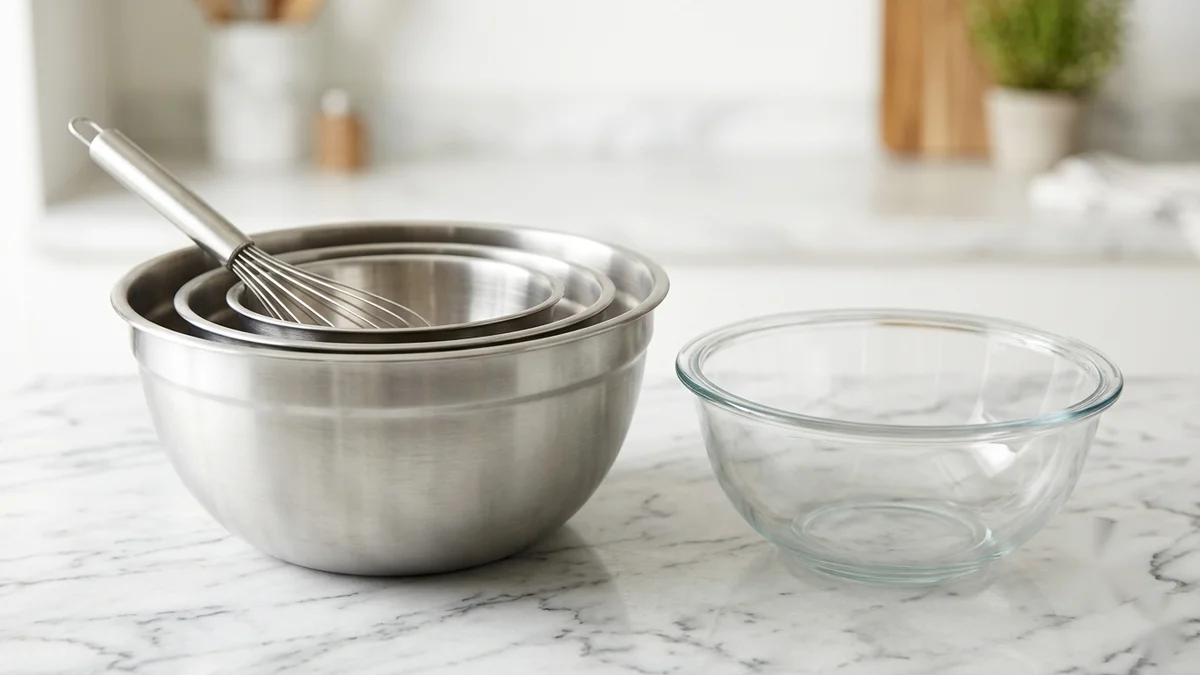
The best mixing bowls for most kitchens are the Cuisinart Stainless Steel Mixing Bowls with Lids ↗, the 3-piece set that three separate test kitchens independently rank first, at $38.99. Light stainless, three nesting sizes, and included lids that turn mixing bowls into storage. If you whisk one-handed, the OXO Good Grips set adds rubber-coated bases that grip the counter, and the Vollrath 5-quart, a restaurant-supply bowl at $17.99, is the pro-grade bargain of the category.
We ranked these seven: the top five from the published, hands-on findings of seven independent editorial tests, plus two additions from reader search data that rank on Amazon listing data alone. We name the source for every verdict below.
The Best Mixing Bowls, Compared
Product names link to the current Amazon listing.
| Rank | Bowl set | Price (September 20, 2026)* | Material | Pieces / Lids | Size and weight |
|---|---|---|---|---|---|
| #1 · Our pick | Cuisinart Stainless with Lids ↗ Best overall | $38.99 | Stainless steel | 3 bowls (1.5/3/5 qt) + 3 lids | 10.5 × 10.5 × 10.5 in · 3.9 lb |
| #2 | OXO Good Grips 3-Piece ↗ Best grip | $69.49 | Stainless, rubber base | 3 bowls (1.5/3/5 qt), no lids | 11.2 × 11.2 × 11.9 in · 3.6 lb |
| #3 | Vollrath 47935 5-Quart ↗ Best pro-grade value | $17.99 | Stainless steel | Sold per bowl (0.75 to 8 qt line) | 11.8 × 11.8 × 5.0 in · 0.6 lb |
| #4 | Pyrex Smart Essentials 8-Piece ↗ Best glass | see price on Amazon | Tempered glass | 4 bowls (1/1.5/2.5/4 qt) + 4 lids | 13.6 × 13.2 × 5.8 in · 10.7 lb |
| #5 | JoyJolt 6-Piece ↗ Best value set | currently unavailable | Stainless steel | 6 bowls, up to 5 qt | 11.2 × 11.2 × 9.4 in · 1.9 lb |
| #6 | Tovolo Stainless Set of 4 ↗ Biggest capacity | $39.99 | Stainless steel | 4 bowls (1.5–7.5 qt) | 11.1 × 11.1 × 7.1 in |
| #7 | Rosti Margrethe with Lids ↗ Design classic | $49.99 | DuRostima plastic | 2 bowls + 2 lids | 22.5 × 22.5 × 18.0 in · 2.2 lb |
*Prices checked September 20, 2026 and change often; check the live listing. Dimensions and weights come from each product’s current Amazon listing data; an em dash means the listing does not publish that figure.
What the Test Kitchens Agreed On
We compared seven independent editorial reviews: Serious Eats (which baked a dozen cakes and whipped quarts of cream across its lineup), America’s Test Kitchen, Wirecutter, The Spruce Eats, Food and Wine, Allrecipes, and Forbes Vetted. Between them, those tests scooped 200 cookies, cracked more than 60 eggs, baked a dozen cakes, and covered 13 bowl sets at Wirecutter alone since 2015. Four findings repeat.
The Cuisinart lidded stainless set is the closest thing to a consensus winner. Wirecutter calls it the best for most whisking, folding, and mixing needs. Allrecipes made it its top pick. Forbes Vetted named it best overall. No other bowl set collected three independent first-place verdicts.
Stainless wins the material argument, with one glass exception. Serious Eats’ conclusion after testing glass, ceramic, bioplastic, and stainless was that each material can make a great bowl, but the working picks across every publication skew heavily stainless: light, unbreakable, non-reactive. The recurring glass exception is Pyrex, the named glass pick at The Spruce Eats and Forbes Vetted, because tempered glass adds microwave duty that metal cannot.
Weight matters more than shoppers expect. America’s Test Kitchen crowned the restaurant-supply Vollrath Economy line its best metal mixing bowl and made a point of the reason: the bowls were the lightest in its lineup, which is what your arm notices halfway through a batch of dough.
Stability features earn their keep. ATK highlighted the OXO set’s rubber-coated bases for the extra stability they add on the counter, and Food and Wine’s favorite, the Viking set, won on the same logic: skid-proof bottoms, helper handles, and lids.
Which Mixing Bowls Did America’s Test Kitchen, Wirecutter, and Serious Eats Pick?
The seven reviews do not crown one universal winner. Each publication made its own call, and every call below is drawn from the findings already cited above.
| Publication | Its mixing bowl verdict | Where it lands in this guide |
|---|---|---|
| America’s Test Kitchen | Vollrath Economy: best metal bowl, the lightest in its lineup | #3, best pro-grade value |
| Wirecutter | Cuisinart lidded stainless set: best for most whisking, folding, and mixing | #1, best overall |
| Serious Eats | No single winner: glass, ceramic, and stainless can each make a great bowl | Material matrix below |
| The Spruce Eats | OXO Good Grips best overall; Pyrex for glass | #2 and #4 |
| Food and Wine | Viking 10-piece: skid-proof bottoms, helper handles, lids | Also worth knowing |
| Allrecipes | Cuisinart top pick; JoyJolt best value | #1 and #5 |
| Forbes Vetted | Cuisinart best overall; Pyrex Smart Essentials for glass | #1 and #4 |
Two secondary calls matter too. America’s Test Kitchen also highlighted the rubber-coated bases on the OXO set for the stability they add, and Serious Eats praised the All-Clad bowls for pouring cleanly, though that set had no reliable first-party Amazon listing at press time.
America’s Test Kitchen’s pick is the Vollrath Economy, Wirecutter’s is the Cuisinart lidded set, and the Cuisinart is the only bowl that took first place at three separate publications.
The 7 Best Mixing Bowls
1. Cuisinart Stainless Steel Mixing Bowls with Lids: Best Overall

The Cuisinart Stainless Steel Mixing Bowls with Lids win on the strength of agreement: Wirecutter judges the set best for most whisking, folding, and mixing needs, Allrecipes makes it its top pick, and Forbes Vetted names it best overall. Three nesting sizes cover the classic small-medium-large spread, the stainless is light enough to hold one-handed while folding, and the included lids are the sleeper feature: mix, lid, refrigerate, no transfer.
At $38.99 for three bowls and three lids, it also undercuts most premium single bowls. For an only-set kitchen, this is the default answer.
Pros:
- First-place verdicts from three independent test kitchens
- Lids included: the mixing bowl doubles as the storage container
- Light, nesting, dishwasher-safe stainless
Cons:
- No non-slip base; it can wander under hard one-handed whisking
- Lids are plastic and eventually outlive their snap
2. OXO Good Grips 3-Piece Stainless Steel: Best Grip

The OXO Good Grips 3-Piece set solves the one problem the winner has: bowls that skate. Its rubber-coated bases plant the bowl on the counter, which America’s Test Kitchen highlighted as adding extra stability, and The Spruce Eats went further, naming this set best overall after its side-by-side testing. The wide, gently flared shape is comfortable for whisking at an angle, and the brushed stainless interior cleans without fuss.
The price at $69.49 is the steepest of the stainless sets here, and there are no lids. You are paying for the grip and the ergonomics; for bakers who whisk one-handed and pour with the other, that trade is worth it.
Pros:
- Rubber-coated non-slip bases; the steadiest bowls in this guide
- A best-overall verdict from one major test kitchen and a stability call-out from another
- Comfortable flared shape for angled whisking
Cons:
- Most expensive stainless set here, with no lids included
- Coated bases prefer the top rack; harsh dishwasher heat ages them
3. Vollrath 47935 5-Quart Economy: Best Pro-Grade Value

The Vollrath Economy line is what restaurant kitchens actually use, and America’s Test Kitchen crowned it the best metal mixing bowl with a telling detail: these were the lightest bowls in its lineup. Light is the point. A bowl you lift, tilt, scrape, and rinse fifty times a week should weigh as little as possible, and the beaded-rim Vollrath does while still shrugging off dents.
It sells per bowl rather than as a set: the 5-quart here runs $17.99, and smaller and larger sizes are listed alongside it, so you build exactly the spread you want. No lids, no rubber base, no color: just the best working bowl per dollar in the category.
Pros:
- A major test kitchen’s best-metal winner, and the lightest bowl it tested
- Restaurant-supply price: build a custom 3-bowl spread for the cost of one retail set
- Beaded rim adds stiffness without adding weight
Cons:
- Sold per bowl; assembling a set takes three purchases
- Thin gauge dents if you treat it like a drum
4. Pyrex Smart Essentials 8-Piece: Best Glass
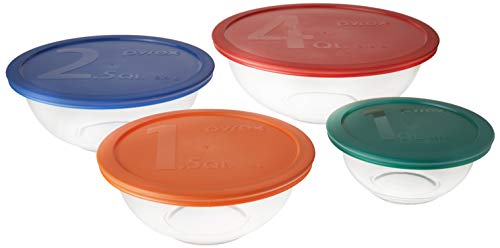
Glass earns its cabinet space the moment a recipe says “microwave in 30-second bursts.” The Pyrex Smart Essentials 8-Piece set, four tempered-glass bowls with four locking lids, is the consensus glass pick: The Spruce Eats names Pyrex its best glass mixing bowl and Forbes Vetted picks the Smart Essentials line by name. Tempered glass will not stain, will not hold garlic odors, and lets you see the bottom of the mix, and these bowls run microwave, freezer, and dishwasher without complaint.
At see price on Amazon for eight pieces it is fairly priced for glass with lids. Glass is glass: the set is the heaviest here, and a drop onto tile ends differently than it does for steel. Availability fluctuates, so check the live listing.
Pros:
- The consensus glass pick across two named rankings
- Two-year limited warranty that covers manufacturing defects, rare in this category
- Microwave, freezer, and dishwasher safe; locking lids included
- Stain-proof and odor-proof, with full visibility while mixing
Cons:
- The heaviest bowls in this guide, and droppable
- Stock comes and goes; verify the live listing
5. JoyJolt 6-Piece Stainless: Best Value Set
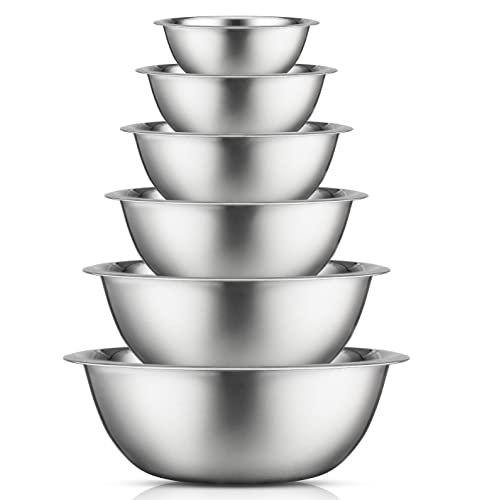
The JoyJolt 6-Piece set is the volume play: six stainless bowls nesting from half a quart to five quarts at currently unavailable, about the price of a single premium bowl. Allrecipes named it the best value in its five-model test, and the six-size spread is genuinely useful, covering mise en place cups at the small end and dough work at the large end.
The gauge is thinner than the Cuisinart and the finish is more utilitarian, which is exactly how a $22 six-bowl set should read. As a first full kit for a new kitchen, or a backup fleet for a serious one, it is the easy pick. Stock ran low when we checked prices, so confirm the listing.
Pros:
- Six sizes for the price of one premium bowl
- A named best-value verdict from an editorial test
- Nests into a single cabinet slot
Cons:
- Thinner steel than the picks above; treat it gently
- Low stock at press time; check the live listing
6. Tovolo Stainless Set of 4: Biggest Capacity

The Tovolo Stainless Set of 4 is the capacity play, and it enters this ranking on listing data alone: none of the seven reviews we compared tested it. The four sizes run 1.5, 3.5, 5.5, and 7.5 quarts, and that last one matters. No other set here goes past 5 quarts, so the 7.5-quart XL is the bowl for double batches of dough, brining, and party-scale salads. The listing also credits a rolled rim for controlled pouring, deep walls that keep flour contained, and steel light enough for one-handed use but rated for electric mixers and double-boiler duty.
At $39.99 for four bowls, with no lids and no rubber base, what you buy here is size range.
Pros:
- The biggest stated capacity in this guide: a 7.5-quart XL
- Rolled rim designed for controlled pouring, per the listing
- Mixer-safe and double-boiler-safe, dishwasher safe
Cons:
- No lids, no non-slip base
- No editorial verdict behind it; this slot rests on product data
7. Rosti Margrethe with Lids: Design Classic

The Rosti Margrethe is the set people search for by name, and like the Tovolo it ranks here on listing data, not an editorial verdict. Two Danish-design bowls (2 and 3 liters) come with lids, a non-slip base ring, and the feature no other ranked set offers: a built-in pour spout. For pancake and crepe batters that go bowl-to-pan, that spout is the whole argument.
The material is the trade-off. The bowls are DuRostima plastic, dishwasher safe per the listing, and every plastic caveat from the material matrix above applies: scratches, stains, and grease films are how plastic bowls age. At $49.99 for two bowls, you are paying for the design and the spout, and you should do it knowingly.
Pros:
- The only ranked set with a built-in pour spout
- Lids and a non-slip base ring included
- Danish design that people search for by name
Cons:
- Plastic, with all the material caveats above
- Two bowls only, and no editorial verdict behind the slot
Also worth knowing
Two reviewer favorites did not make the ranked table. The Viking 10-piece set, Food and Wine’s favorite for its durability, skid-proof bottoms, lids, and helper handles, listed at $94.88, though its availability keeps fluctuating. The All-Clad Stainless Mixing Bowls, which Serious Eats praised for pouring cleanly and for surprisingly helpful handles, showed no reliable first-party Amazon listing at press time. Tovolo also sells a 7-quart XL single bowl ↗ at $20.99, dishwasher safe per its listing, for kitchens that only want the big one. Several models the test kitchens dismissed are worth naming so you can skip them deliberately: Wirecutter found the FineDine and Winco budget sets thin enough to dent in normal use, and the Duralex glass set tops out at 3.5 quarts, too small to whip cream without redecorating the counter. On the flip side, Serious Eats keeps two specialists on its list that we left unranked: the Mason Cash In the Meadow ceramic set, a 10-pound showpiece that doubles as serveware and is oven-safe to 320°F, and the Bamboozle bioplastic set for tiny kitchens. Corning shows up in searches as well; we could not find a current first-party CorningWare mixing-bowl listing to track, and the tempered-glass job in this guide is already covered by the Pyrex set.
Should You Buy a Mixing Bowl Set or Single Bowls?
Six of the seven picks sell as sets. The Vollrath is the exception, sold per bowl, and that difference is the whole decision.
A set fills an empty cabinet in one purchase. The classic 3-piece spread, roughly 1.5, 3, and 5 quarts, covers eggs and dressings, batters, and doughs, and it nests into a single cabinet slot. Buying per bowl means you pay only for the sizes you actually use, at restaurant-supply prices that run a fraction of retail-brand sets.
| Route | Pick from this guide | Why |
|---|---|---|
| One-purchase set | Cuisinart 3-piece, $38.99 | Small-medium-large spread plus lids |
| Budget-friendly set | JoyJolt 6-piece, currently unavailable | Six sizes for the price of one premium bowl |
| Single bowls | Vollrath Economy, $17.99 for the 5-quart | Build a custom spread in only the sizes you reach for |
The per-quart math favors open stock. The Cuisinart’s three bowls total 9.5 quarts and the Tovolo’s four total 18, so divide the live price in the table by those figures to compare routes; a single restaurant-supply bowl usually wins on that arithmetic. Vollrath’s Economy line runs from 0.75 to 8 quarts sold individually, and Wirecutter’s custom-set recommendation, the Thunder Group standard-weight line, stretches from three-quarters of a quart to a commercial 20 quarts for a few dollars a bowl at restaurant-supply stores, with one caveat: shipping can eat the savings if you order bowls one at a time.
If you want the smallest possible first purchase, start with a single Vollrath 5-quart. It handles doughs, salads, and doubled recipes on its own, and you add smaller sizes later as the need shows up.
An empty cabinet wants a set; a kitchen that already knows its habits wants single Vollrath bowls in exactly the sizes it uses.
Glass, Stainless, or Plastic: Which Mixing Bowl Material Should You Buy?
Serious Eats tested glass, ceramic, bioplastic, and stainless side by side and concluded that every material can make a great bowl, with different tradeoffs. The practical matrix:
| Material | Weight | Microwave | Breakable | Best at |
|---|---|---|---|---|
| Stainless steel | Lightest | No | No | Everyday mixing, whipping, chilling fast |
| Tempered glass | Heaviest | Yes | Drop-risk | Microwave workflows, visible layers, serving |
| Plastic / bioplastic | Light | Varies | No | Budget and kids, until it scratches |
Stainless takes the default slot because it does the most with the fewest caveats: non-reactive, unbreakable, featherweight in pro-supply versions like the Vollrath. Glass is the specialist that earns a slot beside the steel, not instead of it. Plastic is where the category’s problems live: scratches that stain and hold odors, plus grease films that can sabotage whipped egg whites. Buy it knowingly or skip it.
How Bowl Shape Changes the Job
Material gets the attention, but the test kitchens’ quieter finding is that geometry decides how a bowl behaves. Three shape rules repeat across their results:
- A thin, flared rim pours cleanly. Serious Eats found thin, flared rims were the difference between a controlled stream and batter down the side of the bowl. Thick rolled lips look sturdy but dribble.
- Depth trades splatter for folding room. Deep, narrow bowls contain a hand mixer on high; wide, shallow bowls give a spatula room to fold. Wirecutter runs a deliberate splatter test with a hand mixer at full speed for exactly this reason, and its genoise comparison came down to fractions: one finalist’s cake rose an eighth of an inch shorter than another’s.
- The base decides stability. A flat, wide base or a grippy bottom keeps the bowl planted during one-handed whisking. Wirecutter goes as far as tossing two cups of cereal around 4-, 5-, and 8-quart bowls and counting what escapes. One caveat on rubber-bottom bowls: the seam where rubber meets steel can trap water and grime, which is why some testers reject them outright and why the OXO’s cons list mentions hand-washing.
One more geometry check that never appears on listings: if you make custards or melt chocolate, your 4-to-5-quart bowl should sit stably in a 2-quart saucepan as a double boiler. Wide restaurant-supply bowls like the Vollrath pass; tall narrow sets often do not.
What Size Mixing Bowl Do You Actually Need?
Capacity guidance from the test kitchens maps cleanly onto three size slots:
| Size | What it actually handles | Ranked pick that covers it |
|---|---|---|
| 2 to 3 qt | Dressings, marinades, whisking a few eggs, dry ingredients | The small bowls in the Cuisinart, OXO, and Pyrex sets |
| 5 qt | Cake batters and cookie dough with a hand mixer, plus the headspace that keeps flour in the bowl | Cuisinart and OXO large bowls, Vollrath 5-quart |
| 7 qt and up | Potato salad, coleslaw, stuffing, bread dough rising to double volume | Tovolo 7.5-quart XL |
For a small household, 3 to 4 quarts covers most days and 5 quarts covers baking; you only need the 7-quart class if you cook for crowds or proof bread. The mistake to avoid is buying only the photogenic middle size: batter needs roughly twice its volume in headspace once a hand mixer starts moving, which is why the 5-quart slot, not the 3-quart, does most of the real mixing work.
Best Mixing Bowls with Lids: Which Picks Include Them?
Three of the seven ranked picks include lids: the top stainless pick, the top glass pick, and the plastic design classic.
| Bowl set | Lids included | Detail |
|---|---|---|
| Cuisinart Stainless with Lids | Yes, 3 | One plastic snap-on lid per bowl |
| Pyrex Smart Essentials | Yes, 4 | Locking lids on all four glass bowls |
| OXO Good Grips 3-Piece | No | You pay for grip, not storage |
| Vollrath Economy | No | Bare restaurant-supply bowl |
| JoyJolt 6-Piece | No | Six bowls, no lids |
| Tovolo Set of 4 | No | Four bowls, sized for capacity, not storage |
| Rosti Margrethe | Yes, 2 | Lids on both bowls, plus a pour spout |
Lids matter when what you mix goes straight into the refrigerator. Nothing gets decanted into a second container, and nothing gets wrapped. If that is your workflow, the decision is short: the Cuisinart set for light stainless that chills fast, the Pyrex set when the same bowl also needs microwave duty, and the Rosti set when a pour spout matters too. One caveat from the Cuisinart cons applies here: the lids are plastic, and the snap fit wears out over time. The Viking 10-piece, Food and Wine’s favorite, also ships with lids, but its availability fluctuated when we checked.
For a lidded set: Cuisinart for stainless, Pyrex for microwave-safe glass, Rosti when you also want the spout.
Which Mixing Bowls Should You Buy?
- For most kitchens: the Cuisinart Stainless with Lids is the best mixing bowl set overall, three test kitchens deep in first-place verdicts.
- For one-handed whisking: the OXO Good Grips set is the best non-slip mixing bowl set, with rubber bases that hold the counter.
- For a pro-style kitchen on a budget: the Vollrath Economy line is the best restaurant-grade mixing bowl, the lightest metal bowl in its test-kitchen ranking.
- For microwave meal prep: the Pyrex Smart Essentials set is the best glass mixing bowl set, tempered glass with locking lids.
- For outfitting a first kitchen: the JoyJolt 6-piece is the best budget mixing bowl set, six sizes for the price of one premium bowl.
- For oversized batches: the Tovolo set’s 7.5-quart XL covers double doughs and brining that 5-quart bowls cannot.
- For pouring batters: the Rosti Margrethe is the only ranked set with a built-in pour spout.
- For baking days: pair the big stainless bowl with a salad spinner for greens and a vegetable chopper for the mirepoix, and prep stops being the slow part.
How We Sourced This Ranking
We did not run our own mixing test. This ranking weighs the published, hands-on findings of Serious Eats (which baked a dozen cakes and whipped quarts of cream across its test field), America’s Test Kitchen, Wirecutter, The Spruce Eats, Food and Wine, Allrecipes, and Forbes Vetted, then checks them against current Amazon product data for specs, prices, and availability, captured September 20, 2026. Amazon’s data feed does not publish star ratings or review counts, so none appear here, and we never invent test results. The top five slots rank on those aggregated verdicts; the #6 and #7 slots, added in August 2026 from reader search data, carry no verdict from the seven publications and rank on Amazon listing data alone, and each entry says so.
Frequently Asked Questions
What is the best type of mixing bowl?
Stainless steel for most kitchens. It is light, unbreakable, reacts with nothing you mix in it, and takes hot or ice-cold contents without complaint, which is why most test-kitchen winners are stainless. Glass earns its place when you want to microwave in the bowl or see layers as you work, and Serious Eats’ testing concluded that glass, ceramic, and stainless can all make great mixing bowls, each with tradeoffs.
What mixing bowls do professional cooks use?
Mostly plain, light stainless restaurant-supply bowls like the Vollrath Economy line. America’s Test Kitchen crowned Vollrath its best metal mixing bowl, noting the bowls were the lightest in its lineup. Pro kitchens buy them per bowl in whatever sizes the station needs, and they cost a fraction of retail-brand sets.
Is glass or stainless steel better for mixing bowls?
Stainless is better for everyday mixing: it is lighter, it cannot shatter, and it chills fast for whipping cream. Glass is better when the bowl doubles as cookware or serveware: it goes in the microwave, it does not stain or hold odors, and you can watch a batter come together through the side. Many well-equipped kitchens keep one of each.
Are plastic mixing bowls safe to use?
Generally yes for cold and room-temperature work, but they come with real limits: plastic scratches, and scratched surfaces stain, hold odors, and shed microplastic over time. Plastic also holds onto grease films that can deflate whipped egg whites. If you mix hot foods, whip meringues, or want bowls that last decades, stainless or glass is the safer long-term buy.
What size mixing bowls do you actually need?
Three sizes cover nearly everything: a small bowl around 1.5 quarts for whisking eggs and dressings, a middle bowl around 3 quarts for batters, and a large bowl of 5 quarts or more for doughs, salads, and doubling recipes. That is exactly the spread the 3-piece Cuisinart and OXO sets nest into one cabinet slot.
Are mixing bowl lids worth it?
Yes, if you meal prep or refrigerate anything you mix. Lids turn the mixing bowl into the storage container, which saves a transfer, a wash, and a strip of plastic wrap. In this guide the Cuisinart stainless, Pyrex glass, and Rosti Margrethe sets include lids, and testers consistently flag lids as the feature that keeps a set in daily rotation.
Do non-slip bases on mixing bowls matter?
They matter most when one hand is pouring and the other is whisking. A rubber or silicone base keeps the bowl planted instead of skating across the counter, which is why America’s Test Kitchen highlighted the rubber-coated bases on the OXO set for extra stability. The tradeoff: coated bases usually should stay out of the dishwasher’s bottom rack heat.
Can you put stainless steel mixing bowls in the microwave?
No. Metal reflects microwaves and can arc, so stainless bowls stay out of the microwave. If bowl-to-microwave is part of your workflow, that is the single strongest reason to pick tempered glass like the Pyrex set, which is microwave, freezer, and dishwasher safe.
Why do restaurant kitchens use cheap stainless bowls instead of fancy sets?
Because for a working kitchen the cheap bowl is the better tool: lighter to lift all day, stackable in bulk, indestructible, and replaceable for a few dollars. Weight is the surprise: premium heavy bowls tire your arm, while the pro-supply Vollrath line won its test-kitchen ranking partly by being the lightest metal bowl tested.
What mixing bowls does America’s Test Kitchen recommend?
America’s Test Kitchen named the Vollrath Economy line its best metal mixing bowl, and weight decided the verdict: Vollrath’s bowls were the lightest ATK tested. ATK also gave a stability call-out to the OXO Good Grips set, whose rubber-coated bases keep the bowl planted on the counter. Both rank in this guide, the Vollrath as best pro-grade value and the OXO as best grip.
Which mixing bowls does Wirecutter recommend?
Wirecutter’s pick is the Cuisinart Stainless Steel Mixing Bowls with Lids, which it judges best for most whisking, folding, and mixing needs. Allrecipes and Forbes Vetted independently reached the same first-place verdict, which is why the Cuisinart set ranks number one in this guide. It is the only set that collected three first-place verdicts across the seven reviews we compared.
What is the best mixing bowl for baking?
A light stainless bowl of 5 quarts or more, like the Vollrath Economy or the largest bowl in the Cuisinart set. Doughs and doubled batters need the room, light steel is easier to hold while folding, and stainless chills fast when a recipe calls for whipping cream. Keep one tempered glass bowl alongside it for recipes with microwave steps, since metal cannot go in the microwave.
Do you need a mixing bowl with a spout?
Only if you regularly pour thin batters, like pancake or crepe batter, straight from the bowl into a pan. Most mixing jobs end with a spatula scrape rather than a pour, and a slow tilt over the rim pours a controlled stream from almost any bowl. In this ranking the Rosti Margrethe set has a built-in pour spout, and the Tovolo set has a rolled rim its listing credits for controlled pouring. Beyond those, Serious Eats singled out the All-Clad stainless bowls for pouring cleanly, though that set had no reliable first-party Amazon listing when we checked.
What shape of mixing bowl is best?
Deep with a thin, flared rim for most work. Depth keeps a hand mixer from spraying batter, the flared rim pours in a controlled stream, and a flat, wide base keeps the bowl planted while you whisk one-handed. Go wide and shallow only for jobs that are mostly folding, and check that your 4-to-5-quart bowl sits in a 2-quart saucepan if you use a double boiler.
Are Vollrath mixing bowls worth it?
Yes, and they are the cheapest pick in this guide. Vollrath’s Economy line is restaurant supply: 26-gauge stainless sold per bowl from 0.75 to 8 quarts, and America’s Test Kitchen named it the best metal mixing bowl largely because the bowls were the lightest it tested. You give up lids and looks; you gain pro-grade bowls at a few dollars per quart.