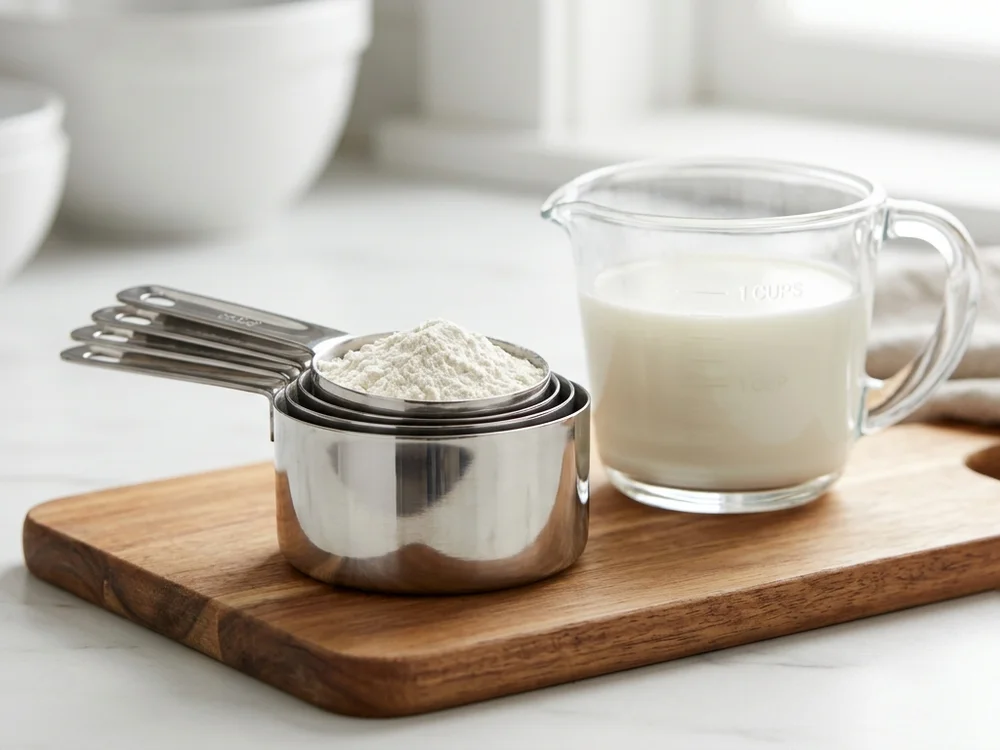
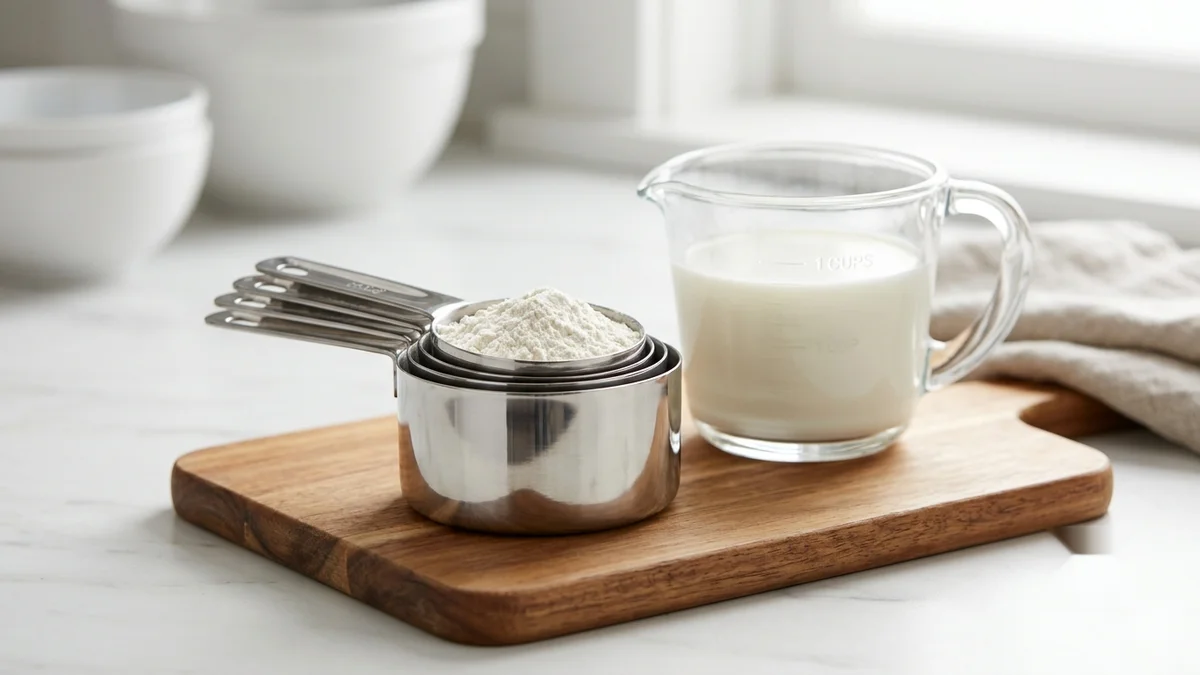
The best measuring cups for most kitchens are the Simply Gourmet Set of 7 ↗, seamless 304-stainless cups at $29.99 that include the sizes cheap sets skip: 2/3, 3/4, and 1.5 cups. One-piece construction means no seams to trap dough and no rivets to loosen, and the engraved sizes cannot wash off. For liquids you want a different tool entirely, and the Pyrex 4-Cup glass cup is that tool; the KitchenAid set covers tight budgets at under $10.
We compared current Amazon product data and specs across the category: materials and gauge, marking durability, set composition, spouts and handles, and the dry-versus-liquid design split that decides accuracy. Here is how the field sorts.
The Best Measuring Cups, Compared
Product names link to the current Amazon listing.
| Rank | Measuring cups | Price (September 13, 2026)* | Material | Sizes | Size and weight |
|---|---|---|---|---|---|
| #1 · Our pick | Simply Gourmet Set of 7 ↗ Best overall (dry) | $29.99 | 304 stainless, seamless | 7, incl. 2/3, 3/4, 1.5 | 3.0 × 6.0 × 4.0 in · 1.1 lb |
| #2 | OXO Good Grips Magnetic ↗ Best storage design | $22.98 | Stainless, magnetic snaps | 4 | 3.0 × 8.7 × 5.0 in · 0.8 lb |
| #3 | Hudson Essentials 6-Piece ↗ Best heavy-duty | $23.99 | Thick-gauge stainless | 6 | 5.3 × 2.6 × 3.5 in · 1.1 lb |
| #4 | Pyrex 4-Cup Glass ↗ Best for liquids | $13.99 | Tempered glass | 1 (4-cup, spouted) | 9.9 × 8.7 × 4.9 in · 2.1 lb |
| #5 | KitchenAid Set of 4 ↗ Best budget | $9.25 | Plastic | 4 | 7.4 × 3.6 × 3.0 in · 0.3 lb |
| #6 | Amco Advanced Performance ↗ Best one-piece four-size | $29.59 | 18/10 stainless, seamless | 4 | 7.5 × 4.0 × 1.5 in · 1.0 lb |
| #7 | Viking 4-Piece ↗ Heavy-gauge 304 | $62.58 | Heavy-gauge 304 stainless | 4 | 7.5 × 4.0 × 2.5 in · 1.4 lb |
*Prices checked September 13, 2026 and change often; check the live listing. Dimensions and weights come from each product’s current Amazon listing data; an em dash means the listing does not publish that figure.
How We Chose
We compared current Amazon product data and manufacturer specs across the measuring cup category: cup material and gauge, seam and rivet construction, how the size markings are applied (engraved versus printed), which sizes each set includes, nesting and storage hardware, and the dry-versus-liquid design distinction that governs accuracy. We did not run a lab test, and we do not repeat star ratings or review counts, because Amazon’s product data feed does not publish them. The #6 and #7 slots were added in August 2026 from reader search data and rank by the same listing-level criteria as the rest.
The 7 Best Measuring Cups
1. Simply Gourmet Set of 7: Best Overall for Dry Ingredients

The Simply Gourmet Set of 7 wins on set composition and construction. Most sets stop at four sizes; this one adds the 2/3, 3/4, and 1.5 cups that recipes constantly call for, turning two-scoop jobs into one. Each cup is 304 stainless steel, the food-grade standard, drawn as one seamless piece: no interior seams to trap dough, no spot-welded handle to loosen, and engraved size markings that survive any number of dishwasher cycles.
At $29.99 it costs more than a basic four-piece, and the extra is going somewhere you can verify by looking at the cups: more sizes, one-piece construction, permanent markings. For a kitchen that bakes weekly, this is the last dry set it buys.
Pros:
- Seven sizes including the 2/3, 3/4, and 1.5 cups most sets omit
- Seamless one-piece 304 stainless; nothing to trap dough or work loose
- Engraved markings that cannot wash off
Cons:
- Costs more than basic four-piece sets
- Seven loose cups need a hook or ring to stay organized
2. OXO Good Grips with Magnetic Snaps: Best Storage Design

The everyday failure of measuring cup sets is not the cups; it is the ring that holds them. Unclip it for the middle size, and the set never reassembles. The OXO Good Grips 4-Piece replaces the ring with magnets: each stainless cup snaps to the next, the set lives nested in the drawer, and any size pulls free with one hand while the rest stay put.
The cups themselves are solid stainless with soft non-slip grips, at $22.98. The set covers the standard four sizes only, so pair it with an odd-size cup if your recipes lean on 2/3 and 3/4, but as the set you actually keep organized, the magnets earn the slot.
Pros:
- Magnetic nesting: no ring, no scattered sizes, one-handed grab
- Stainless cups with cushioned non-slip handles
- Compact nested footprint in a drawer
Cons:
- Standard four sizes only; no odd sizes
- Magnets add a little weight per cup
3. Hudson Essentials 6-Piece: Best Heavy-Duty
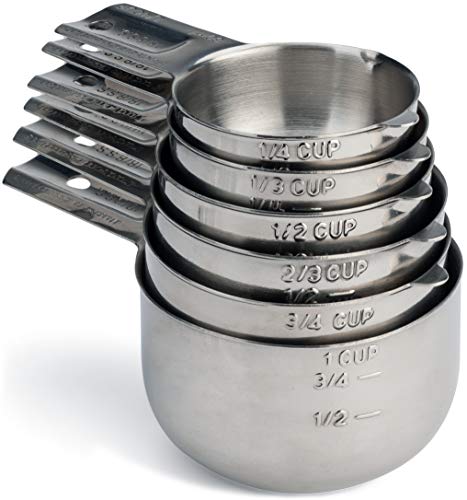
The Hudson Essentials 6-Piece is the buy-it-once dry set: thick-gauge polished stainless that does not flex when you pack brown sugar, with engraved markings and six sizes that add the useful 2/3 and 3/4 cups to the standard four. The heavier gauge is the practical difference: thin cups dent and their handles bend at the weld when you scoop hard flour, while these behave like small cookware.
At $23.99 it lands between the budget four-pieces and the seven-piece winner. If your baking is heavy on packed ingredients, dense doughs, and hard scooping, the extra metal is the feature to pay for.
Pros:
- Thick-gauge stainless that does not flex under packed ingredients
- Six sizes including 2/3 and 3/4 cups; engraved markings
- Polished finish releases sticky ingredients cleanly
Cons:
- Heavier in the hand than thin-gauge sets
- No magnetic or ring storage solution included
4. Pyrex 4-Cup Glass: Best for Liquids
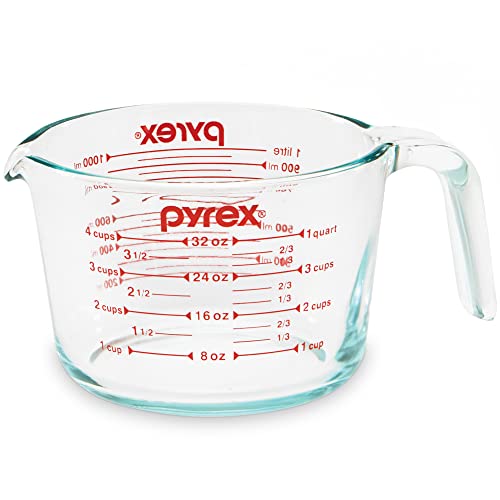
Liquids need a different tool, and the Pyrex 4-Cup is the category’s default for a reason. Tempered glass with graduated markings lets you read the meniscus at eye level, the spout pours without dribbling, and the headroom above the top line means a full measure travels from counter to bowl without spilling. It is dishwasher, freezer, microwave, and preheated-oven safe per the listing, so it doubles as the vessel you warm milk or melt butter in.
At $13.99 it was also sitting on Amazon’s own bestseller list for the category when we checked. The 4-cup size is the most versatile single buy; add the smaller sizes later if you find yourself measuring tablespoons of liquid often.
Pros:
- Purpose-built for liquids: spout, headroom, eye-level graduations
- Microwave, freezer, oven, and dishwasher safe tempered glass
- The category’s long-standing default, still under $15
Cons:
- Glass: it can break, and it is the heaviest item here
- Printed graduations deserve the soft side of the sponge
5. KitchenAid Set of 4: Best Budget

At $9.25, the KitchenAid Set of 4 is the honest budget answer: the standard four sizes in sturdy BPA-free plastic from a brand that stakes its name on kitchen basics. The cups nest on a ring, the embossed sizes are molded into the plastic rather than merely printed, and the wide handles are comfortable for small hands, which also makes this the set to hand a kid learning to bake.
Plastic is plastic: it can stain with turmeric and tomato, and it will not survive a decade the way stainless does. As a first set, a backup set, or a camper-kitchen set, it does the job for less than the price of two coffees.
Pros:
- Under $10 from a known kitchen brand
- Molded-in size markings rather than paint
- Light and kid-friendly
Cons:
- Plastic stains and wears faster than stainless
- Standard four sizes only
6. Amco Advanced Performance: Best One-Piece Four-Size Set

The Amco Advanced Performance set entered this ranking in August 2026 from reader search data, and it earns the slot on the same checks as the rest of the field. The listing covers the two checks that matter most: single-piece construction with no welds or seams, and engraved measurements in 18/10 stainless. Each cup also carries a half-measurement mark inside, which quietly solves the halve-a-recipe scoop without a second cup.
The limit is composition: the core 1/4, 1/3, 1/2, and 1 cup sizes only ($29.59). Stock ran low when we checked prices, so confirm the live listing.
Pros:
- One-piece 18/10 stainless; no welds or seams to loosen or trap dough
- Engraved sizes plus a half-measure mark inside each cup
- Dishwasher safe
Cons:
- Core four sizes only; no 2/3, 3/4, or 1.5 cups
- Low stock at press time; check the live listing
7. Viking 4-Piece: Heavy-Gauge 304

The Viking 4-Piece is the other reader-searched entry, and its listing leads with material: heavy-gauge 304 stainless in a nesting design with a removable storage ring, dishwasher safe. A practical extra: the 1-cup and 1/4-cup carry internal markings for incremental measuring, so one cup can stand in for smaller amounts in a pinch.
It ranks behind the Amco on the checklist’s first check: the listing does not say how the size markings are applied, the one durability question it leaves unanswered, while Amco’s engraving is stated outright. Like the Amco it covers the core four sizes only, and at $62.58 you are paying for gauge.
Pros:
- Heavy-gauge 304 stainless per the listing
- Internal increment marks on the 1-cup and 1/4-cup
- Removable storage ring; dishwasher safe
Cons:
- Core four sizes only
- Marking method undisclosed on the listing
Also worth knowing
Oneida measuring sets come up in searches too, but both Oneida listings we checked in August 2026 showed no available stock. If one returns, the checklist below is how to judge it.
How Do You Judge a Good Measuring Cup? 5 Checks Before You Buy
You can grade a measuring cup from the store aisle or a listing photo. Five checks separate the set that lasts a decade from the set you replace next year.
| Check | Look for | Walk away from |
|---|---|---|
| Markings | Engraved metal or molded-in plastic | Printed or painted sizes |
| Construction | One piece, no interior seams | Riveted or spot-welded handles |
| Sizes | 2/3, 3/4, and 1.5 cups beyond the core four | Four sizes at a premium price |
| Type | A dry set plus a separate spouted liquid cup | One cup claiming both jobs |
| Gauge | Metal that does not flex in the hand | Thin cups that dent |
Markings matter most. A cup stays accurate only as long as you know which size it is, and printed sizes wear away with scrubbing while engraved and molded-in markings are permanent. Construction comes second: interior seams trap dough, and handles attached with rivets or welds loosen exactly when you scoop something dense. The rest is fit. Odd sizes turn two-scoop jobs into one, and no single cup measures dry and liquid accurately, because a dry cup holds its volume at the brim while a liquid cup needs headroom and a spout.
If the sizes are engraved or molded in and the cup is drawn as one piece, it will outlast a printed-label set at any price.
Dry vs Liquid Measuring Cups: Why You Need Both
The two types are calibrated around opposite filling techniques, and that is the whole story of measuring accuracy.
| Dry cup | Liquid cup | |
|---|---|---|
| Fill technique | Overfill, then level flat | Fill to the line, read the meniscus |
| Capacity line | At the brim | Below the rim, with headroom |
| Pouring | Not designed to pour | Spout, made to pour |
| Materials here | Stainless, plastic | Tempered glass |
Use a liquid cup for flour and you cannot level it, so the measure rides high. Use a dry cup for milk and you either fill to the brim and spill in transit, or stop short and underfill. The error runs several percent either way, which a stew forgives and a cake does not. The working setup is one good dry set and one spouted glass cup, which together still cost less than a single premium gadget.
What Is the Best Liquid Measuring Cup?
For liquids the answer is short: the Pyrex 4-Cup Glass ↗, at $13.99. A liquid cup earns the job with three features. A transparent wall lets you read the meniscus at eye level. Marked lines sit below the rim, so a full measure has headroom and travels without spilling. A spout pours clean. The Pyrex delivers all three in tempered glass rated microwave, freezer, oven, and dishwasher safe per the listing, so the same cup handles warming milk and melting butter.
Material decides more than brand here.
| Liquid-cup wall | Read at eye level | Microwave | Weak point |
|---|---|---|---|
| Tempered glass | Yes | Yes | Breaks if dropped |
| Clear plastic | Yes | Only if rated | Lines wear off, stains |
| Stainless steel | No, top-down only | No | Opaque wall hides the level |
Stainless is the wrong wall for liquids for one reason: you cannot see through it, so you read from above while the surface curves away from you. Glass reads true, takes heat, and does not hold stains or odors.
On size, the 4-cup covers the widest range in one vessel, from half a cup of milk to a full quart. The smaller glass sizes are a later addition if you often measure a spoonful or two.
The best liquid measuring cup is spouted tempered glass with headroom above the top line, and the Pyrex 4-Cup remains the default.
Which Measuring Cups Should You Buy?
- For most kitchens: the Simply Gourmet Set of 7 is the best dry measuring cup set overall, seamless stainless with the odd sizes that save double-scooping.
- For drawer organization: the OXO Good Grips magnetic set is the best measuring cup set for small kitchens, nesting without a ring.
- For heavy bakers: the Hudson Essentials 6-piece is the best heavy-duty measuring cup set, thick-gauge steel for packed ingredients.
- For liquids: the Pyrex 4-Cup is the best liquid measuring cup, spouted tempered glass that reads at eye level.
- For a first kitchen or a budget: the KitchenAid Set of 4 is the best cheap measuring cup set, name-brand basics under $10.
- For a one-piece four-size set: the Amco Advanced Performance is seamless 18/10 stainless with engraved sizes and half-measure marks inside each cup.
- For heavy-gauge basics: the Viking 4-piece is 304 stainless with internal increment marks and a removable storage ring.
- For meal prep days: cups measure, but a vegetable chopper preps; the two together cover most weeknight mise en place.
Which Measuring Cup Material Is Best? Stainless vs Glass vs Plastic
There are only two functional types of measuring cup: dry cups, leveled flat at the brim, and liquid cups, read at a line below the rim. Everything else on the shelf is a material or storage variation, ring-nested or magnetic, four sizes or seven. So the material question is really three questions, one per material.
| Material | Best job | Markings | How it fails |
|---|---|---|---|
| Stainless steel | Dry ingredients | Engraved, permanent | Thin gauge dents; heavy gauge does not |
| Tempered glass | Liquids | Printed, wants the soft sponge | Breaks if dropped |
| Plastic | Budget, backup, kids | Molded-in beats printed | Stains and wears in years, not decades |
Stainless wins dry duty because it survives scooping, leveling, and the dishwasher without warping, staining, or holding odors, and engraved sizes never wash off. Glass wins liquid duty because you read the measurement through the wall at eye level. Plastic wins on price and weight, which makes it the right first set for a kid or a camper kitchen, and molded-in markings are what separate a usable cheap set from a disposable one.
There is no single best material, there is a best material per job: stainless for dry, tempered glass for liquids, plastic where price or weight decides.
Frequently Asked Questions
Why do you need separate dry and liquid measuring cups?
Because the accurate filling technique is different for each. A dry cup is built to be overfilled and leveled flat with a straightedge, so it must hold exactly its stated volume at the brim. A liquid cup is built to be read at the meniscus, the curve of the liquid’s surface, so it needs headroom above the top line and a spout to pour without spilling. Using one type for the other job routinely throws measurements off by several percent, which shows up in baking.
What are the best measuring cups for baking?
A seamless stainless dry set plus one glass liquid cup. For dry ingredients, the Simply Gourmet 7-piece covers flour-scoop sizes most sets skip, including 2/3, 3/4, and 1.5 cups, in seamless 304 stainless with nothing to trap dough. For liquids, the Pyrex 4-cup reads at eye level and takes a microwave. Serious bakers eventually add a scale, but good cups remain the daily tool.
Are stainless steel measuring cups better than plastic?
For longevity and accuracy retention, yes. Stainless cups do not warp in the dishwasher, do not stain or absorb odors, and their handles do not snap. The failure mode that matters most is markings: printed sizes on plastic wear away with scrubbing, while engraved or etched stainless markings are permanent. Plastic’s advantages are price and weight, which is why it still makes sense as a budget or backup set.
What sizes should a measuring cup set include?
The baseline four are 1/4, 1/3, 1/2, and 1 cup. The step up that saves real time is the odd sizes: 2/3, 3/4, and 1.5 cups mean one scoop instead of two or three for the amounts recipes actually call for. That is the case for a 6- or 7-piece set like the Simply Gourmet or Hudson Essentials over a basic four.
How do you measure flour accurately with a measuring cup?
Fluff the flour in its container, spoon it into the dry cup without packing, then level the top flat with the back of a knife. Scooping the cup directly into the bag compacts the flour and can pack in noticeably more than the recipe intends, which is the most common cause of dense baked goods. A level cup of all-purpose flour weighs about 120 to 125 grams.
Can you measure liquids in a dry measuring cup?
You can, but accuracy suffers at the edges. Filled to the brim a dry cup does hold its stated volume, but a brim-full cup cannot be carried or poured without losing some, and stopping short underfills it. A spouted liquid cup with headroom solves both problems, which is why the two types exist. For a tablespoon or two of liquid the difference is trivial; for a cup of milk in a batter it is not.
Are magnetic measuring cups worth it?
If your measuring cups live in a drawer, yes. The usual set is joined by a ring that you unclip and re-thread every time you need the middle size, so the ring ends up in a drawer corner and the sizes scatter. Magnetic nesting, like the snaps on the OXO set, keeps the cups paired without hardware, and each cup pulls free with one hand.
How do you clean measuring cups so the markings last?
Engraved stainless can go through the dishwasher forever, since the markings are cut into the metal. For cups with printed or painted markings, hand-wash with the soft side of the sponge; abrasive pads and repeated dishwasher cycles are what erase sizes off handles. If a cup’s marking has already worn away, retire it from baking duty, since a mystery size is worse than no cup.
Which measuring cups are for dry ingredients?
The opaque nested cups with flat rims, usually stainless steel or plastic and sold in sets of four to seven, are the dry cups. A dry cup holds its full stated volume exactly at the brim, so you can overfill it and level the top flat. If a cup has a spout and marked lines below the rim, it is a liquid cup. In this guide, every set except the Pyrex is a dry set.
Which measuring cup set is best for beginners who cook and bake a lot?
Skip the single do-everything cup and start with one dry set plus one spouted glass liquid cup. A beginner who bakes weekly is better served by a six or seven piece stainless set with engraved markings, because the odd sizes and permanent markings remove the two most common frustrations early. On a tight budget, a plastic set with molded-in markings covers the same core four sizes until you upgrade. The pairing still costs less than a single premium gadget.
Where can you buy a reliable set of dry measuring cups?
Any store type that stocks kitchen basics carries them: big-box stores, kitchen and homeware specialty shops, restaurant-supply stores, and online listings. The storefront matters less than the checklist, which is engraved or molded-in size markings, one-piece construction with no seams or rivets, and a set that goes beyond the core four sizes. Restaurant-supply stores are worth knowing because they stock tools built for daily commercial use. Whatever the store, pass on any cup whose sizes are only painted on the handle.
How do you choose measuring cups that are affordable, accurate, and durable?
Check markings first: accuracy over years depends on sizes you cannot wash off, so choose engraved stainless or molded-in plastic over printed labels. Check construction second: one-piece cups with no seams or riveted handles have nothing to loosen or trap dough. Then match the set to your cooking, since the core four sizes cover most kitchens and the 2/3, 3/4, and 1.5 cup sizes pay off once you bake weekly. Affordable and durable coexist at both ends: molded-marking plastic keeps its sizes at the lowest price, and a one-piece stainless set is bought once.