For small batches, onions, herbs, and quick prep, buy a manual food chopper. It costs less, needs no power, and cleans up faster, in about 60 to 90 seconds versus 2 to 3 minutes for an electric base, per the Love Great Finds comparison guide. Choose an electric food chopper if you process large volumes often and want hands-free speed, and you accept the noise, the bulk, and a motor that can fail.
The table below pulls the figures reviewers actually reported, so you can weigh speed, effort, noise, cleanup, and price before you buy.
Manual vs. Electric Food Chopper: How Do They Compare?
Both tools cut whole food into smaller pieces, but they trade effort, speed, noise, and cleanup in different ways. This table collects what reviewers and manufacturers reported. The sourcing section below names each one.
| What reviewers measured | Manual food chopper | Electric food chopper |
|---|---|---|
| Onion dice, timed | Not separately timed (see note) | 18 sec for a quartered red onion, “almost all of the pieces were consistent in shape” |
| Nut butter, timed | n/a | 2 min for smooth peanut butter, pulsed in 30-sec intervals |
| Bowl capacity | 1 to 4 cups (Zyliss Easy Pull: 800 ml / 27 oz) | 3.5 to 5 cups across the small processors ATK tested |
| Speed per cup | 5 to 10 sec | 10 to 15 sec including pulse |
| Noise | Silent | 75 to 85 dB (loud-blender range) |
| Cleaning time | 60 to 90 sec | 2 to 3 min (motor base wipe) |
| Electricity, year 1 | $0 | $4 to $6 |
| Texture control | High: stop after each pull | Lower: blade runs until you let go |
| Typical price | $15 to $35 | $35 to $120 (ATK winners $41 to $90) |
| Durability | No motor to burn out | ATK winner “still looked and worked well even after numerous rounds of testing” |
| Best for | Onions, garlic, herbs, salsa, small kitchens | High-volume daily prep, hands-free batches |
Two caveats keep these numbers honest. The manual speed, noise, cleaning, electricity, and price figures come from a single commercial guide (Love Great Finds) and are editorial estimates, not an independent stopwatch lab test. The electric onion and peanut-butter times are from one hands-on review of one machine (Homes & Gardens), not a multi-model average. The How we sourced these numbers section lists every source with its limits.
Quick summary: manual choppers win on price, control, quiet, cleanup, and portability. Electric choppers win on hands-free speed for large, repeated batches.
Manual and Electric: The Pros and Cons of Each
Manual food chopper
Pros: Quiet, with the Love Great Finds guide rating it silent against 75 to 85 dB for electric. Cheap, at about $15 to $35. Costs $0 a year to run. Cleans up in 60 to 90 seconds because there is no sealed motor. The enclosed bowl traps onion fumes and gives you stop-and-check texture control on every pull. Zyliss builds the same pull design with “three stainless steel blades that rotate in opposite directions to chop, blend and purée everything from onions to dips.”
Cons: Smaller bowls, roughly 1 to 4 cups (the Zyliss Easy Pull holds 800 ml, about 27 oz). You supply the force, so very dense or very large batches take more pulls. Not hands-free.
Electric food chopper
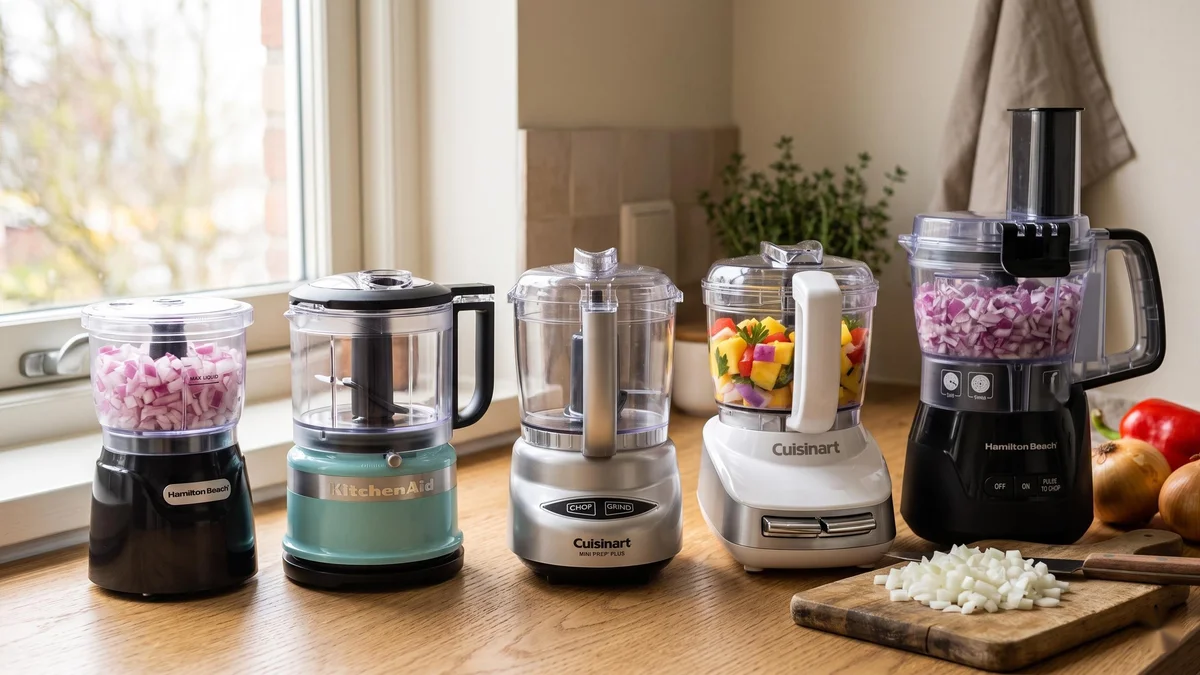
Pros: Hands-free and fast for a single batch. In a Homes & Gardens test a Cuisinart Mini Prep Plus diced a quartered red onion in 18 seconds and made smooth peanut butter in 2 minutes. Larger bowls, 3.5 to 5 cups across the small processors America’s Test Kitchen tested. ATK’s top small pick, the KitchenAid 3.5 Cup, “does a stellar job of mincing, dicing, grating, chopping, and blending quickly,” and proved durable, since it “still looked and worked well even after numerous rounds of testing and washing.”
Cons: Loud, at 75 to 85 dB. Pricier, at $35 to $120 (ATK’s tested winners ran $41 to $90). The motor base cannot be submerged, so cleanup runs 2 to 3 minutes. The blade runs until you release the button, so it can overprocess to pulp. A burned-out motor ends the tool’s life.
How Does a Manual Food Chopper Work?
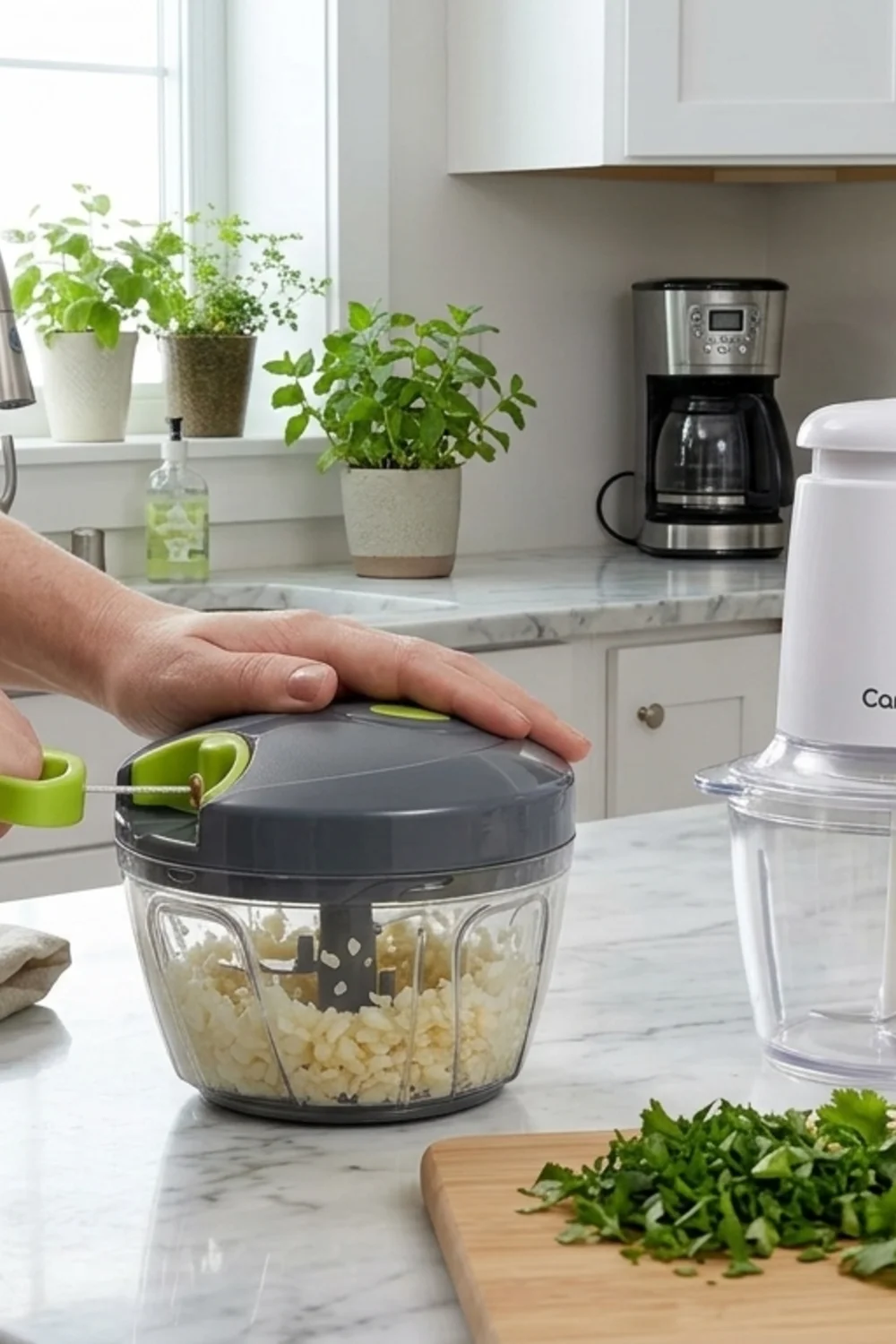
A manual food chopper turns your hand motion into a cut. You drop food into the bowl, close the lid, and pull a cord or turn a crank that spins the blades. Each pull cuts a little more, so you watch through the bowl and stop at the texture you want. No motor, no cord, no waiting for the blade to spin down.
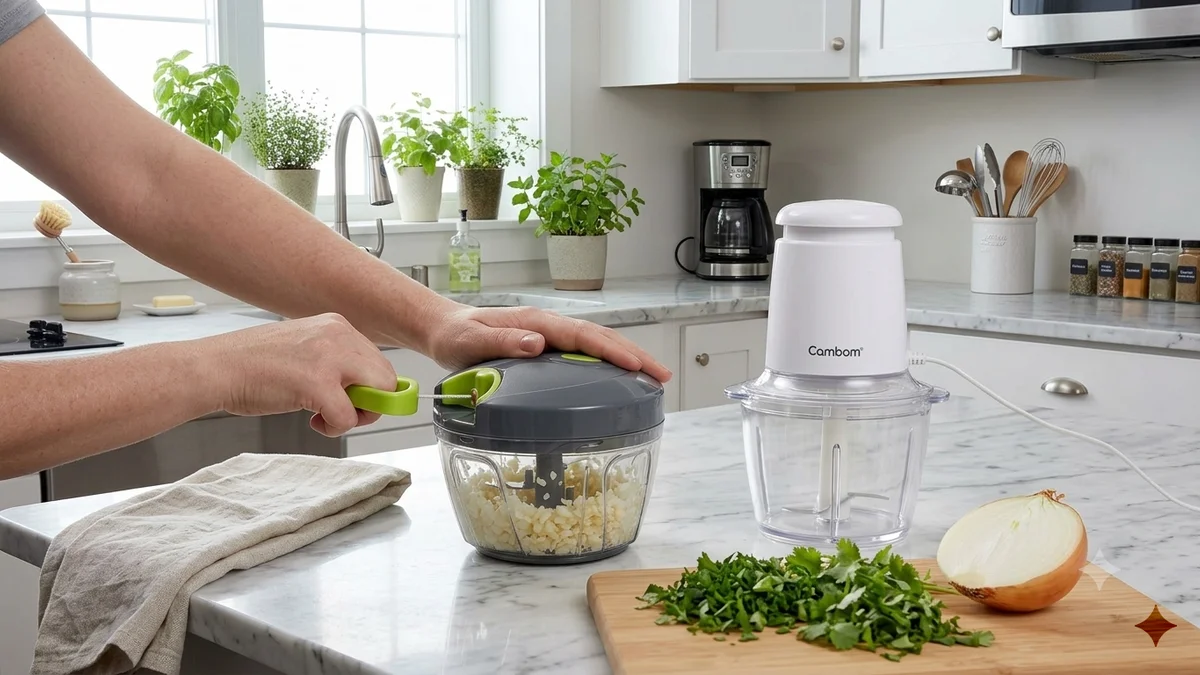
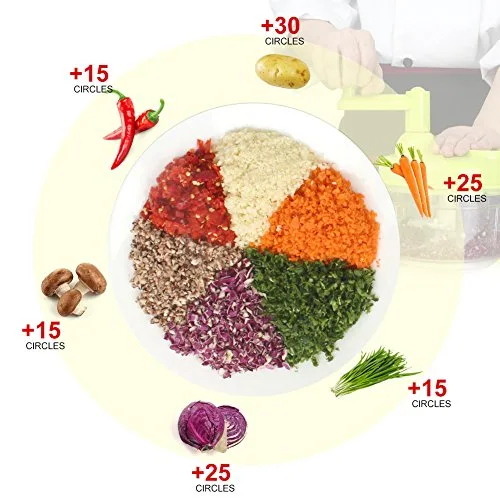
Zyliss describes the mechanism plainly on its Easy Pull processor: three stainless steel blades “rotate in opposite directions to chop, blend and purée everything from onions to dips with speed and ease,” inside an 800 ml (27 oz) bowl. The Cambom 8-in-1 Manual Food Chopper uses the same idea, with three stainless-steel blades inside a 1200 ml BPA-free bowl. Beyond chopping it works as a mixer, blender, whipper, mincer, grinder, and dicer, and it includes an egg separator and a whisk. Every part comes apart and goes in the dishwasher.
How Does an Electric Food Chopper Work?
An electric food chopper does the spinning for you. You load the bowl, lock the motor lid on top, plug it in, and press a button. The motor drives the blade until you let go, so it runs hands-free and powers through dense or fibrous food faster than your arm can. The same Homes & Gardens reviewer pulsed the Cuisinart in 30-second intervals to build smooth peanut butter in 2 minutes, which shows how the pulse approach trades raw speed for control.
The motor sets the trade-off. It adds noise, weight, and a power cord, the base stays out of water, and a burned-out motor ends the tool’s life. You also lose fine texture control, because a blade that runs a second too long turns a coarse dice into puree.
Which Is Better for Onions, Manual or Electric?
For onions, a manual chopper wins on control. Three or four pulls give you an even, coarse dice, and you stop before the onion breaks down into the watery, bitter pulp that an electric blade produces when it overruns. The closed bowl also traps the sulfur fumes that sting your eyes, so you chop without tears.
Electric choppers can dice an onion well in a careful hand. In a Homes & Gardens hands-on test, a Cuisinart Mini Prep Plus diced a quartered red onion in 18 seconds, and the reviewer reported that “almost all of the pieces were consistent in shape too.” The catch is the continuous blade: one extra second of run time separates diced onion from onion soup. For salsa, mirepoix, or anything where you want distinct pieces, the manual chopper’s stop-and-check control beats raw speed.
Which Is Faster, Manual or Electric?
Batch size decides it. For a single large batch, electric wins because the motor runs without pausing, and the Love Great Finds guide times its full chop at 10 to 15 seconds per cup including pulse. For a small job, manual wins door to door: the same guide clocks the manual chop at 5 to 10 seconds per cup, with no outlet to find and fewer parts to wash. Chopping one onion or a clove of garlic goes faster by hand once you count setup and cleanup, which the guide puts at 60 to 90 seconds for manual against 2 to 3 minutes for an electric base wipe.
Most home cooking comes in small, repeated jobs rather than one giant batch. There, a manual chopper’s quick setup and teardown adds up across the week. Love Great Finds reports that in its own self-reported six-month daily-use test, a manual chopper “saved an average 15 to 25 minutes per prep session,” though that is one tester’s anecdote rather than a controlled lab result.
Is a Manual Food Chopper Easier to Clean?
Yes. A manual chopper has fewer parts and no sealed motor, so every piece goes in the dishwasher. On the Cambom 8-in-1, the three blades, the 1200 ml bowl, and the lid all separate and go straight in. The Love Great Finds guide pegs manual cleanup at 60 to 90 seconds.
An electric chopper’s motor base stays out of water. You wash the bowl and blade, then wipe the motor unit by hand and dry around the buttons and seams, which the same guide times at 2 to 3 minutes. That extra step returns every time you use it.
What Can a Manual Food Chopper Do Besides Chop?
The Cambom 8-in-1 Manual Food Chopper covers eight jobs with one tool:
- Chop vegetables, onions, and garlic
- Mix dips, dressings, and batters
- Blend soft fruit and sauces
- Whip cream and eggs with the whisk attachment
- Mince herbs and aromatics
- Grind nuts and seeds
- Dice firm produce evenly
- Separate eggs with the included egg separator
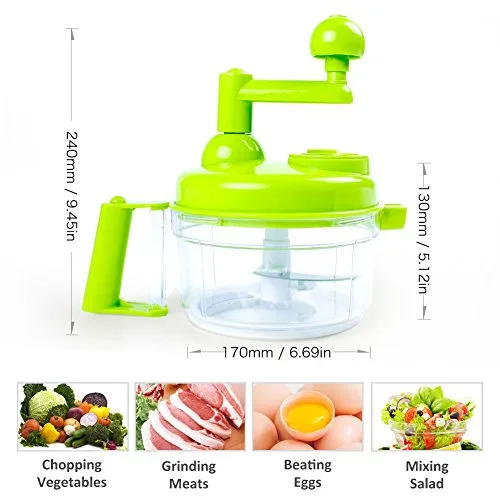
Three stainless-steel blades handle the cutting work, and the whisk attachment swaps in for whipping. One purchase replaces a chopper, a mini blender, and a hand whisk. The pull design mirrors Zyliss’s Easy Pull, whose three counter-rotating blades handle “everything from onions to dips.”
Which Chopper Capacity and Price Fit Your Kitchen?
Capacity and price split the two types cleanly. Manual choppers run small, roughly 1 to 4 cups per the Love Great Finds guide, with the Zyliss Easy Pull at 800 ml (about 27 oz) and the Cambom at 1200 ml. Electric small processors run larger, 3.5 to 5 cups across the models America’s Test Kitchen tested.
On price, the Love Great Finds guide lists manual at $15 to $35 and electric at $35 to $120. ATK’s tested small processors landed inside that electric band, at about $41 to $90 at the time of testing. Add the running cost the guide estimates, $0 for manual against $4 to $6 in first-year electricity for electric, and the manual chopper is the cheaper tool to buy and to keep.
Which One Should You Buy?
Buy a manual food chopper if you:
- Prep small to medium batches most of the time
- Chop onions, garlic, herbs, and salsa often
- Want quiet, whether in an apartment or near a sleeping baby
- Have limited counter and cabinet space
- Travel, camp, or cook where power runs short
- Want the lowest price and the fewest parts to clean
Buy an electric food chopper if you:
- Process large volumes of food every day
- Want fully hands-free operation
- Need a larger 3.5 to 5 cup bowl
- Accept the noise, the bulk, and wiping a motor base by hand
- Accept a higher price and a motor that can wear out
How We Sourced These Numbers
We pulled every figure in this guide from independent reviewers and named manufacturers, not our own marketing. Here is each source and what it measured, with the honest limits.
- America’s Test Kitchen, Small Food Processors: named the KitchenAid 3.5 Cup their top small pick, with bowl capacities of 3.5 to 5 cups and test prices of about $41 to $90. The performance and durability lines (“does a stellar job of mincing, dicing, grating, chopping, and blending quickly,” “still looked and worked well even after numerous rounds of testing and washing”) are qualitative. ATK published no timed onion-chop or decibel figure we could verify, so we did not invent one.
- Homes & Gardens, Cuisinart Mini Prep Plus review: a single hands-on test of one electric chopper. It timed an 18-second onion dice and a 2-minute peanut butter, and noted “almost all of the pieces were consistent in shape too.” This is one machine in one reviewer’s kitchen, not a multi-model average.
- Zyliss, Easy Pull processor: manufacturer specs for a manual pull-cord chopper, an 800 ml (27 oz) bowl and three counter-rotating stainless steel blades. These are the maker’s own product claims, not an independent test.
- Love Great Finds, Best Manual Food Chopper vs Electric: the source for the comparison table’s noise (silent vs 75 to 85 dB), manual capacity (1 to 4 cups), speed per cup (5 to 10 vs 10 to 15 sec), cleaning time (60 to 90 sec vs 2 to 3 min), price ($15 to $35 vs $35 to $120), and electricity ($0 vs $4 to $6) rows. These are editorial estimates from a commercial guide, not a stopwatch lab test. The “saved 15 to 25 minutes per prep session” line is that guide’s self-reported six-month anecdote, so we labeled it as such.
Where a number was a marketing claim we could not verify against a real test, we left it out rather than repeat it.
Our Pick
For most home cooks, a manual chopper is the smarter buy, and the Cambom 8-in-1 Manual Food Chopper covers the widest range of jobs. It packs three stainless-steel blades into a 1200 ml BPA-free bowl and works as a chopper, mixer, blender, whipper, mincer, grinder, and dicer, plus an egg separator and whisk. It runs on a hand crank with no electricity, so it costs nothing to power, stays silent, and cleans up in about a minute. Every part goes in the dishwasher, and it stores small enough for an apartment kitchen, an RV, or a dorm. Buy on Amazon →
Frequently Asked Questions
Which is better for onions, a manual or electric food chopper?
A manual food chopper is better for onions. Pulling the cord a few times gives you a coarse, even dice without turning the onion to watery pulp, which is what electric choppers often do when the blade runs too long. The enclosed bowl also traps the fumes that make you cry. Electric can still do it well in a careful hand: in a Homes & Gardens hands-on test, a Cuisinart Mini Prep Plus diced a quartered red onion in 18 seconds and the reviewer found “almost all of the pieces were consistent in shape too.” The risk with electric is overrun, since the blade runs until you stop it. A manual chopper hands you that control by default.
Are manual food choppers worth it?
Yes, for small to medium batches a manual food chopper is worth it. It costs less, needs no electricity, takes up little space, and comes apart for fast cleanup. The commercial comparison guide at Love Great Finds lists manual choppers at $15 to $35 against $35 to $120 for electric, and pegs first-year running cost at $0 versus $4 to $6. The Cambom 8-in-1 Manual Food Chopper handles chopping, mixing, blending, whipping, mincing, grinding, and dicing in a 1200 ml bowl, so it replaces several gadgets. Electric becomes worth the extra cost only when you process large volumes day after day.
Do manual food choppers need electricity?
No. A manual food chopper runs entirely on a hand crank or pull cord, so it needs no outlet, batteries, or charging. That makes it usable during a power outage and ideal for camping, RVs, dorms, and small kitchens. It also runs silent, while the Love Great Finds comparison guide rates electric choppers at 75 to 85 decibels, the range of a loud blender. The Cambom 8-in-1 Manual Food Chopper is hand-crank only.
Is a manual or electric food chopper faster?
An electric chopper is faster for a single large batch because the motor runs continuously. In a Homes & Gardens test, a Cuisinart Mini Prep Plus diced a quartered onion in 18 seconds and made smooth peanut butter in 2 minutes. A manual chopper is faster overall for small jobs once you count setup and cleanup, since there is no cord to plug in and fewer parts to wash. The Love Great Finds guide puts manual cleaning at 60 to 90 seconds against 2 to 3 minutes for an electric base wipe. For one onion or a clove of garlic, manual usually wins door to door.
What can a manual food chopper do besides chop?
The Cambom 8-in-1 Manual Food Chopper does eight jobs: it works as a chopper, mixer, blender, whipper, mincer, grinder, and dicer, and it includes an egg separator and a whisk. Three stainless-steel blades handle vegetables, nuts, and herbs, and the whisk attachment whips cream or eggs, so one tool replaces several. The pull-cord design is the same one Zyliss uses on its Easy Pull manual processor, where three counter-rotating stainless steel blades “chop, blend and purée everything from onions to dips.”
Is a manual food chopper easier to clean than an electric one?
Yes. A manual food chopper has fewer parts and no sealed motor, so every piece is dishwasher safe. The Cambom chopper’s blades, 1200 ml bowl, and lid all come apart and go in the dishwasher. An electric chopper’s motor base can never be submerged and must be wiped by hand. The Love Great Finds comparison guide times manual cleanup at 60 to 90 seconds versus 2 to 3 minutes for an electric base wipe, which adds a step to every cleanup.
Reviewed by the Cambom Kitchen Team. Updated June 26, 2026.